To be honest, my day was dominated by big news that had nothing to do with healthcare…..we closed on our house today (the one we were buying….we closed our sale yesterday).
Month: June 2012
Conspiracy theories and replicatability
I’m working on a theory around how many conspiracy theories a reasonable person is allowed to buy in to in their lifetime while still being completely normal. My current thought is you’re allowed at least 3 during your teenage years, and then one every 5 – 10 years after.
When I say conspiracy theories, I will mention that I’m only including ones that do not actually change your daily life in a significant way.
Conspiracy theories in general are a fantastic study of selective data interpretation. All of them do it in different ways, but there are some general themes. One of them was illustrated quite entertainingly by xkcd.com this morning:
To note: I never disbelieved the moon landing, but my (normally rational) little brother did for about 3 weeks one summer after watching a documentary on TV. He’s now a high school science teacher, for what it’s worth.
Causes of death and perception skewing
My first job out of college was working in one of the busiest Emergency Departments in the country. I learned a lot of interesting things about human behavior there, and some random facts about the way the ED interacts with the government as far as reporting goes.
Arizona Immigration and fake statistics
In case you haven’t heard, the Supreme Court ruled on Arizona’s immigration law today.
I was not surprised to see this show up on some of the feminist blogs I read, as they generally have a pro-immigration slant, but I was more than a little surprised to see that Amanda Marcotte considers this a women’s issue.
In a blog post for the XX blog on Slate.com, she argues that the laws surrounding checking IDs will likely result in racial profiling (certainly) and probably target the young (highly likely) but that this will also target women more than men (wait, huh?).
Her reasoning:
…..women, especially in poor or rural communities, are also much more likely to be out and about without legal identification than men, especially if they don’t drive or drive often. Women that are poor or undereducated are much more likely to be stay-at-home mothers with few resources, which makes it very easy to let concerns about up-to-date licenses or ID slip, especially if you don’t drive a car much because someone else in the household is using it for work. If your daily life is dedicated to running errands for your family, you may not have much cause to worry about keeping all your papers in order generally, until it’s too late and you’re finding yourself in jail for not being able to prove citizenship on the spot.
A few comments:
- I have searched for 20 minutes for any study or proof that women leave the house without their ID more often than men. I can’t find it. Maybe the idea is that women walk around more than men?
- Women that are poor and undereducated are not more likely to be stay at home mothers. 56% of SAHM have at least some college education or more.
- I can’t find any hard data on which gender lets their license expire more often, but I also can’t find proof that it’s women.
Life goes on, and so does life expectancy
Life expectancy is a funny thing. It’s a pretty often quoted statistic that not many people realize is just that – a statistic. It’s also fairly misunderstood, in that many people presume it’s static.
Truthfully, your life expectancy changes over the course of your life based on how long you’ve already lived. Most people accept this as making sense once it’s pointed out, but it’s not often the first thought people have when they here it (and journalist’s are ABYSMAL at clarifying the “at birth” part of most life expectancy estimates). Anyway, this week chartporn.org posted this chart, which I think illustrates the changes nicely. I didn’t check all the other data they put on there (though I was surprised to see how low the median age for first divorces is), but I thought the overall affect was quite informative.
In particular, I like the beginning of the chart, where it shows that if you make it beyond your first year, you actually get a bump up pretty quickly. Infant mortality is not often thought of as affecting overall life expectancy in developed countries, but it does.
Friday Fun Links 6-22-12
Why ignorance shouldn’t be a dirty word.
Work got you down? Don’t try robbing banks. It’s not as lucrative as it would seem.
Since that’s out, perhaps you should go on a road trip. Weather.com has a trip planner that will show you weather for your route.
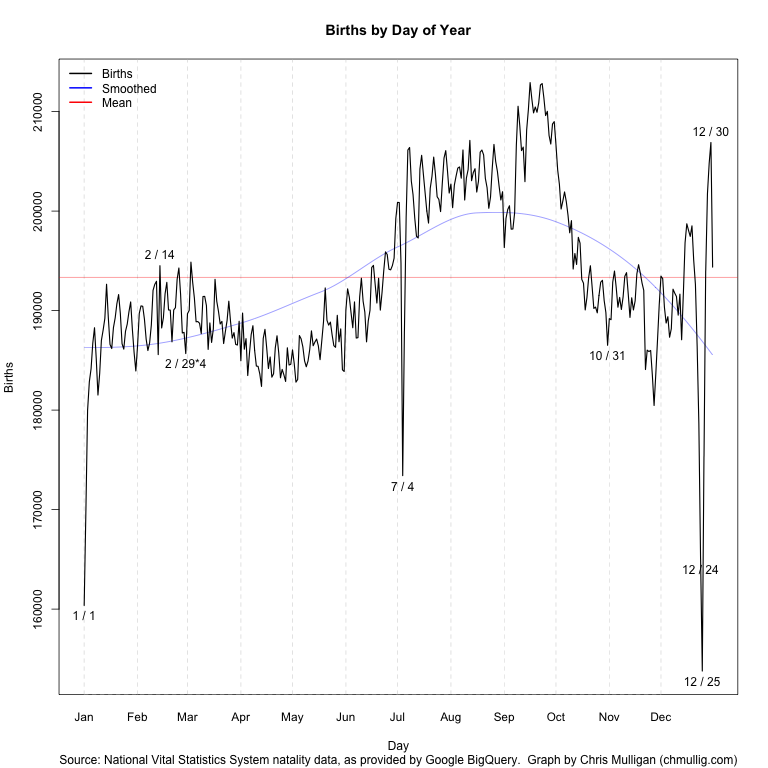
This may not be as interesting to you as it is to me at the moment, but Chris Mulligan put up this very cool graph of birth trends by day of the year:
It looks like the data used is from 1969 to 1988….I would have loved to see this graph for 100 years ago, before there were any c-sections or inducements to contend with. I had a Coptic Egyptian roommate at one point, and she told me that when she was little, they couldn’t divide up kids by birth date when they went to sort people out. Apparently Coptic’s are prohibited from having sex for almost 170 days out of the year, and so the babies are all born very clustered together (9 months after the end of Lent for example). I’d imagine the data would be nearly impossible to get a hold of, but I’d love to see some cultural variations on this to see how things correlated with social norms.
More thoughts on the soda ban
Yesterday I found out the soda ban is potentially hitting a bit closer to home.
For those of you not familiar with Cambridge, MA, it’s affectionately known as “The People’s Republic” (and even has a communist bar of the same name). Thus the proposed ban was pretty unsurprising.
Coincidentally, Ben Goldacre put up a new post yesterday publicizing a paper he coauthored to try to push governments in the UK to actually conduct trials of their policies before implementing them.
Best quote:
We also show that policy people need to have a little humility, and accept that they don’t necessarily know if their great new idea really will achieve its stated objectives. We do this using examples of policies which should have been great in principle, but turned out to be actively harmful when they were finally tested.
Contrast this to the Mayor of Cambridge’s statement on the soda ban:
“As much free will as you can have in a society is a good idea,” Davis said Tuesday. “… But with a public health issue, you look at those things that are dangerous for people, that need government regulation.”
Is no one interested in finding out if this idea will actually work before implementing it? The leading researchers in the field seem to think it won’t. I tend to agree with them. You know what though? I’m game. Let’s put it to a randomized trial. There are those who think the constitutionality of this should be worked out first, but I think a well run trial could open the door for an opt in system rather than a mandatory one.
Hey, maybe if politicians stayed a little more open to testing their ideas, you wouldn’t wind up with cartoons like this one:
Quote of the Week
Another thing I must point out is that you cannot prove a vague theory wrong. If the guess that you make is poorly expressed and rather vague, and the method that you use for figuring out the consequences is a little vague – you are not sure, and you say, ‘I think everything’s right because it’s all due to so and so, and such and such do this and that more or less, and I can sort of explain how this works’…then you see that this theory is good, because it cannot be proved wrong! Also if the process of computing the consequences is indefinite, then with a little skill any experimental results can be made to look like the expected consequences. -Richard Feynman “The Character of Physical Law” 1992 pp.158-159
I feel this quote should be a mandatory back drop for every political speech given, especially in election years.
Does race or profession affect sleep?
I’ve commented before on my skepticism about self reported sleep studies.
Two recent studies on sleep piqued my interest, and while my original criticisms hold, there was yet another issue I wanted to bring up.
The first was from a few months back at the NYT blog, commenting on the most sleep deprived professions.
The second is from Time magazine, and talks about sleep differences among the races.
My gripe with both studies is the extremely small difference between the rankings.
In the professions study (sponsored by Sleepy’s btw), the most sleep deprived profession (home health aide) clocks in at 6hr57m. The most well rested is loggers, with 7h20m. On a self reported survey, how significant is 23 minutes?
From the study on races:
Overall, the researchers found, blacks, Hispanics and Asians slept less than whites. Blacks got 6.8 hours of sleep a night on average, compared with 6.9 hours for Hispanics and Asians, and 7.4 hours a night for whites.
Here we see the same thing….there’s a 6 minute difference between the totals for Blacks and Hispanics and Asians. Whites get 30 minutes more than Hispanics/Asians and 36 minutes more than blacks.
I question the significance of this, since I can’t remember whether I went to bed at 9:00 or 9:30 last night, and would have to guess if someone asked me. Both surveys state this was self reported, and thus the chance these averages could be even closer together is huge.
Additionally, these differences do not actually reach the level of significance that the studies showing the dangers of sleep deprivation reach.
For example, in this study about sleep and overeating, subjects were woken up 2/3rds of the way through their normal sleep time. That would be 2 hours early for nearly everyone above. The studies on heart disease were only linked with chronic insomnia. Cancer and diabetes are both more common in shift workers, but as someone who worked overnights for 3 years, I can tell you that’s not the same as waking up 30 minutes early.
Kaiser Fung has a great post about the popularizing of tiny effects that will be a hit if you didn’t like Freakonomics.
Stats and Father’s and Father’s Day Stats
I spent most of yesterday driving back from somewhere on the Pennsylvania/Maryland/West Virginia border, so I didn’t have time to do a proper Father’s Day post. I did call my dad though, so I guess I get half credit.