New Year’s Resolutions

I don’t often make New Year’s resolutions, but this year I’ve decided to join Gretchen Rubin (of happiness project fame) in resolving to go on a 20 minutes walk every day in 2020. Her theory is that if you aren’t getting much exercise, resolving to get a little bit daily will provide big benefits. She has research on her side on this one, and it doesn’t hurt that walking seems to be the only form of exercise that makes my migraines better rather than worse. We’ll see how this goes.

This got me thinking about New Year’s resolutions in general, and wondering what the most common ones were. there appears to be a lot of selection bias in the studies, but healthy eating/exercise/weight loss and saving money seem to be the most common in America.

I tried to find some from other countries, and it seems like Germans may put stress reduction and family time at the top of their list. My googling for other European and north and south American countries didn’t turn up much.

I did however, find this blog post from Duolingo, that had some really interesting insights about one particular New Year’s resolution. Duolingo is an app that helps you learn a second language, and they have a distinctive peak in sign ups and account usage just before the first of the year. They discovered that the countries their users normally came from changed a bit around the first of the year:

Apparently users who sign up around the first of the year actually are slightly more likely to continue using the app than those who sign up at other times.

Overall, I’ll admit I was a little surprised that I couldn’t find more research on the subject of New Year’s resolutions. It seems like this would be an interesting study in how priorities change across countries or time. If anyone knows of any good resources that I didn’t find, please let me know! In the meantime, happy new year everyone!

Diversity and Religion Trivia Question

Back when this blog was in its first incarnation, I used to occasionally do some challenge questions. I stumbled across one this week that seemed like a good candidate, and since my computer is still broken I figured I’d throw it out there.

As part of their religious landscape survey, Pew Research has put together a racial diversity ranking of religions and major denominations in the US. Six groups were found to be more diverse than the U.S. general population. What are they?

A few clarifications and one hint to help:

1. The diversity ranking measures the spread across 5 racial groups: White, Black, Asian, Latino and Mixed/Other. A perfect score would be 20% in each category. In other words, a group dominated by one group would not be considered diverse even if that group was a minority group in the US.

2. Pew breaks Christianity down in to major denominations and includes several types of unaffiliated (aka not religious) groups in their survey. If you want to see the groups included, see this page.

3. The survey also only looked at people in the US, so diversity is only based solely on that. Groups may have more diversity in other countries, but only their US members were counted.

4. If you need a hint: 3 of the top 6 groups are Christian or Christian-adjacent* and 3 were other religions or unaffiliated groups.

For the answer, see the list here.

*For purposes of this question, Christian adjacent means that the members of the group might consider themselves Christians, but a majority of Christians in other denominations do not.

If Not Voting Were a Candidate

My computer is still having problems, so another short post today. I saw this graphic on Twitter this week, and thought it was interesting:

Our voting certainly leaves a wide margin of error with regards to public opinion.

What’s interesting of course is that we have no idea how those people would vote if they were forced to, though many people seem to think they know. From experiences in other countries it seems like it might increase support for left leaning policies and higher tax brackets. However in other countries it boosted fringe third parties, and doing away with it increased support for major parties. Other countries have not seen a difference.

Point being, a non-random sample doesn’t always tell you much about what’s not in the sample. Keep that in mind with any initiatives aimed at changing voting requirements.

Health Expenditures and Obesity

So I dropped my laptop 2 weeks ago and the internet connection has been off and on, dying completely yesterday. Until I either fix it or get a new one, posts will be limited to what I can type on my phone without getting aggravated.

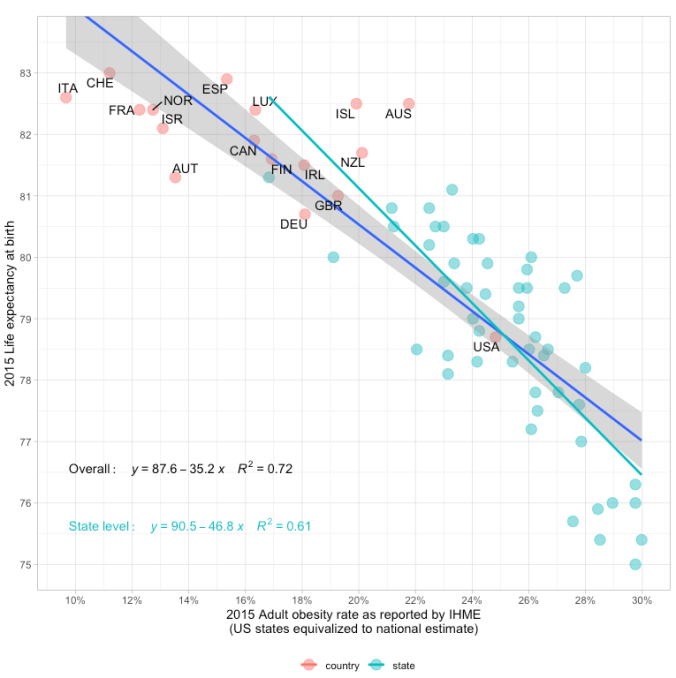
This week I came across a post by Random Critical Analysis analyzing the fairly famous “US spends more on healthcare and has lower life expectancy” graphs. As part of this analysis, he graphs life expectancy vs obesity and shows that the US is very well in line with other developed countries given our above average obesity rate.

To further the point, he breaks down the states individually and shows that this holds within our countries as well:

In other words, low obesity Colorado has a life expectancy in with the other developed countries, while higher obesity states are much lower. He also redid the analysis by splitting other countries up in to regions, and found this pattern holds for other countries as well. The post then goes on to build the causal chain, and it’s pretty fascinating. It even throws in maternal mortality, and shows that if we adjust for BMI, we’re right on par there as well.

I obviously suggest reading the whole post, but it’s a good reminder that this factor has been under discussed in the conversation about healthcare. We often say “other countries have figured out how to deliver healthcare more effectively than we have”, but no country has figured out how to do that with a population as obese as ours. In other words, it seems that unless we really start finding some good ways of preventing obesity or facilitating weight loss, it may be hard to ever reduce our costs. Sobering thought.

An Anecdote About Paranoia and Baseline Assumptions

The Assistant Village Idiot has re-posted one of my favorite anecdotes of his. For those not familiar with him, he has 40+ years experience in a state mental hospital. It’s short, so I’ll repost it in its entirety here (source):

A paranoid patient of ours had taken the book 1984 out of the patient library.  His particular paranoia is very much concerned with thought reading and thought broadcasting. He is not a person one might expect to have good general knowledge of literature and political culture, and he did not have much preconceived notion what it might be about.  He had heard somewhere it was an important book.  We were a little concerned what he might take away from the book, but we don’t get much involved in people’s selections.

He found it sad.  This guy had a girlfriend, but he lost her.

He didn’t really notice the paranoia-inducing parts of the book.  Those were just normal background to him

I think about that a lot, most often when I see a poll question asking people how they feel about current events or to compare previous years to this one. Getting people’s impressions without knowing their baseline can be highly misleading.