Soviet Propaganda, Infographic Style

In “How to Lie With Statistics“, the author frequently comments about Soviet Propaganda and how bad it is. Being a member of a cynical generation, Huff’s annoyance at an oppressive regime using data skewing to seem better than it was seemed almost quaint….I mean of course they were.

Even given my cynicism and lack of Russian skills, I have to admit these infographics from the Duke U library are pretty interesting.

This one’s my favorite, because none of the bar heights make any sense:

Moral of the story?  Every time you share a bad infographic, the Communists win.

Good hospital/Bad hospital

Several years ago, back when I was working in the Emergency Department, I had a rather fascinating encounter with a patient’s wife.  It was late in the evening on a Friday….a generally bad time to come in to the ER….and she had brought her husband in with a large cut on his arm.  He needed stitches for sure, but the place was hopping that night, and so she, her husband, and her two small children had been stuck in the waiting room for several hours.  After some time, she had come in asking me when someone was going to come get him.  At that point, I think they still had 4 or 5 people ahead of them, and I let her know.  

She (fairly understandably) flipped out.  
As I tried to calm her down, she started to lecture me about how long they had been waiting….and then proceeded to let me know that this wait had come after she had driven her husband over an hour and a half to get there.  “You are SUPPOSED to be the best hospital in the country” she raged.  “How can you be if you make patients wait so long????”.
Now I had the “why am I waiting so long” conversation with literally thousands of patients in my time in the ER, but something really struck me about this poor woman’s frustration.  She had brought her husband to a hospital that was supposed to be the best (this particular hospital bounces around the top 5 in the country pretty routinely), but not for what he needed done that night.  What he needed was a simple set of stitches, the likes of which nearly any doctor in the country could have done.  When I took a look at her address, I realized she had driven by at least five different hospitals with ERs to get to ours.  Most likely any one of them would have gotten her faster service with the same quality of care.  In fact, within the next few years, three of them would devise marketing strategies around publicizing that fact.  The problem is, this woman had confused “the best” with “good at everything”.  
When it comes to hospitals, that’s just not true.
Given my professional experience, I was unsurprised  to see Time reporting that not one of the 17 best hospitals (according to US News and World Report) made the consumer reports list of safest hospitals.  
There’s a couple reasons for this, some good and some bad:
  1. Best hospitals tend to be large teaching hospitals.  Large teaching hospitals have a lot of residents. Residents can be a little dicey.
  2. Best hospitals tend to see huge numbers of patients.  This can complicate things.
  3. Best hospitals tend to see cases other hospitals can’t help.  Almost all of your top hospitals will have higher mortality rates than smaller community hospitals.  Why?  Because unless you’re literally DOA, the first thing a small hospital will do with a really sick patient is to ship them off to a hospital with a good intensive care unit.  The top hospitals almost never transfer their patients.
  4. Best hospitals are ranked in large part on how they treat the toughest cases.  The more unique your condition, or the worse your risk factors, the more selective you need to be.  The more routine your complaint, the more a top hospital can actually work against you….you’re going to be one of many, and nothing makes you stand out.
  5. Large medical centers, specifically in urban settings, give away a lot of free care to a lot of high risk populations.  These patients are unlikely to do well in any setting, and can skew the data tremendously.  Location counts.
There’s constant strife over how to accurately rank hospitals, because professionals skew hospital rankings in the direction of valuing medical uniqueness.  Patients on the other hand, tend to value things like “comfort of chairs in the waiting room” nearly as high as they do “physician competence”.  Patient’s also claim to want things that they don’t really….for example nearly everyone says they value physician competence over bedside manner, yet patient’s routinely rate physicians with good bedside manner higher than those with good technical skill.  Patient’s receiving appropriate care also file plenty of complaints if it wasn’t the care they expected.  No hospital ranking is going to hit every part of the hospital equally regardless of who ranks it, and every department can have a bad day.   
I don’t have a lot of answers to these issues, but it’s important to keep them in mind when you hear ideas for improvement.  While the Time article got a bit too political for my taste, it is true that patients can only make informed decisions if the information they have is what they think it is.

19 women don’t like sports

Normally this is the sort of thing Joseph’s blog specializes in, but I couldn’t let this one slide.

I’ve spent all of last week and this week listening to construction workers traipsing around my basement, working diligently to finish it so we can finally have the sports room my husband’s impressive memorabilia collection deserves.  Thus, it distressed me a bit to see the headline that married women only watch sports for the sake of their husbands.  Is my interest in the sports room one big lie? Has my Red Sox fandom all been a fraud?  Should I toss out all my vintage basketball cards from the 80s?  And football…..okay, I actually didn’t like it all that much until I got married.  I’ll give you that one.  Two out of three ain’t bad.

Anyway, I pretty amused when Jezebel and other’s quickly pointed out that the sample size for this study was 19.     19 women, all from around the University of Tennessee.  In case you’re curious, The Bleacher Report ranked Knoxville the 44th best sports town in the USA.  Maybe my perception is skewed because Boston’s #2, but I’m not sure that’s an overly representative sample from an overly representative town.

Get some good Southie girls together and ask them what they think, I bet you’ll get a wicked different picture.

Fair Market Rent and Another Dubious Infographic

I’ve seen this infographic a few places now, and it has been causing me some furrowed brow time:

Supposedly, this is a graphic showing how many hours you would have to work per week at a minimum wage job in order to afford a two bedroom apartment in each of the given states.  This version appears to be a year or so out of date, but here’s the original report.
I had all sorts of questions about this when I saw it, so of course I went digging.  
To clarify the parameters, affordable is defined to mean 30% of income, and this chart assumes only one income earner per apartment.  Availability of low income housing or other programs is not taken in to account, which is probably where I find this chart most misleading.  Massachusetts has a fairly extensive Section 8 housing program, and from my understanding New York and California do as well.  I couldn’t find a ranking for the state distribution of aid levels, but I’d wager the less affordable the state, the more they give out in assistance.
As for the fair market value rents….I couldn’t find where they got their figure from.  Rents in Massachusetts vary wildly between the 3 largest city areas.  Boston rents run high….mostly because students rent most of the apartments near the colleges.  Springfield and Worcester however are much cheaper.  The MA website for Section 8 housing cites the difference between Boston and Worcester as almost $450 a month.  It appears the number used above is an average of several areas.  
If you dig further in the report however, it becomes even more interesting.  Apparently New England is the only section of the country that doesn’t report whole counties when reporting fair market rates for renters, New England only reports rates for metro areas and surrounding communities.  Is the northeast really that much pricier than the rest of the country, or does their reporting just make them look that way?
While I ultimately appreciate the issue at hand with this chart, I think it would be nice to see a more comprehensive chart including states efforts to address the high housing cost.  On the chart above, NH appears slightly more affordable, but if you google “section 8 housing nh” you will find a lot of people telling you to save yourself the trouble and move to Massachusetts.  Bigger cities tend to mean higher rents AND more social programs.  Throwing them all in to one big average is not the best way of representing information in a usable fashion.

Humor, Gender, and YouTube Research

While peer reviewed research is the gold standard for results, sometimes more informal research can be pretty darn interesting.  I got sent an interesting informal study this week that I thought was quite fascinating despite (or perhaps because?) it lacked typical rigor.

This study was based on humor and gender.  Now, as a matter of course most gender research annoys me.  Gender is the biggest subgroup you can have (3.5 billion of each, give or take) and any conclusions you draw must be taken with the knowledge that much of the data will vary wildly.  This is fine if your goal is something like, oh advertising that will appeal to a larger number of women or men in specific.  However, if your goal is to address something to a specific man or woman (like say therapy) gender generalizations can only give hints of paths to follow, and will rarely tell the story for one person.  One of the bigger challenges couples therapists face is actually convincing clients that it doesn’t matter what most men do, it matters what your spouse does, and vice versa.

Quick example: Back in the day when it used to be a novel idea that a woman would be Secretary of State, I remember having someone tell me that women would be bad at international diplomacy because your average woman was more emotional than your average man.  I had never thought about it before, but I remember retorting that I sincerely hoped that we never had an average woman in a position that high, as I was sure we had probably had never had an average man.  On average, nobody should be Secretary of State.

I thought about some of this when the AVI forwarded me this Steve Sailer post about men being funnier than women.  Humor is another tricky subject to study, and you put it together with gender and you can get bogged down for forever in questions and caveats.  Humor is in large part a cultural construct (watch the British, German, and French versions of The Office and you’ll see what I mean), and even within humor there are always questions about who is “truly” funny.  Commercially successful comedians?  Indie comics?  Their TV shows and movies or their stand-up days?  Or are we just talking about cocktail party chatter and our friends?  Also, the kind of humor you like has a lot to do with who you think is funny…puns?  Situational comedy, pranks, physical comedy, LOL cats?  My personal favorite comedy brand is the Comedy Central Roasts and South Park.  However you answer these questions though, I think it’s important to note that your average person is not terribly funny to anyone outside their own circle.


Quick example:  This is only funny for those who both appreciate farming humor and know who LMFAO is.  Since I listen to the radio and grew up on a farm, it made me laugh pretty hard:


That being said, I thought the research Kyria Abrahams did was truly enlightening.  She went through and found 10 unknown but rising comedians, and wrote down all the topics they made jokes about.  Then she postulated that the list of mens topics was more varied and more interesting to a broader audience than the women’s list.  Take a look and see if you agree:

Female Comics

Apartment is annoying
Bathroom attendants
Being a female comedian (x2)
Cosmo Magazine
Dating is awkward (x2)
Diamonds
Did poorly in school
Doesn’t want kids because she’s “selfish”
Gay marriage
Gynecologists/pap smears
Hangovers
Hates New York
Her body (x2)
Her mom (x2)
Her vagina
How guys hit on her
It’s hard being a woman, putting on makeup, and wearing heels and stuff
Jizz
Just got engaged
Just went through a breakup
Masturbation
Roommate is annoying
Sex and condoms
She’s flat-chested
She’s fat
She’s too pretty to do standup (x2)
What she’s wearing
What/who she looks like (x2)
Yoga
Male comics:
Alaska
Being thanked on an elevator
Clichés people use
Free AIDS clinics
God won’t help you bowl/God doesn’t exist
Having sex with animals
His name
Holding the phone between your ear and shoulder
How to treat AIDS
If the Jews killed Jesus
Jail shows
Mayan 2012 prediction
People asking him where he’s from
Pickle juice
The “ethnic needs” section of the supermarket
The age of sliced bread
The Cyclone at Coney Island
The Roman Empire
The storylines behind rollercoasters
Vegan soul food
What/who he looks like (x2)
White chocolate is racist

So yes….the men’s topics are more unexpected, fresher, and more likely to be funny than the women’s.  Now whether that’s because women are getting pigeonholed or what, I can’t say, but I had to appreciate this addition to the conversation.  While I have seen plenty of discussion regarding men and women and who is funnier, I had never seen someone actually try to tease out what comedians were talking about when we assessed their humor.  It’s an important variable, and her data suggests a big discrepancy.  If women changed this would it close the gap?  Who knows, but it’s an interesting thought.  To act like the gender/humor question only has one moving variable (the listener’s sexism) is to reduce two extremely complex topics down to nothing.  Mentioning other variables is not sexist (as Kyria was accused of in her comments section) it’s just good research.

The moral of the story?  Keep average people off my TV, when I want comedy, I want exceptional.

More physics…Einstein and teaching

With all the Higgs Boson excitement, I have had  physics on the brain lately.  Thus when Instapundit linked to this article from NPR, regarding how Einstein would not have been qualified to teach high school physics, I was intrigued.

The article is a rant against (some) licensing standards.  Licensing standards are really just performance metrics, which does make them an interesting study in data and outcomes.  Teaching is a particularly tricky profession to measure outcomes in, as every attempt to standardize (SATs, MCAS, etc) is typically met with objections about what real learning is.

I was fascinated by the Einstein question though.  While I certainly like Einstein, I was wondering if I’d really have wanted him as a physics teacher.  When I took psych stats in grad school, I averaged 107% in the class (there was lots of extra credit), but I was probably the worst resource there.  I can’t explain basic stats worth anything to people, because it comes naturally.  That’s why I like critiquing news stories….it’s much easier to explain what’s wrong with something when you have an example in front of you.  Explaining a t-test from scratch though?  I’ll leave that to the professionals.

Aside from that, the study the NPR post points to is pretty interesting.  It compares licensed, unlicensed and alternatively credentialed teachers from NYC.  Interestingly, the most significant factor in teacher effectiveness tended to be years of experience (in the first few years) instead of credentialing.  All the differences however, were evaluated based on standardized testing scores, which may or may not be something you agree with as a metric.  Still, a fairly interesting and comprehensive look at the issue, if your interested in education metrics.

Update:  The purpose of education and outcome metrics are going to become increasingly important if this catches on (and I hope it does).

Spanking and Mental Trauma

The headline reads “Spanking Linked to Mental Illness“, and I was immediately intrigued.  Spanking, generally, is a very hard thing to study, as it is so often correlated with other things.  Physical punishment of children is often linked to frustrated and under resourced parents, cultural norms that can be positive or negative, and even immigration status.

Curious how the study authors controlled for such things, but assured by the article that they had, I flipped over to the study itself.  It didn’t take long for me to realize this was yet another example of bad journalism mucking about with a half decent study.

The article starts like this:

Although the American Academy of Pediatrics (AAP) strongly discourages spanking, at leasthalf of parents admit to physically punishing their children. Some research suggests that as many as 70-90 percent of mothers have resorted to spanking at one time or another. Anew study published in the journal Pediatrics may cause parents to think more carefully before laying a hand on their little ones.

However, the study states:

Physical punishment was assessed with the question, “As a child how often were you ever pushed, grabbed, shoved, slapped or hit by your parents or any adult living in your house?” Respondents who reported an answer of“sometimes” or greater to this event were considered as having experienced harsh physical punishment. The term harsh physicalpunishment was used for this study because the measure includes acts of physical force beyond slapping, which some may consider more severe than “customary” physical punishment (ie, spanking).

 So the study specifically excluded “customary” physical punishment when it assessed the effects on future mental illness….which pretty much completely contradicts the headline.   I also doubt this is what 70-90% of mother’s are admitting to when they spank “at one time or another”.  

Irresponsible.

The SCOTUS and perception of statistics

Finally got internet in the new house.  Can’t complain too much….the guy finished running the wire to our house even though a thunderstorm started.  Clearly that man was getting paid by the job, not the hour.

Anyway, had an interesting chat with my father (a lawyer) after our closing on Thursday about the Supreme Court ruling on health care.  He mentioned that a coworker was griping that the Supreme Court meant nothing any more because they only voted on party lines.  My father, being the good data accuracy man that he is, quickly dissented.

He looked it up, and asserted that nearly half of the decisions last year were unanimous.  For this year, 7-2 votes were the least common (8%), then 8-1 (11%), 6-3 (17%) and then 5-4 (20%).  So overall,  they agree nearly as much as they disagree, and they are only completely divided on about 1 in 5 cases.  Kennedy and Roberts voted with the majority over 90% of the time.  Ginsburg was the least likely to vote in the majority.  Lots of interesting stats to be run on this, another good breakdown of some of the data is here.

It seems the perception that every vote is political is heavily skewed by the very few court cases most of us hear about every year.  I would wager even highly political citizens probably couldn’t rattle off more than a handful.  When you break down the 5-4 decisions exclusively, about 2/3rds of them vote down ideological lines…..which totals to about 10 cases for 2011.

This kind of skewing of perception is common when a few high profile events dramatically overshadow regular operations.  Thanks Dad, for pointing that out.

Arizona Immigration and fake statistics

In case you haven’t heard, the Supreme Court ruled on Arizona’s immigration law today.

I was not surprised to see this show up on some of the feminist blogs I read, as they generally have a pro-immigration slant, but I was more than a little surprised to see that Amanda Marcotte considers this a women’s issue.

In a blog post for the XX blog on Slate.com, she argues that the laws surrounding checking IDs will likely result in racial profiling (certainly) and probably target the young (highly likely) but that this will also target women more than men (wait, huh?).

Her reasoning:

…..women, especially in poor or rural communities, are also much more likely to be out and about without legal identification than men, especially if they don’t drive or drive often. Women that are poor or undereducated are much more likely to be stay-at-home mothers with few resources, which makes it very easy to let concerns about up-to-date licenses or ID slip, especially if you don’t drive a car much because someone else in the household is using it for work. If your daily life is dedicated to running errands for your family, you may not have much cause to worry about keeping all your papers in order generally, until it’s too late and you’re finding yourself in jail for not being able to prove citizenship on the spot.

A few comments:

  1. I have searched for 20 minutes for any study or proof that women leave the house without their ID more often than men.  I can’t find it.  Maybe the idea is that women walk around more than men?
  2. Women that are poor and undereducated are not more likely to be stay at home mothers.  56% of SAHM have at least some college education or more.
  3. I can’t find any hard data on which gender lets their license expire more often, but I also can’t find proof that it’s women.
I hate statistics based on bad data, but I really hate statistics just pulled from thin air.  Some assertions are self evident for sure….I don’t know that many people would argue that a group of teenage boys out on a corner is more likely to be stopped by the police than a group of 70 year old men….but the paragraph above states quite definitively several things that don’t seem at all definitive.  I could be wrong, but there weren’t any sources attached to check with.  When you factor in the idea that men are probably more likely to be stopped than women, it’s hard to figure out where this particular point is coming from.
If you disagree with Arizona’s law, that’s fine….but don’t make up statistics about it’s impact on women to justify that.  If it’s wrong, it’s wrong because it impacts people in general, not women in particular.

More thoughts on the soda ban

Yesterday I found out the soda ban is potentially hitting a bit closer to home.

For those of you not familiar with Cambridge, MA, it’s affectionately known as “The People’s Republic” (and even has a communist bar of the same name).  Thus the proposed ban was pretty unsurprising.

Coincidentally, Ben Goldacre put up a new post yesterday publicizing a paper he coauthored to try to push governments in the UK to actually conduct trials of their policies before implementing them.

Best quote:

We also show that policy people need to have a little humility, and accept that they don’t necessarily know if their great new idea really will achieve its stated objectives. We do this using examples of policies which should have been great in principle, but turned out to be actively harmful when they were finally tested.

Contrast this to the Mayor of Cambridge’s statement on the soda ban:

“As much free will as you can have in a society is a good idea,” Davis said Tuesday. “… But with a public health issue, you look at those things that are dangerous for people, that need government regulation.”

Is no one interested in finding out if this idea will actually work before implementing it?  The leading researchers in the field seem to think it won’t.   I tend to agree with them.  You know what though?  I’m game.  Let’s put it to a randomized trial.  There are those who think the constitutionality of this should be worked out first, but I think a well run trial could open the door for an opt in system rather than a mandatory one.

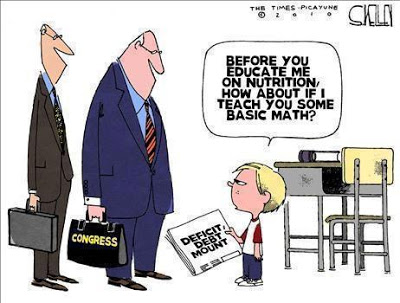
Hey, maybe if politicians stayed a little more open to testing their ideas, you wouldn’t wind up with cartoons like this one: