Germans and Bone Marrow Donation

I’m headed to Germany for the week to visit a bone marrow collection center there. Most people don’t know this, but 25-33% of all the world’s unrelated volunteer bone marrow donors are managed by the German national registry.

Even though bone marrow transplants were pioneered in the US,  Germany and the Netherlands that took a lead on building registries where people could look for donors if someone didn’t have a suitable sibling donor. As they started to build their own registries, they also got backing from their governments to recruit people to them as well. German participation in the bone marrow registry is about double the US (almost 10% vs 5%).

Anyway, I’ll be giving two talks (thankfully with a colleague) that are supposed to go 3 hours. Since I only know about 10 German words, this could get interesting. Fingers crossed for me!

The Mandela Effect: Group False Memory

I’ve talked a lot on this blog about the problems with memory, but I realized recently I’d never done a post on the topic of group false memory, particularly the Mandela Effect. If you’ve never heard of that, it’s a term that was invented/popularized by this website discussing the phenomena of “…apparently real, alternate memories of a history that doesn’t match the documented history in this reality.” More specifically, these are very vivid memories about pop culture or world events, held by multiple people with no association to each other, that were not true.

Now unlike many things I write about here, the interesting part about these is that they are not motivated by anything in particular. No one gains any ego/political/social points by believing them. The phenomena was actually named when the woman who started site realized that she had erroneously believed that Nelson Mandela died in prison rather than in 2013. She thought she was confused, until she later heard a near stranger at a conference mention that they had believed the same thing.  Eerily, this was not a “I thought I heard that”, they both had full memories of news and seeing the funeral.

Some other common examples:

More here.

I specifically listed the three above because those are all memories I have, and I was surprised to find out none of them were real (well, I figured out my Billy Graham memory was wrong in February, but I was surprised to find out I wasn’t the only one who clearly “remembered” this). The chartreuse one particularly surprised me because I remember googling it when “Frozen” came out and Olaf mentions it. Maybe it’s because he says “crimson” right before, but I’m not clear how I looked that up and still remembered it incorrectly.

Anyway, there’s not a great theory for why this happens,  other than that alternate universes occasionally open up and drop alternate realities on us. Kidding. Sorta.

Seriously though, the best suggestion is that around some events there’s enough subtle cues that large numbers of people get them mixed up. Like the for the Berestain Bears, most of us have met people with a last name ending in -stein, so at some point we think it looks more correct. Combine that with the loopy handwriting from the books and the southern twang influenced pronunciation in the TV show theme song, and you’ve got a mass memory of a name that never existed.

The other idea is that events or people that are in the news at the same time might get conflated. For example this article points out that when asked to identify former US presidents, many people will say Alexander Hamilton was while missing actual former presidents. However,  we know that’s because most people learn about him at the same time they are learning about the founding fathers, so they associate him with that. It’s possible a similar thing happens with events. Did Nelson Mandela make headlines for something else around the same time someone else’s funeral was going on? Maybe! That would be really hard to track back, but it’s plausible. If even 1% of people seeing those headlines conflated them at some point later, that could seem pretty freaky…..especially now that they can gather on the internet.

You know, it’s that or we’re all on the hologram deck.

Short Little Viral Vectors

Posting will probably be light in April. I’m dealing with some (hopefully easily resolvable) health issues, including some very low white blood cell counts that seem to be making me susceptible to every little thing that goes around. I felt like I was spending half my time sick, so it was fortuitous that I ran across this study that confirmed my fears: Community Surveillance of Respiratory Viruses Among Families in the Utah Better Identification of Germs-Longitudinal Viral Epidemiology (BIG-LoVE) Study.

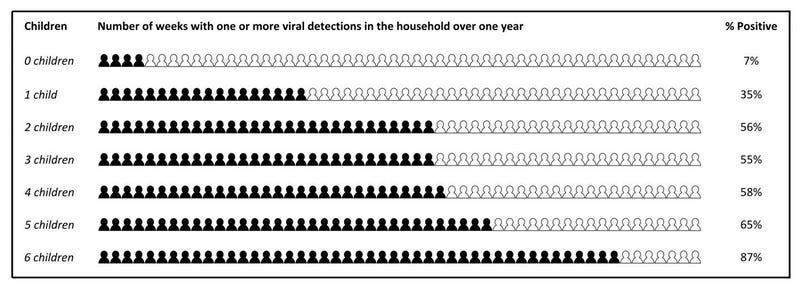
In this study, they actually got 26 households (105 people total) to volunteer to get nasal swabs done once a week for a full year. They tested these swabs to see how often a viral infection was present, regardless of symptoms. The results were something every parent would intuitively guess…..households with kids had far more weeks with viruses present than those without:

I was interested to see that it’s the second kid that really ups things, and then the third and fourth don’t really add much viral load. 6 kids appears to just be madness.

Anyway, it’s a small sample size, but I am guessing this result would hold up pretty well.

Back to me….I may take a page out of the AVIs handbook and find a few old posts to bump, but other than that things may be light for a bit. Stay well everyone!

Easter and April Fools Day

Happy Easter to all of you out there who celebrate it and base your observance date on the Gregorian calendar! Happy April Fools Day to any of you out there who happen to enjoy that kind of thing!

I went on a Googling spree this morning because I couldn’t remember if these two dates had ever coincided before (or at least in my lifetime) and now I’ve learned all sorts of interesting facts about how often this happens. Even after 13 years of Baptist school I never quite got the hang of figuring out when Easter actually was going to be each year, so I realized I had no concept of how often it coincided with April Fools Day. Turns out it’s about 3-4 times/century, and the last time this happened was 1956.

I was curious if the 62 year gap was the longest gap that had taken place, but it turns out it’s not. That prize goes to the 68 year gap between 1736-1804. The shortest gap is 11 years, and it happens pretty frequently. For example, that’s the gap we have between this year and the next time the two days will coincide in 2029. The next one after that will be in 2040, and then not again until 2108.

Interestingly, for churches that adhere to the Julian calendar for scheduling Easter, the earliest Easter can be at this point is April 5th, so this won’t come up for them at all. If you’d like an overview of when Easter falls and why different churches put it on different days, try this link.

If you’d like to see one of the more amusing April Fools Day pranks done by a math teacher, watch this video:

Enjoy the day!

3 Control Groups I’m Pondering

One of the more important (but often overlooked) parts of research is the choice of control group, i.e. what we are comparing the group of interest to. While this seems like a small thing, it can actually have some big implications for interpreting research.  I’ve seen a few interesting examples recently, so I figured I’d do a quick list here:

First up, a new-to-me article about personality assessments in a traditional hunter-gatherer tribe. I’ve mentioned the problem of psychological research focusing too much on WEIRD (Westernized, Educated, Industrialized, Rich and Democratic) countries before, and this study sought to correct that error. Basically, they used the “Big 5” personality testing model and then tried to assess members of a traditional South American tribe according to this “universal” personality measurement. It failed. While it seemed like extraversion and conscientiousness could actually translate somewhat, agreeableness and openness were mixed, and neuroticism didn’t translate all that well. They ended up with a “Big Two”, which were basically an agreeableness/extraversion mix (pro-sociality) and something like conscientiousness (industriousness). They talk a lot about the challenges (translation issues, non-literate populations, etc), but the point is that what we call “universal” relies on a very narrow set of circumstances. Western college kids don’t make a good baseline.

Second, a new dietary study shows that nutritional education can be an effective treatment for depression.  It’s a good study, and I was interested to see the control group was given increased social support/time with a trained listener/companion type person. At 12 weeks, almost a third of the diet group were no longer depressed, whereas only 8% of the control group were feeling better. Interesting to note though: this was advertised as a dietary study, so those who didn’t get the diet intervention knew they were the control group. There was a higher dropout rate in the control group (25% vs 6%), and interestingly it was the most educated people who dropped out. Gotta admit, part of me wonders if it was the introverts driving this result. Just wondering how many people really enjoyed the whole “hang out with a stranger who’s not a therapist” thing. I would be interested to see how this works when paired with some sort of “hour of general relaxation” type thing.

Finally, after putting up my pre-cognition post on Sunday, I realized there was a Slate Star Codex post a few years back about the Bem paper that I wanted to reread. It was called “The Control Group is out of Control” and took the stance that parapsychology was actually a great control group for all of science. Given that you have a whole group of people attempting to follow the scientific method to prove something that most people believe doesn’t exist, they end up serving as a sort of “placebo science”, or an indicator of what science looks like when it’s chasing after nothing.

He has some really interesting anecdotes here about the amount of evidence we have that researchers are influencing their own results in ways that seem nearly impossible to control for. For example, he talks about a case in which rival researchers who supported different hypotheses and had gotten different results teamed up to use the same protocol and watched each other execute the experiments to see if they could figure out where the other one was going wrong. They still both ended up proving their preferred hypothesis, and in the discussion section brought up the (mutual) possibility that one or the other of them had hacked the computer records. That’s an odd thing to ponder, but it’s even odder when you wonder what this means for every other study ever done.


6 Year Blogiversary: Things I’ve Learned

Six years ago today I began blogging (well, at the old site) with a rather ambitious mission statement. While I don’t have quite as much hubris now as I did then, I was happy to see that I actually stand by most of what I said when I kicked this whole thing off. Six years, 647 posts,  a few hiatuses and one applied stats degree later, I think 2012 BS King would be pretty happy with how things turned out.

I actually went looking for my blogiversary date because of a recent discussion I had about the 10,000 hour rule myth. The person I was talking to had mentioned that after all these years of blogging my writing must have improved dramatically, and I mentioned that the difference was probably not as big as you might think. While I do occasionally get feedback on grammar or confusing sentences, no one sits down with bloggers and tells them “hey you really should have combined those two sentences” or “paragraph three was totally unnecessary”. In the context of the 10,000 hour rule, this means I’m lacking the “focused practice” that would truly make me a better writer. To truly improve you need both quality AND quantity in your practice.

The discussion got me wondering a bit…what skills does blogging help you hone? If the ROI for writing is minimal, what does it help me with?  I mean, there’s a lot of stuff I love about it: the exchange of ideas, meeting interesting people, getting to talk about the geeky topics I want to talk about, thinking more about how I explain statistics and having people send me interesting stuff. But does any of that result in the kind of focused practice and feedback that improves a skill?

As I mulled it over, I realized there are two main areas I’ve improved in, one smaller, one bigger. The first is simply finding more colorful examples for statistical concepts. Talking to high school students helps with this, as those kids are unapologetic about falling asleep on you if you bore them. Blogging and thinking about this stuff all the time means I end up permanently on the lookout for new examples, and since I tend to blog about the best ones, I can always find them again.

The second thing I’ve improved on is a little more subtle. Right after I put this blog up, I established some ground rules for myself. While I’ve failed miserably at some of these (apostrophes are still my nemesis), I have really tried to stick to discussing data over politics. This is tricky because most of the data people are interested in is political in nature, so I can’t avoid blogging about it. Attempting to figure out how to explain a data issue routed in a political controversy with a reader base that contains highly opinionated conservatives, liberals and a smattering of libertarians has taught me a LOT about what words are charged and which aren’t. This has actually transferred over to my day job, where I occasionally get looped in to situations just so I can “do that thing where you recap what everyone’s saying without getting anyone mad”.

I even notice this when I’m reading other things now, how often people attempt to subtly bias their words in one direction or another while claiming to be “neutral”. While I would never say I am perfect at this, I believe the feedback I’ve gotten over the years has definitely improved my ability to present an issue neutrally, which I hope leads to a a better discussion about where data goes wrong. Nothing has made me happier over the years than hearing people who I know feel strongly about an issue agree to stop using certain numbers and to use better ones instead.

So six years in, I suppose I just want to say thank you to everyone who’s read here over the years, given me feedback, kept me honest, and put up with my terrible use of punctuation and run on sentences. You’ve all made me laugh, and made me think, and I appreciate you taking the time to stop on by. Here’s to another year!

YouTube Radicals and Recommendation Bias

The Assistant Village Idiot passed along an interesting article about concerns being raised over YouTube’s tendency to “radicalize” suggestions in order to keep people on the site. I’ve talked before about the hidden dangers and biases algorithms can have over our lives, and this was an interesting example.

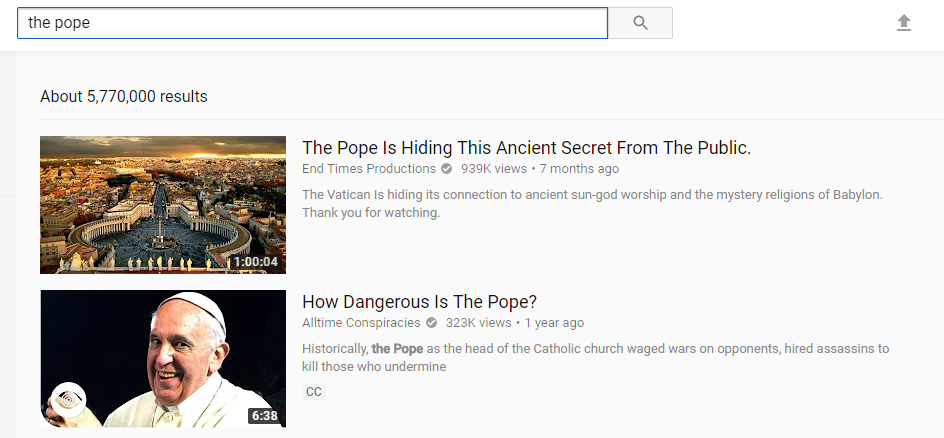
Essentially, it appears that YouTube has a tendency to suggest more inflammatory or radical content in response to both regular searches and in response to watching more “mainstream” viewing. So for example, if you search for the phrase “the Pope” as I just did in incognito mode on Chrome, it gives me these as the top 2 hits:

Neither of those videos are even the most watched Pope videos….scrolling down a bit shows some funny moments with the Pope (little boy steals the show) with 2.1 million hits and a Jimmy Kimmel bit on him with 4 million views.

According to the article, watching more mainstream news stories will quickly get you to more biased or inflammatory content. It appears that in it’s quest to make an algorithm that will keep users on the site, YouTube has created the digital equivalent of junk food…..content that is tempting but without a lot of substance.

It makes a certain amount of sense if you think about it. Users may not have time to really play around much on YouTube, unless the next thing they see is slightly more tempting than what they were originally looking for. Very few people would watch three videos in a row of Obama State of the Union Address coverage, but you might watch Obama’s State of the Union address followed by Obama’s last White House Correspondents Dinner talk followed by “Obama’s best comebacks” (the videos I got suggested to me when I looked for “Obama state of the Union”.

Even with benign things I’ve noticed this tendency. For example, my favorite go to YouTube channel after a long day is the Epic Rap Battles of History channel. After I’ve watched two or three videos, I started noticing it would point me towards videos from the creators lesser-watched personal channels. I actually had thought this was some sort of setting the creators set, but now I’m wondering if it’s the same algorithm. Maybe people doing random clicking gravitate towards lesser watched content as they keep watching. Who knows.

What makes this trend a little concerning is that so many young people use YouTube to learn about different things. My science teacher brother had mentioned seeing an uptick in kids spouting conspiracy theories in his classes, and I’m wondering if this is part of the reason. Back in my day, kids had to actually go looking for their offbeat conspiracy theories, now YouTube brings this right to them. In fact a science teacher who asks their kids to look for information on a benign topic may find that they’ve now inadvertently put them in the path of conspiracy theories that came up as video recommendations after the real science. It seems like this algorithm may have inadvertently stumbled on how to prime people for conversion to radical thought, just through collecting data.

According the the Wall Street Journal, YouTube is looking to tackle this problem, but it’s not clear how they’re  going to do that without running in to the same problems Facebook did when it started to crack down on fake news. It will be interesting to watch this develop, and it’s a good bias to keep in mind.

In the meantime, here’s my current favorite Epic Rap Battle:


What I’m Reading: March 2018

I’ve talked about salami slicing before, but Neuroskeptic has found perhaps the most egregious example of “split your data up and publish each piece individually” ever. An Iranian mental health study surveyed the whole population, then split up their results in to 31 papers….one for each Iranian province. They also wrote two summary papers, one of which got cited in each of the other 32. Now there’s a way to boost your publication count.

Also from Neuroskeptic: the fickleness of the media, and why we can’t have nice replications. Back in 2008, a study found that antidepressants worked mildly better than a placebo with a Standard Mean Difference of .32 (.2 is small, .5 is moderate). In 2018, another meta analysis found that they worked with a Standard Mean Difference of .3. Replication! Consistency! We have a real finding here! Right? Well, here are the Guardian headlines: 

Never trust the headlines.

In another interesting side by side, Scott Alexander Tweeted out the links to two different blog post write ups about the new “growth mindset” study. One calls it the “nail in the coffin” for the theory, the other calls it a successful replication.  Interesting to see the two different takes. The pre-print looks like it was taken down, but apparently they found that watching 2 25 minute videos about the growth mindset resulted in an average GPA boost of .03. However, it looks like that effect was higher for the most at risk students. The question appears to be if that effect is particular to the “growth mindset” instruction, or whether it’s really just a new way of emphasizing the value of hard work.

Also, close to my heart, are critical thinking and media literacy efforts backfiring? This one covers a lot of things I covered in my Two Ways to Be Wrong post. Sometimes teaching people to be critical results in people who don’t believe anything. No clear solution to this one.

I also just finished The Vanishing American Adult by Ben Sasse. Lots of interesting stuff in this book, particularly if you’re a parent in the child rearing years. One of the more interesting chapters covered building a reading list/bookshelf of the all time great books throughout history and encouraging your kids to tackle them. His list was good, but it always irks me a little that lists like these are so heavy on philosophy and literature and rarely include foundational mathematical or scientific books. I may have to work on this.


On Wansink, the Joy of Cooking, and Multiple Comparisons

I’m down with a terrible cold this week, so I figured I’d just do a short update on the Buzzfeed article everyone’s sending me about the latest on Brian Wansink . The article does a pretty good job of recapping the situation up until now, so feel free to dive on in to the drama.

The reason this update is particularly juicy is because somehow Buzzfeed got a hold of a whole bunch of emails from within the lab, and it turns out a lot of the chicanery was a feature not a bug. The whole thing is so bad that even the Joy of Cooking went after Wansink today on Twitter, and DAMN is that a cookbook that can hold a grudge. Posting the whole thread because it’s not every day you see a cookbook publisher get in to it about research methodology:

Now normally I would think this was a pretty innocuous research methods dispute, but given Wansink’s current situation, it’s hard not to wonder if the cookbook has a point. Given what we now know about Wansink, the idea that he was chasing headlines seems a pretty reasonable charge.

However, in the (rightful) rush to condemn Wansink, I do want to make sure we don’t get too crazy here. For example, the Joy of Cooking complains that Wansink only picked out 18 recipes to look at out of 275. In and of itself, that is NOT a problem. Sampling from a larger group is how almost all research is done. The problem only arises if those samples aren’t at least somewhat random, or if they’re otherwise cherry picked. If he really did use recipes with no serving sizes to prove that “serving sizes have increased” that’s pretty terrible.

Andrew Gelman makes a similar point about one of the claims in the Buzzfeed article. Lee (the author) stated that “Ideally, statisticians say, researchers should set out to prove a specific hypothesis before a study begins.” While Gelman praises Lee for following the story and says Wansink’s work is “….the most extraordinary collection of mishaps, of confusion, that has ever been gathered in the scientific literature – with the possible exception of when Richard Tol wrote alone.” he also gently cautions that we shouldn’t go to far. The problem, he says, is not that Wansink didn’t start out with a specific hypothesis or that he ran 400 comparisons, it’s that he didn’t include that part in the paper.

I completely agree with this, and it’s a point everyone should remember.

For example, when I wrote my thesis paper, I did a lot of exploratory data analysis. I had 24 variables, and I compared all of them to obesity rates and/or food insecurity status. I didn’t have a specific hypothesis about which one would be significant, I just ran all the comparisons. When I put the paper together though, I included every comparison in the Appendix, clarified the number I did, and then focused on discussing the ones whose p values were particularly low. My cutoff was .05, but I used the Bonferri correction method to figure out which ones to talk about. That method is pretty simple….if you do 20 comparisons and want an alpha of less than .05, you divide .05 by 20 = .0025. I still got significant results, and I had the bonus of giving everyone all the information. If anyone ever wanted to replicate any part of what I did, or compare a different study to mine, they could do so.

Gelman goes on to point out that in many cases there really isn’t one “right” way of doing stats, so the best we can do is be transparent. He sums up his stance like this: “Ideally, statisticians say, researchers should report all their comparisons of interest, as well as as much of their raw data as possible, rather than set out to prove a specific hypothesis before a study begins.”

This strikes me as a very good lesson. Working with uncertainty is hard and slow going, but we have to make due with what we have. Otherwise we’ll be throwing out every study that doesn’t live up to some sort of hyper-perfect ideal, which will make it very hard to do any science at all. Questioning is great, but believing nothing is not the answer. That’s a lesson we all could benefit from. Well, that and “don’t piss off a cookbook with a long memory.” That burn’s gonna leave a mark.
 

Personalized Nutrition: Blood Sugar Testing Round 1

Quite some time ago I did a blog post about some research out of Israel on personalized glucose responses.  The study helped people test their own unique glucose response to various types of foods, then created personalized diet plans based on those foods. They found that some foods that were normally considered “healthy” caused extreme responses in some people, while some foods often deemed “unhealthy” were fine. I had mentioned that I wanted to try a similar experiment on myself, and yet I never did…..until now.

Recently the authors of the study came out with a book called “The Personalized Diet” which goes over their research and how someone could apply it to their life. While they recommend testing various meals, I decided to start testing specific carbohydrates sources from fruit, grains or starches to see what things looked like. I adhered to a few rules to keep things fair:

  1. I tested all of these at midday, noon or 2pm. Glucose response can vary over the course of the day, so I decided to try midday on weekends. The tests below happened over a series of weeks, but all at the same time of day.
  2. Each serving was 50g of carbohydrates. I’ve seen people do this with “effective carbs” (carbs-fiber) or portion size, but I decided to do this with just plain old carbs.
  3. I ate all the food in 15 minutes. The times below represent “time from first bite” but I tried to make sure I had finished off the portion at around the 15 minute mark.
  4. I tried not to do much for the first 60 minutes, just to make sure the readings wouldn’t be changed by exercise/movement.
  5. I’ve only tried each food item once. Technically I should do everything twice to confirm, but I haven’t had time yet.

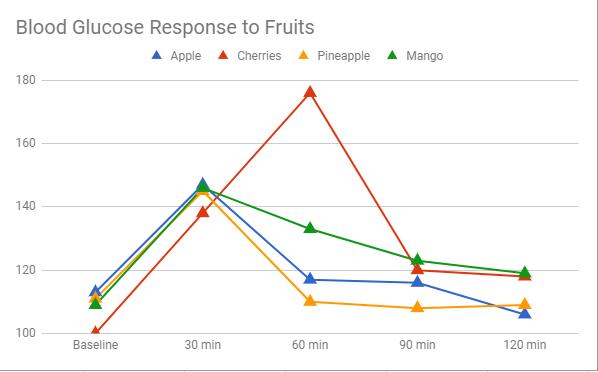
Now some results! I don’t have a ton of data yet, but I thought my haul so far was pretty interesting. Note: my fasting glucose is running a bit high, which is why I’m interested in this experiment to begin with. First, my fruit experiments:

Wow, cherries, what did I ever do to you? I was interested to see that so many fruits were identical, with one major outlier. I would never have thought something like pineapple would be so different from cherries. While I should probably repeat the measurement, it kind of supports the idea that some food responses are a bit unusual.

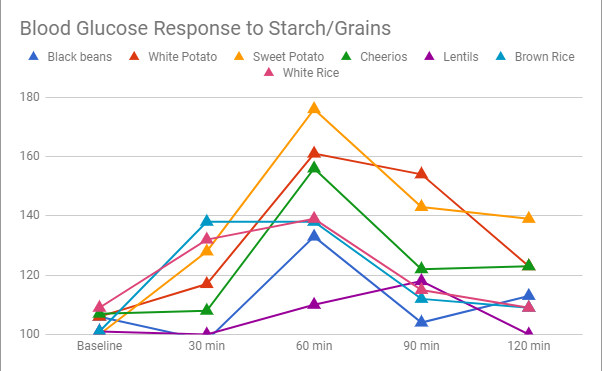
Next, my starches/grains. Note the shift of the peak from 30 minutes for fruit, to 60 minutes for most of these foods:

A couple of interesting things here:

  1. I was surprised how much higher the variability was.
  2. Sweet potatoes apparently are not my friend
  3. Kind of surprising that white rice and brown rice were almost exactly the same
  4. Beans and lentils were the lowest reaction of any food I tested

Overall I thought these results were very interesting, and I’ll have to consider how to use them going forward. My next step is going to be to try to expand this list, and then move on to some junk food/fast food/takeout meals to see if my response is significantly different to things like burgers and fries vs pizza. That should be interesting. I’ll probably base that on a serving (or at least the serving I eat) as opposed to carb count. If I get really crazy I may try some desserts or maybe some alcohol. You know, for science.

Let it never be said I’m not willing to suffer for my art.