Think I’ll have myself a beer

Well, I made it through the first work “week”, though not without getting on the wrong commuter rail on the way home and winding up quite a few miles away from anywhere familiar.  Did I mention I then got threatened by a 14 year old who seemed to think I was mildly out of line for being at the train stop when she wanted to smoke pot there with her friends?  Because I did.  Sigh*.

Given all that, this chart from the Economist seemed appropriate.

I like this graphic because it juxtaposes two interesting things….average wages and the price of alcohol.  I had no idea the Brits and Aussie’s were paying so much for their booze, but it’s interesting to see how well the developed world still comes out in this.

I did have to wonder whether this was average beer prices or lowest cost beer, and for what region.  I actually am allergic to beer, so I’m not sure if that $1.80 for 500 mL (17 oz or so) is accurate or common.  Seemed a bit low to me, but it’s likely because it’s part of a retail price for a six pack, not the bar prices I’ve seen.

Regardless, I was glad to see that if I needed to do some drinking, I’m apparently in the right country for it.

*In case you’re curious how I fared in this encounter with the Roslindale hooligans, the answer is strangely.  I was pretty over the top upset about the train thing (it was unmarked with a broken PA system so I couldn’t even correct my mistake quickly as they weren’t announcing any stops).  In my tired still post-partum hormonal state, I really couldn’t handle this child attempting to impress her friends, and ended up rolling my eyes at her and walking off with a “Fine, whatever”.  I think she was genuinely surprised by that response, couldn’t think of a comeback and then I was gone.  It occurred to me later that I had quite possibly just out teenagered a teenager.  

Ultimately, my very sweet husband came and found me, which was quite nice of him.
Thursday Quote of the Day

“Statistical thinking will one day be as necessary for efficient citizenship as the ability to read and write.” – H.G. Wells

Odds and ends

A few good links from readers:

A good piece from the Assistant Village Idiot on zero points in graphs.  Especially in an election year, I’ve been seeing a lot of these graphs with deceptive scales.  Axes matter.

From Dubbahdee, a link entitled “The Most Dishonest thing Fox News Has Ever Done“.  I can’t say I watch Fox news (or any other network for that matter), but I’ll agree this was pretty darn deceptive.   In an attempt to show the worsening economy, they reported the official unemployment rate from 2009 with the “real’ unemployment rate from 2012…making it look like unemployment had doubled in the last three years.  Aren’t there enough real problems going on to keep them busy?

From my dear brother, Scientific America’s piece on the political candidates view on science/science policy. Disgustingly full of rhetoric, but interesting nevertheless.

Brief update

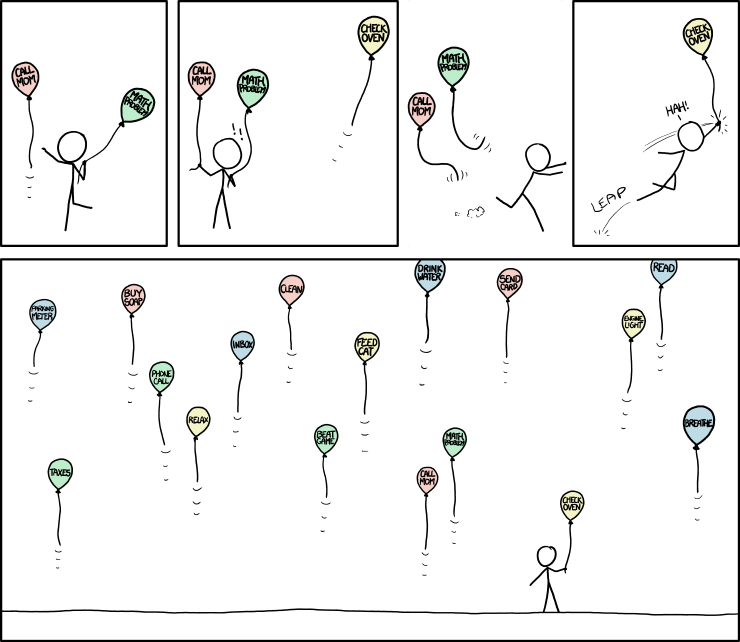
Leave it to xkcd to post a comic that perfectly describes my life right now.
Still trying to figure out when to blog, but his lordship seems to be sleeping in progressively longer bouts, so I may get some time back soon.
I’m feeling very motivated to post regularly again, as my brother let me know this morning that I have in fact made a difference in the world.  He’s currently an executive producer on a new film about poverty in America, and apparently felt one of the stats the filmmaker used was a bit fishy.  He looked up the source and felt it was a deceptive stat, and asked her not to use it.  Then he called me and told me about it.  I feel I’ve accomplished something here.
If your curious, the movie is here: http://www.thelinemovie.com/

5 Easy Pieces

Simply Statistics put up this link to an interview with David Spiegelhalter on 5 good books to help understand statistics and risk.  I haven’t read any of them, but they looked excellent.  Also, this quote is excellent:

There is a nice quote from Joel Best that “all statistics are social products, the results of people’s efforts”. He says you should always ask, “Why was this statistic created?” Certainly statistics are constructed from things that people have chosen to measure and define, and the numbers that come out of those studies often take on a life of their own.

I’m pretty sure that about sums it up.

Religion and income

Religion and income distribution.  Not sure I get exactly what data they used to get this, but still kind of interesting.  Incomes seem to skew upward the smaller the group, which makes a certain amount of sense.

 The Hindu numbers surprised me a bit.  I was guessing that has something to do with the high percentage of Indians in tech/healthcare professions, presumably making $100k+.  

Things to ponder on a Sunday

Year of the Snake (also, Statistics…but not Algebra)

My credit for links is beginning to go downhill, I blame the baby thing.  When I find good links, I leave the page open in Chrome, but don’t often leave the source open as well.  No one told me having a child would cause my internet etiquette to go so precipitously downhill.

All that to say, I have no idea where I saw this, but apparently 2013 has been declared The International Year of Statistics.  
Sadly, none of the events are in my neck of the woods, but still fun to know about.  
It also brought to mind this NYT Op-Ed piece about the necessity of algebra.  I’m a bit tardy in bringing it up, as there have been quite a few good responses to it already, but I wanted to throw my two cents in.  
Andrew Hacker argues that algebra and other current math standards are impractical and unfairly hold back people who aren’t good at math.  My first reaction was annoyance.  No one would ever argue that someone deserved to graduate high school without being able to read, no matter how much they excelled at math….and yet here someone is essentially arguing the reverse.  
When I took a deep breath however, it occurred to me that the last thing I want to do is defend the way math is taught to most high schoolers.  For many people, a course on functional statistics and/or financial math would be more useful, practical, and most likely easier to learn and remember.  If we’re headed that direction, there’s probably very few subjects taught in high school that couldn’t be improved with a little more practicality and a little less theory. 
To get back to the start of the post, I wouldn’t mind seeing algebra replaced with more statistical teaching….though large scale public understanding of stats and research methods might leave me with fewer things to blog about.  

Olympics of Yesteryear

Well the Olympics have come and gone, but I’m still not over my crush on the plethora of Olympic related data out there.  Indulge me one last time, as I repost the Economist’s list of discontinued Olympic events.

Who knew tug of war was in there until 1920?  They should bring that back.

Olympic visuals

One of the nice parts of having a baby during the Olympics is that there’s always something interesting on TV at 3am.

I had posted a visual representation of the winners of past years vs the winners today last week, and yesterday I saw an even better one.   It won’t embed, but it’s worth a watch.  It focuses primarily on Usian Bolt’s 100m dash time.  Apparently the gold medalist from 1896 still would have had 65 feet left to run when Bolt finished.

Additionally, the bronze medalist from 1896 would be finishing on par with today’s record setting 8 year olds.  It’s interesting stuff, even if (like the AVI) you believe there’s chicanery involved.