A Greek was born on the 260th day of 20 B.C. and died on the 260th day of 60 A.D. How many years did he live?
Neurobunk and how to properly blame a journalist
“When in doubt, blame the journalist” is one of my favorite explanations for bad science. So often the science behind the headline is actually good (or at least appropriately admitting of it’s shortcomings) and then a journalist comes along and mucks it all up. I’ve often wondered how scientists feel about seeing their work so grossly misrepresented, and yesterday I stumbled upon this TED talk where a neuroscientist explains how it felt to see that done to her own work:
http://embed.ted.com/talks/molly_crockett_beware_neuro_bunk.html
It’s a good video, but if you don’t have time for it, here’s the low down: Molly Crockett and her lab did a study on whether or not taking away tryptophan from the brain would result in worse decision making. They did this by giving people a gross drink. The headlines ended up blaring “eat cheese for better decision making”. Apparently the fact that cheese contains tryptophan was enough for the writers to conclude that eating cheese would cause decision making getting better….something the study never claimed to say.
The rest of her talk is quite good. Some interesting points:
- People are more likely to believe scientific articles that have pictures of the brain in them
- Most regions of the brain have multiple functions, so any study claiming that the area associated with a specific emotion lit up at stimulus x likely just picked the function of that part of the brain they liked best
- Oxytocin not only promotes good feelings (like is commonly reported) but also jealousy and bad feelings
I don’t know much about neuroscience, so I enjoyed seeing new ways of cutting through the hype.
It also led me to this article from a few months ago, which is also good.
Will the real racist please stand up?
For those of you who don’t follow the activities of the Supreme Court, you missed a good one last week. Shelby County v Holder went up before the judges, and Scalia, Roberts, Sotomayor and Kagan all got in some commentary that made headlines. The case is a challenge specifically to Section 5 of the Voting Rights Act, which requires that states with a history of discriminatory practices in voting must get any changes to their voting practices “precleared” before they can implement them.
Other states, like the one I currently reside in, can change their practices willy-nilly, and then just get sued later under section 2 of the Voting Rights Act, which all states must uphold.
Shelby County is arguing that Section 5 infringes on states rights by holding some states to a different standard based on past history. As of 2008, here’s who’s on the section 5 list:
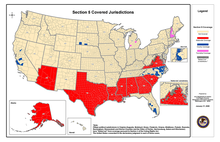
Now I’ll admit I wasn’t following the case all that closely, but my Dad and I talked about it briefly this weekend, which led him to send me this link. Apparently part way through the arguments, Chief Justice Roberts queried why Mississippi needs special clearance when Massachusetts has a lower percentage of registered black voters and lower turnout rates than Mississippi does. There’s been some bickering over whether the stats he used to back him up are valid or not (short version: given the margin of error they could be wrong, but it’s not overly likely), but that’s not what I wanted to talk about.
What I wanted to talk about was how in the world a state goes about proving they’re not racist in their voting practices.
This is a tough question. Voter turnout is a funny thing….it’s typically low enough that the environment in which the vote is taking place can actually make a difference. Here’s a few things you’d have to consider when assessing how many people in a particular :
- Which elections are we counting? The census data Chief Justice Roberts was citing was from this lower court decision, which clarifies this was from the 2004 election. I would like to see some more robust data that shows where these numbers go when it’s not a presidential election.
- What/who else was on the ballot in the individual states in the year the data was pulled. Some issues just effect certain groups more. We should really at least attempt to tease out if there was any significant differences in ballot measures/state level races in 2004 before comparing the numbers.
- Does it matter more who votes, or how much it took to get there? Voter turnout’s a funny thing…sometimes the more hurdles in people’s way, the more dedicated they get. If two states have identical turnout rates, it wouldn’t always mean that it was equally easy for people to get to the polls. At no point in any of these decisions did I see an attempt to assess how easy/difficult people felt it was to vote.
- How many laws have they tried to pass but not been able to? When looking at who votes, it’s important to remember that those votes were cast using the setup of laws actually implemented. Sotomayor mentioned the first day that Shelby County has had 240 laws blocked under Section 2, and as I noted above, Massachusetts has tried to pass laws that did not hold up in court.
- Can we separate the effect of race from the effect of socioeconomic status? I voted in urban precincts for a number of years. They can be terrible.
- How are other minorities doing? I mean I get why the focus is where it is, but doesn’t it matter how other races are doing to?
So those are my thoughts on how you’d start to assess racism in elections in a meaningful way. Other facets the court cited but I didn’t comment on included proportion of black elected officials (which I put less credence in because if the minority population isn’t even distributed throughout the state this skews easily) and the number of observers the federal government has sent to monitor elections (a circular argument the court admits, the federal government sends people where it thinks there’s a problem, you shouldn’t then use that to prove there’s a problem).
To be clear, this is more a thought experiment on how you would assess state by state racism than any commentary on what should happen with the Voting Rights Act. I’ve also never been to Mississippi, and thus will withhold any judgment on the level of racism there in comparison to my state. I have enough trouble figuring out where the heck I’m supposed to show up to vote in general (I’ve moved a lot) to have any idea if our voting policies are good, bad, or indifferent.
In case you’re curious though, here’s an example of a literacy test from Mississippi from the 1950s. Yikes.
Weekend Moment of Zen 3-3-13

Friday Fun Links 3-1-13
Hey! Happy Friday! In celebration, I think it’s time you ask the internet “Am I Awesome?”
I mentioned that in Salt Lake City I rekindled my love affair with dinosaurs. Thus, this Tumblr makes me happy.
This also makes me happy: the most obscenely titled peer reviewed paper you’ll see all day.
Also from io9, the scientists that would make the best superheros.
I know I’m feeling pretty burnt out on politics, but this site is pretty cool….locate your state level representation, and get the bills they sponsor, committees they serve on, and other such fiddle faddle.
Women work harder than men OR there is no "p" in "3M"
In one of those weird “stalking bad data” moments today, I found this Jezebel article that claimed that women worked harder than men. The Jezebel article linked to a Forbes article about a study from 3M, but there was no link. Finally, someone in the comments section actually found the study and I got to take a look.
Now the whole reason I wanted to track this down was because the claim that “women work harder than men” appeared to be based on the difference of a few seconds over the course of 10 minutes (2.5 minutes for women vs 2.1 minutes for men). Of course I wanted to see a p value here….they do know that’s how we assess if the difference of 24 seconds actually means something right?
Alas, no. No p value. Just a one time 10 minute trial of who logged more keystrokes when a researcher was sitting nearby.
Also according to the study, people under 35 work harder than those over 35, and supervisors work harder than non-supervisors. What’s weird is apparently the only metric used to assess “work” was keystrokes, and it doesn’t appear anyone group spent more than an average 5 minutes out of 10 working, even with a researcher standing over their shoulder.
Alright, I know this whole study is one big advertisement for their privacy software, but they couldn’t even give us a p value for how much better everyone did with their software? Why even use statistics if you’re not going to at least pretend to be rigorous?
Must have been a man who put this together. Everyone knows they don’t do much.*
*If you presume an 8 hour work day, and assume equal productivity across the day, the men in this office work 101 minutes to the women’s 120 minutes. How the heck to I get a job where I only do 2 hours of work per day????
Wednesday Brain Teaser 2-27-13
If I were to give you the equation 26 = 47 in big foam numbers, how could you rearrange them to make it an accurate equation? You can’t add any mathematical operators or get rid of the equal sign.
What can your dentist tell you about your risk for ovarian cancer?
Answer: more than I thought.
The absolute rates aren’t small either…20% of women with epithelial ovarian cancer have hypodontia, as opposed to 3% of women overall. Women are 4 times as likely to have hypodontia as men.
I bring this up because I think it’s an interesting clear case of correlation without causation. Missing teeth don’t cause ovarian cancer, and ovarian cancer doesn’t cause missing teeth. It’s also an interesting case of how research has to move in two directions. Now that there’s proof that ovarian cancer patients tend to have hypodontia, there are trials underway to see if women with hypodontia get ovarian cancer, and if so how high the rate is. A correlation also does not mean prediction. Prediction means prediction.
If you’re wondering why this came up, it’s because I have hypodontia, and I’d never really thought to look it up until now*. Apparently it’s a half decent idea for me to let my primary care doctor know about this, as there are very few early signs of ovarian cancer. Science….it never fails to surprise me.**
*Sometimes I forget we have the internet. Not really, but sometimes there are questions I had pre-internet that it never occurs to me I can get answers to now. I found out about the teeth thing when my teeth failed to develop, back in around 1993 or so.
**In case you’re really curious about my dentistry: I’m congenitally missing 8 teeth total, but 4 of them are my wisdom teeth. To be clear, these were not pulled, they never existed. Wisdom teeth (third molars) don’t count in the diagnosing of hypodontia. I’m completely missing my mandibular second molars, and I only have baby teeth for my mandibular second bicuspid (second premolar). None of this is visible unless you’re seriously looking in my mouth, but dentists do generally go “oh cool!” when they see my mouth for the first time. The teeth I’m missing are all the most common ones, though 4 is on the high side to be missing (all the people in the study were only missing one or two). I also had a tooth try to grow in on the roof of my mouth, but that’s a whole different story.
P(x|y) = eww, gross
I finished my first midterm of the semester this week. There was a decent section that revolved around calculating P(x|y)….in other words the probability of x if we know that y has already happened. In simple terms, if you have a probability of something happening (x), and something else that’s related to x happens (y), the probability of x happening changes.
This is not an overly complex concept when it’s spelled out mathematically, but in real life it can be hard for people to remember that improbable events are often far more probable if you consider what’s already happened.
I was reminded of this when I was reading Dear Prudence (Slate.com’s advice column) last week and came across this letter from a man (born by artificial insemination from an unknown sperm donor) who decided to seek out his father, only to discover that it was the same man who had donated to his wife’s mother. Oops. And gross. Seriously, gross.
What struck me as more though, was a response that was printed from another reader:
I know you/we cannot know, but color me skeptical that this letter is legit. The odds of such a “match” have to be very small. I can’t help but wonder if this letter is a fiction pushing a political agenda.
This seems true of course…I mean, it’s a sort of Casablanca moment right? Of all the gin joints in all the towns in all the world….
But let’s think about this couple for a second:
- They’d be the same age. I don’t know about sperm banks in particular, but I do know that most stored bodily fluids are only considered “good” for a few years…so if two people were to result from one donor, they would likely be around the same age. Most people tend to marry someone within a few years plus or minus their own age.
- They’d be from the same place. Sperm donors are unlikely to trit trot around the country donating to various centers….they’re more likely to stay in the city they actually live in. I have no particular experience with this, but I’d imagine that people looking for a sperm bank stick to their same town as well….which means these two children would like be raised in the same city, making their chances of meeting go up and the culture they were raised in more similar.
- Their mothers had a lot in common. From the letter, the couple is at least over the age of 30. From what I gather, it was less common for people to use sperm banks prior to 1980. According to this article, in 1987, only 5000 single women asked for donor sperm. At the time the letter writers mother and mother-in-law were looking, it was likely even fewer. This means the two shared a very unique background, and had mothers who were both counter-cultural enough to go forward with this. This would give them quite a bit in common.
- They’d likely have at least some similar hobbies, interests, and personality traits. I think most people would agree that at least some of our hobbies/interests/personality traits/taste in friends/what have you are more nature than nurture. I would thus think it extremely likely that two people sharing the same father would have at least one major hobby or interest in common, making it much more likely that their social circles would cross and that they’d have something to talk about when it did. The more you believe genetics influence who you eventually are, the better the chances they’d meet.
- People (might) like people who look like them. I actually had some trouble finding a good paper that proves this, but it’s a theory. Interestingly, the only scholarly article cited in support of this on the Wikipedia page actually turned out to say they found no evidence of this. This is why Wikipedia =/= research.
- Their parents would likely have supported the union. In-law issues are tough, but I’d imagine if you were a lesbian mother in the 80s and found out your adult son was going to marry the daughter of another lesbian mother from the 80s, you’d be pretty psyched. Also, they’d very likely have been in a similar socio-economic class, as both their moms were well off enough to pursue this avenue.
So we’re not calculating the probability of two random people finding each other. We’re calculating the probability that two people in the same age group, from the same city, with the same unique background and similar interests, from similar cultures, with some similar personality traits, who looked similar, would meet, start dating and with (likely) large amounts of family support get married. The chances would still likely be small, but not nearly as small. When you throw in that they ended up at the same college, the chances actually get pretty high.
Many people seems to think that we have some sort of “incest flag” that would make us not attracted to relatives, but it actually is more likely related to the Westermark effect…or being in close proximity during childhood. While it appears sperm banks are now actually trying to account for this, there could be some scary ramifications for some people. Kinda brings new meaning to the phrase “what’s your name, who’s your daddy?” eh?
Who talks more…men or women?
There is nothing I love more than a clever phrase to describe a phenomena that bothers me. Last night I found such a phrase in a Jezebel article about gender differences in number of words spoken per day.
The phrase: public domain data.
This describes the phenomena of data that’s been so often cited that no one seems to think you need a reference for it anymore (think “you need 8 glasses of water per day”).
In this particular article, she brings it up in the context of the assertion that women say more words per day than men do. The most commonly cited data puts it at anywhere from double to quadruple the number…quite a difference by any stretch of the imagination. The problem is the numbers are apparently quite fictional.
The Jezebel piece links to this piece on a blog from UPENN where someone actually tried to track down a study that ever established the numbers quoted. They found that it apparently originated with James Dobson sometime in the late 80’s or early 90’s, and that he did not seem to have a study to back him up (his actual quote was that “God gave women 50,000 words for the day, and men 25,000”).
From there it seems to have changed and distorted, but it does not seem anyone has actually sat down and counted the number of words men and women said.
If you think about it, this would be a really hard study to do. I mean, I think most people would knee-jerk agree that women talk more than men, but we have to remember that we’re only thinking of social situations. Your choice of profession would HEAVILY skew how many words you were saying per day. I mean, my brother the biology teacher is by far the quietest member of my immediate family when we get together. However, I would hazard a guess that 5 days out of the week he likely says more words than I do. I mean, he teaches. He has to say words. I spend at least half my day analyzing data. No words needed. I also have a longer commute (no talking needed) and unless I’m giving a presentation all of my meetings involve giving people equal time to talk. But of course people who met us wouldn’t count his professional speaking. It would be clear to everyone that I talk more…unless you had a researcher study us on an average day.
Additionally, even if this stat had been true in 1993, how would we count it today? In 1993, most social communication was verbal. How would we count blogging, Twitter, Reddit or texting? It feels strange to count those as words, but also strange to not include them.
I mean, the little lord’s been taking his morning nap for the past hour or so. In that time I have commented on 4 blogs, written two emails, one Facebook message, and written this post. For research purposes though, I haven’t said a word. Interesting, isn’t it?

