I am now at the age where I, along with most of my friends, have retired parents. This has led to a natural increase in the discussions of the problems of aging, some of which I expected and some of which I did not. One thing I’ve been surprised by is the number of people I’ve had mention to me recently that their parent(s) have a problem with hoarding. This piqued my interest because I have no direct experience with this (my parents have made a big point of continuously going through their stuff), but when I started to mention that I was hearing this a lot more, I started to get more stories of people’s parents or friends parents who were struggling with this. And these stories were bad. This wasn’t “moms house is a little more cluttered than I’m comfortable with”, these were stories of rooms being rendered fully unusable, important things going missing, and fears of having to be the one to clean it up after they pass away. So what’s going on here? Is this a case of increased awareness, expanded definitions or a real uptick? Turns out it might be all three! Let’s dig in.
What is Hoarding Disorder?
Hoarding disorder is actually a fairly new diagnosis, first introduced in to the DSM in 2013. Prior to that it was considered a subset of obsessive compulsive disorder. The full criteria is here, but it’s basically the psychological inability to get rid of stuff in a way that ends up negatively impacting your life or health. People keep accumulating stuff whether through compulsive overbuying or just refusal to discard anything in such a way that their homes fill up. The estimates are that about 19 million Americans reach the criteria. It’s estimated about a quarter of all preventable fire deaths happen due to hoarding.
One of the more interesting things I found while looking in to this is that a group called Hoarding UK actually publishes something called the “Clutter Index Rating“, a visual guide to what level of clutter might require help or intervention. They recommend that a 4 or above might require help. Here’s an example of their visual for the kitchen:
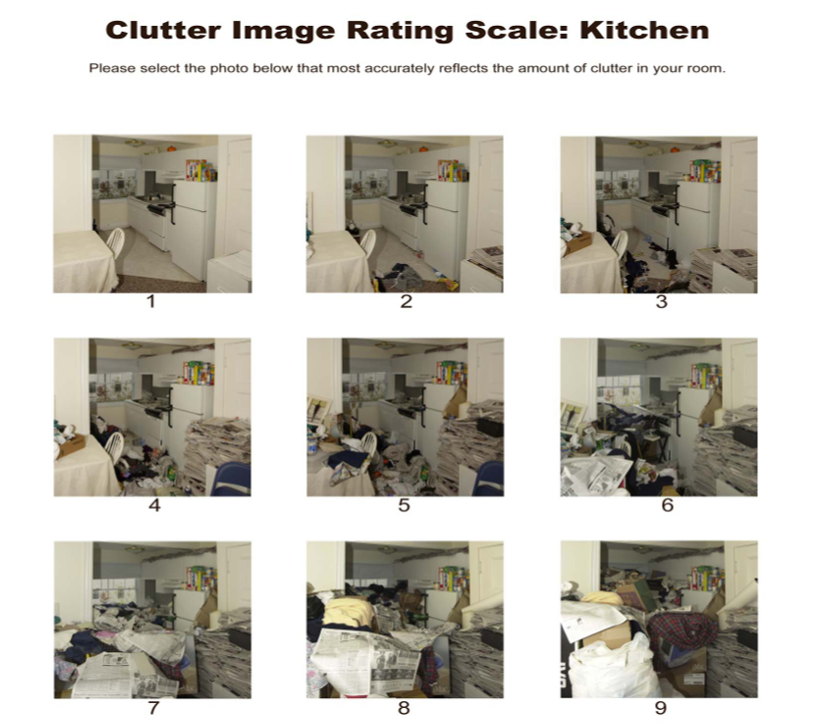
I was relieved to discover my house does not fall in the problem zone.
Why are we hearing more about this now?
Well, a few reasons. Between the reality show “Hoarders” debuting in 2009 and the new diagnosis being added in 2013, the public did start having a new level of awareness of this disorder. This led to more people talking about it, which tends to lead to more people identifying that their dads inability to throw out any newspaper he’d ever gotten had a real name.
Next, there’s the obvious issue that stuff is easier to accumulate now than ever before. Could you fill up a house with random stuff back in 1900? Sure but it would have taken a lot longer. Interestingly this post was inspired by someone encountering a (likely) hoarder who tried to pick up some stuff they’d left our for free by the side of the road, and despite her whole car being full of random stuff, she started asking if they had anything else laying around she could look at.
But finally, hoarding is not evenly distributed across the lifespan: it is far more common in those over 65. People who just had a clutter problem in their younger years may turn in to full blown hoarders later in life, so as the baby boomers cross age 65 we can expect to see an increase in those impacted. Interestingly despite the initial link to OCD, it actually seems it’s more closely linked to depression. People who have divorced, lost a spouse or are otherwise isolated may be even more vulnerable. Unsurprisingly, this also means that the pandemic boosted the problem, though it’s not clear if that persisted. Sadly, some major cases of hoarding aren’t discovered until the affected person passes away.
So what do we do about this?
Well, much like any difficult psychological problem, there’s not one clear answer. My local council on aging has resources and my state also supplies support, particularly to landlords who may need to evict a hoarder. There are 12 step programs and traditional therapy options, there are services that will clean your house out. However, it is noted that cleaning the house out has a 100% recidivism rate if no other support is given. My state provided this interesting little decision tree, which I appreciated:

But overall this will depend a lot on local resources and exact circumstances. Not an easy spot to be in if you’re a loved one.
 graph paper diaries