For those of you who don’t follow the activities of the Supreme Court, you missed a good one last week. Shelby County v Holder went up before the judges, and Scalia, Roberts, Sotomayor and Kagan all got in some commentary that made headlines. The case is a challenge specifically to Section 5 of the Voting Rights Act, which requires that states with a history of discriminatory practices in voting must get any changes to their voting practices “precleared” before they can implement them.
Other states, like the one I currently reside in, can change their practices willy-nilly, and
then just get sued later under section 2 of the Voting Rights Act, which all states must uphold.
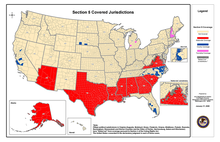
Shelby County is arguing that Section 5 infringes on states rights by holding some states to a different standard based on past history. As of 2008, here’s who’s on the section 5 list:
Now I’ll admit I wasn’t following the case all that closely, but my Dad and I talked about it briefly this weekend, which led him to send me
this link. Apparently part way through the arguments, Chief Justice Roberts queried why Mississippi needs special clearance when Massachusetts has a lower percentage of registered black voters and lower turnout rates than Mississippi does. There’s been
some bickering over whether the stats he used to back him up are valid or not (short version: given the margin of error they could be wrong, but it’s not overly likely), but that’s not what I wanted to talk about.
What I wanted to talk about was how in the world a state goes about proving they’re not racist in their voting practices.
This is a tough question. Voter turnout is a funny thing….it’s typically low enough that the environment in which the vote is taking place can actually make a difference. Here’s a few things you’d have to consider when assessing how many people in a particular :
- Which elections are we counting? The census data Chief Justice Roberts was citing was from this lower court decision, which clarifies this was from the 2004 election. I would like to see some more robust data that shows where these numbers go when it’s not a presidential election.
- What/who else was on the ballot in the individual states in the year the data was pulled. Some issues just effect certain groups more. We should really at least attempt to tease out if there was any significant differences in ballot measures/state level races in 2004 before comparing the numbers.
- Does it matter more who votes, or how much it took to get there? Voter turnout’s a funny thing…sometimes the more hurdles in people’s way, the more dedicated they get. If two states have identical turnout rates, it wouldn’t always mean that it was equally easy for people to get to the polls. At no point in any of these decisions did I see an attempt to assess how easy/difficult people felt it was to vote.
- How many laws have they tried to pass but not been able to? When looking at who votes, it’s important to remember that those votes were cast using the setup of laws actually implemented. Sotomayor mentioned the first day that Shelby County has had 240 laws blocked under Section 2, and as I noted above, Massachusetts has tried to pass laws that did not hold up in court.
- Can we separate the effect of race from the effect of socioeconomic status? I voted in urban precincts for a number of years. They can be terrible.
- How are other minorities doing? I mean I get why the focus is where it is, but doesn’t it matter how other races are doing to?
So those are my thoughts on how you’d start to assess racism in elections in a meaningful way. Other facets the court cited but I didn’t comment on included proportion of black elected officials (which I put less credence in because if the minority population isn’t even distributed throughout the state this skews easily) and the number of observers the federal government has sent to monitor elections (a circular argument the court admits, the federal government sends people where it thinks there’s a problem, you shouldn’t then use that to prove there’s a problem).
To be clear, this is more a thought experiment on how you would assess state by state racism than any commentary on what should happen with the Voting Rights Act. I’ve also never been to Mississippi, and thus will withhold any judgment on the level of racism there in comparison to my state. I have enough trouble figuring out where the heck I’m supposed to show up to vote in general (I’ve moved a lot) to have any idea if our voting policies are good, bad, or indifferent.

 graph paper diaries