Type III Errors: Another Way to Be Wrong

I talk a lot about ways to be wrong on this blog, and most of them are pretty recognizable logical fallacies or statistical issues. For example, I’ve previously talked about the two ways of being wrong when hypothesis testing that are generally accepted by statisticians.  If you don’t feel like clicking, here’s the gist: Type I errors are also known as false positives, or the error of believing something to be true when it is not. Type II errors are the opposite, false negatives, or the error of believing an idea to be false when it is not.

Both of those definitions are really useful when testing a scientific hypothesis, which is why they have formal definitions. Today though, I want to bring up the proposal for there to be a recognized Type III error: correctly answering the wrong question.

Here are a couple of examples:

  1. Drunk Under a Streetlight: Most famously, this could be considered a variant of the streetlight effect. It’s named after this anecdote: “A policeman sees a drunk man searching for something under a streetlight and asks what the drunk has lost. He says he lost his keys and they both look under the streetlight together. After a few minutes the policeman asks if he is sure he lost them here, and the drunk replies, no, and that he lost them in the park. The policeman asks why he is searching here, and the drunk replies, “this is where the light is.”
  2. Blame it on the GPS: In my “All About that Base Rate” post, I talked about a scenario where the police were testing trash cans for the presence of drugs. A type I error is getting a positive test on a trash can with no drugs in it. A type II error is getting a negative test on a trash can with drugs in it. A type III error would be correctly finding drugs in a trash can at the wrong house.
  3. Stressing about string theory: James recently had a post about the failure to prove some key aspects of string theory which was great timing since I just finished reading “The Trouble With Physics” and was feeling a bit stressed out by the whole thing. In the book, the author Lee Smolin makes a rather concerning case that we are putting almost all of our theoretical physics eggs in the string theory basket, and we don’t have much to fall back on if we’re wrong. He repeatedly asserts that good science is being done, but that there is very little thought given to the whole “is this the right direction” question.
  4. Blood Transfusions and Mental Health:The book “Blood Work: A Tale of Medicine and Murder in the Scientific Revolution” provides another example, as it recounts the history of the blood transfusion. Originally, the idea was that transfusions could be used as psychiatric treatments. For many many reasons, this use failed spectacularly enough that they weren’t used again for almost 150 years. At that point someone realized they should try using them to treat blood loss, and the science improved from there.

No matter how good the research was in all of these cases, the answer still wouldn’t have helped answer the larger questions at hand. Like a swimmer in open water, the best techniques in the world don’t help if you’re not headed in the right direction. It sounds obvious, but formalizing a definition like this and teaching it while you teach other techniques might help remind scientists/statisticians to look up every once in a while. You know, just to see where you’re going.
 

Death and Destruction: The Infographic

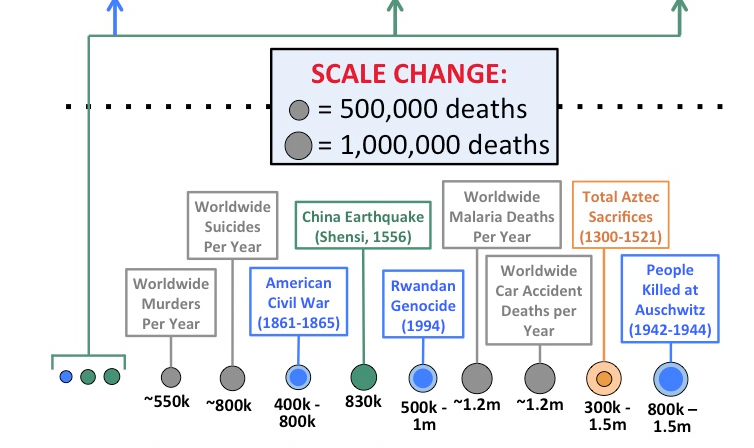
I am rather notoriously skeptical of infographics, but I found this one from Wait But Why today and it’s completely fascinating. It’s a comparison of how many people die/have died by various causes, some natural, some not so natural.

The whole thing is huge, but here’s a taste:

Deathtoll

I’ve been perusing this for about half an hour now, and I’ve learned about the Masada suicides, the Shensi Earthquake, and the Mao Era in China. It’s not a definitive list, but a really interesting one!

The Signal and the Noise: Chapter 2

This is a series of posts featuring anecdotes from the book The Signal and the Noise by Nate Silver.  Read the Chapter 1 post here.

Chapter 2 of The Signal and the Noise focuses on why political pundits are so often wrong. When TV channels select for those making crazy predictions, it turns out accuracy rates go way down. You can either get bold, or you can be right, but very rarely can you be both.

SignalNoiseCh2

Basically, networks don’t care about false positives….big predictions that don’t come true. What they do care about is false negatives….possibilities that don’t get raised. They consider the first just understandable bluster, but the second is unforgivable. So next time you wonder why there’s so many stupid opinions on TV, remember that’s a feature not a bug.

Read all The Signal and the Noise posts here, or go back to Chapter 1 here.

What I’m Reading: July 2016

This month my book was The Signal and the Noise,  which I enjoyed enough that I’m doing a chapter by chapter contingency matrix series on it over at the other blog.

Sampling strategy and research design can sound really boring, until you blow through $1.3 billion dollars and have nothing to show for it. This article on the long slow death of the National Children’s Study should be assigned reading for anyone who ever wanted to know why it was so damn hard to get good research done.

Did you hear the one about all the Brexit voters furiously Googling “What is the EU?” after they voted to leave it? Yeah? That was pretty bogus. It was about 1000 people total, no one knows if their Googling was “furious”, how they voted, or if those people were even eligible to vote.

This article is from a few months ago, but it’s an interesting look at motivations and political bias. It turns out people do better on “political fact” tests when you offer them money for right answers than when they take them with no incentives.  The Volokh Conspiracy discusses implications for our understanding of political ignorance.

Also from a few months ago: the Quartz guide to bad data. More properly it might be called “guide to cleaning up your spreadsheet”. If you ever actually get a large data file and don’t know how to find potential problems before you analyze it, this is a good start.

Another good guide is this list of data science books from Stitch Fix. Stitch Fix is an online personal stylist service that I just so happen to use to get most of my work clothes. They also have a REALLY active data science division that helps come up with clothing recommendations. Good stuff.

This is an interesting data visualization of the changing American obesity rates.

I actually listened to this one, but there was an interesting piece on Science Friday about “differential privacy” and response randomization. The transcript is available here,  and there’s some interesting discussion about honesty, privacy, and research in the big data era.


Proving Causality: Who Was Bradford Hill and What Were His Criteria?

Last week I had a lot of fun talking about correlation/causation confusion, and this week I wanted to talk about the flip side: correctly proving causality. While there’s definitely a cost to incorrectly believing that Thing A causes Thing B when it does not, it can also be quite dangerous to NOT believe Thing A causes Thing B when it actually does.

This was the challenge that faced many public health researchers when attempting to establish a link between smoking and lung cancer. With all the doubt around correlation and causation, how do you actually prove your hypothesis?  British statistician Austin Bradford Hill was quite concerned with this problem, and he established a set of nine criteria to help prove causal association. While this criteria is primarily used for proving causes for medical conditions, it is a pretty useful framework for assessing correlation/causation claims.

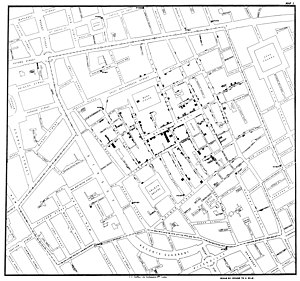
Typically this criteria is explained using smoking (here for example), as that’s what is was developed to assess. I’m actually going to use examples from the book The Ghost Map, which documents the cholera outbreak in London in 1854 and the birth of modern epidemiology.  A quick recap: A physician named John Snow witnessed the start of the cholera outbreak in the Soho neighborhood of London, and was desperate to figure out how the disease was spreading. The prevailing wisdom at the time was that cholera and other diseases were  transmitted by foul smelling air (miasma theory), but based on his investigation Snow began to believe the problem was actually a contaminated water source. In the era prior to germ theory, the idea of a water-borne illness was a radical one, and Snow had to vigorously document his evidence and defend his case….all while hundreds of people were dying. His investigation and documentation is typically acknowledged as the beginning of the field of formal epidemiology, and it is likely he saved hundreds if not thousands of lives by convincing authorities to remove the handle of the Broad Street pump (the contaminated water source).

With that background, here are the criteria:

  1. Strength of Association: The first criteria for proof is basic. People who do Thing A must have a higher rate of Thing B than those who don’t. This is basically a request for an initial correlation. In the case of cholera, this was where John Snow’s “Ghost Map” came in. He created a visual diagram showing that the outbreak of cholera was not necessarily purely based on location, but by proximity to one particular water pump. Houses that were right next to each other had dramatically different death rates IF the inhabitants typically used different water pumps. Of those living near the water pump, 127 died. Of those living nearer to other pumps, 10 died. That’s one hell of an association.
  2. Temporality: The suspected cause must come before the effect. This one seems obvious, but must be remembered. It’s clear that both water and air are consumed frequently, so either method of transmission passed this criteria. However, if you looked closely, it was clear that bad smells often came after disease and death, not before. OTOH, there were a lot of open sewer systems in London at the time, so everything probably smelled kinda bad. We’ll call this one a draw.
  3. Consistency: Different locations must show the same effects. This criteria is a big reason why miasma theory (the theory that bad smells caused disease) had taken hold. When disease outbreaks happened, the smells were often unbearable. This appeared to be very consistent across locations and different outbreaks. Given John Snow’s predictions however, it would have been beneficial to see if cholera outbreaks had unusual patterns around water sources, or if changing water sources changes the outbreak trajectory.
  4. Theoretical Plausibility This one can be tricky to establish, but basically it requires that you can propose a mechanism for cause. It’s designed to help keep out really out there ideas about crystals and star alignment and such. Ingesting a substance such as water quite plausibly could cause illness, so this passed.  Inhaling air also passed this test, since we now know that many diseases are actually transmitted through airborne germs. Cholera didn’t happen to have this method of transmission, but it wasn’t implausible that it could have. Without germ theory, plausibility was much harder to establish. Plausibility is only as good as current scientific understanding.
  5. Coherence The coherence requirement looks at whether the proposed cause agrees with other knowledge, especially laboratory findings. John Snow didn’t have those, but he did gain coherence when the pump handle was removed and the outbreak stopped. That showed that the theory was coherent, or that things proceeded the way you would predict they would if he was correct. Conversely, the end of the outbreak caused a lack of coherence for miasma theory…if bad air was the cause, you would not expect changing a water source to have an effect.
  6. Specificity in the causes The more specific or direct the relationship between Thing A and Thing B, the clearer the causal relationship and the easier it is to prove. Here again, by showing that those drinking the water were getting cholera at very high rates and those not drinking the water were not getting cholera as often, Snow offered a very straightforward cause and effect. If there had been other factors involved….say water drawn at a certain time of day….this link would have been more difficult to establish.
  7.  Dose Response Relationship The more exposure you have to the cause, the more likely you are to have the effect. This one can be tricky. In the event of an infectious disease for example, one exposure may be all it takes to get sick. In the case of John Snow, he actually doubted miasma theory because of this criteria. He had studied men who worked in the sewers, and noted that they must have more exposure to foul air than anyone else. However, they did not seem to get cholera more often than other people. The idea that bad air made you sick, but that lots of bad air didn’t make you more likely to be ill troubled him. With the water on the other hand, he noted that those using the pump daily became sick immediately.
  8. Experimental Evidence While direct human experiments are almost never possible or ethical to run, some experimental evidence may used as support for the theory. Snow didn’t have much to experiment on, and it would have been unethical if he had. However, he did note people who had avoided the pump and noted if they got sick or not. If he had known of animals that were susceptible to cholera, he could have tested the water by giving one animal “good” water and another animal “bad” water.
  9. Analogy If you know that something occurs one place, you can reasonably assume it occurs in other places. If Snow had known of other water-borne diseases, one suspects it would have been easier for him to make his case to city officials. This one can obviously bias people at times, but is actually pretty useful. We would never dream of requiring a modern epidemiologist to prove that a new disease could be water-borne….we would all assume it was at least a possibility.

Even though Snow didn’t have this checklist available to him, he ended up checking most of the boxes anyway. In particular, he proved his theory using strength of association, coherence, consistency and specificity. He also raised questions about the rival theory by pointing to the lack of dose-response relationship. Ultimately, the experiment of removing the pump handle succeeded in halting the outbreak.

Not bad for a little data visualization:

While some of these criteria have been modified or improved, this is a great fundamental framework for thinking about causal associations. Also, if you’re looking for a good summer read, I would recommend the book I referenced here: The Ghost Map. At the very least it will help you stop making “You Know Nothing John Snow” jokes.

The Fallibility of Journalistic Memory, a Play in Three Acts

If you’re looking for a little fun reading on this long holiday weekend, I would like to point you to a series of posts Ann Althouse has put up over the past couple of days. It’s not stats related, but touches on some of my other favorite topics: bias, certainty, and memory.

Act 1: Poetic Justices and Questionable Citations

Linda Greenhouse writes an Op-Ed for the New York Times, in which she complains about the “lack of poetry” in the recent Supreme Court Whole Women’s Health vs Hellerstedt decision.  Greenhouse compares it to the decision Planned Parenthood vs Casey, written 24 years earlier.

The next day, Ann Althouse blogs about the article, noting that Greenhouse attributed the line “Liberty finds no refuge in a jurisprudence of doubt” from Planned Parenthood vs Casey  to Anthony Kennedy.  Althouse points out that the line was taken from a jointly written decision, and that to attribute it to only one justice (Kennedy) is not correct.

Act 2: Challenge Accepted

Ann Althouse posts a follow-up post after Linda Greenhouse emails her to dispute the quote mis-attribution charge. In her email, Greenhouse cites her source for attributing the line to Kennedy: the Jeffrey Toobin book “The Nine” and her own presence in the courtroom the day the justices read the Planned Parenthood vs Casey decision 24 years earlier. She recounts Kennedy leading off with the line in question, and the stir it created in the courtroom. She asserts that the act of reading the line verifies that he was the author. She ends the email with the line “Of course you are completely free to trash my opinions and my writing style.  I would caution you against challenging my facts.”

Althouse, choosing to ignore that last part,  located the original recording of the reading of the decision. She discovers that not only did Kennedy not lead off, but neither he nor anyone else reads the line that Greenhouse so clearly remembers hearing.

The book in question does attribute the line to him, but has no named source for that information.

Part 3: We’re All a Little Wrong Sometimes, Aren’t We Though?

Confronted with the recording that shows her memory was incorrect, Greenhouse emails Althouse again, conceding that “I guess it’s fair to say that each of us was right and each of us was wrong.”

Althouse posts that email, along with her complete rejection of Greenhouse’s conclusion here. She (Althouse) ends her post with “I didn’t say anything that was wrong. I have a way of blogging that keeps me out of trouble like that. I don’t make assertions about things I don’t know.”

Epilogue: One of my favorite books is Mistakes Were Made (But Not By Me) by Carol Tavris1. There’s a tremendous amount of research in to how and why we rewrite memories, and the book covers a lot of those reasons. The main takeaway here though is that we all need to guard against created memories and overconfidence in our facts….ESPECIALLY if you’re going to be writing for the New York Times and PARTICULARLY if you’re challenged.

The point of who exactly wrote that original line is a minor one to many people. Kennedy was certainly involved in with the decision, so naming him as a solo author isn’t that out there. If Greenhouse had merely cited the book that mentioned the line as his, I would never have thought twice about it. However, when she cited her own vivid recollection that turned out to be completely wrong I have to imagine nearly everyone reading the saga started questioning her more seriously.

To her credit, Greenhouse did fully admit her shock at discovering her memory was incorrect. Hopefully the lesson for all of us here is to be very cautious when we rely on an emotionally charged memory, and  EXTRA cautious when we tell someone not to challenge our facts.

1. Conservative readers be warned: in the very first chapter of the book Tavris lets some pretty liberal biased statements through as fact. She cuts this out (I think) after the first chapter, but it’s really bugged at least one person I’ve recommended the book to. I think it’s worthwhile despite that, but YMMV.