Baby, You Can’t Drive My Car

This week I was rather surprised to find out that a early-20s acquaintance of mine who lives in a rather rural area did not have a driver’s license. I know this person well enough to know there is no medical reason for this, and she is now pursuing getting one. Knowing the area she lives in I was pretty surprised to hear this, particularly considering she has a job and a small child.

Now living around a large city with lots of public transportation options, I do know people who are medically unable to get a license (and thus stick close to public transit) and those who simply dislike the thought of driving (because they grew up around public transit), but I hadn’t met many people in the (non-big city) area I grew up in who didn’t get a license.

As often happens when I’m surprised by something, I decided to go ahead and look up some numbers to see how warranted my surprise was. It turns out I was right to be surprised, but there may be a trend developing here.

According to the Federal Highway Administration, in 2009 87% of the over-16 population had a driver’s license. There’s a lot of state to state variation, but the states I’ve lived in do trend high when it comes to the number of drivers per 1000 people:
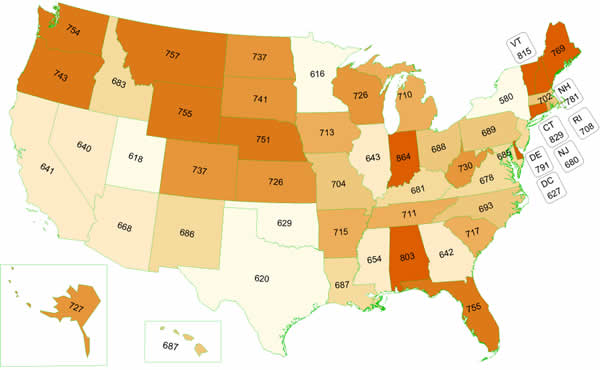
Note: that map is licenses per 1000 people of all ages, so some states with particularly young populations may get skewed.

This appeared to confirm my suspicions that not having a license was relatively unusual, particularly in the New England region. Most of the places that have lower rates of licenses are those that have big cities, where presumably people can still get around even if they don’t know how to drive. I am a little curious about what’s driving the lowish rates in Utah, Texas and Oklahoma, so if anyone from there wants to weigh in I’d appreciate it.

I thought that was the end of the story, until I did some more Googling and found this story from the Atlantic, about the decreasing number of people who are getting driver’s licenses. The data I cited above is from 2009, and apparently the number of licensed drivers has been falling ever since then. For example, this paper found that in 2008, 82% of 20-24 year olds had driver’s licenses, but by 2014 76.7% did. In contrast, in 1983 that number was 91.8%.

So what’s the reason for the decline? According to this survey, the top 5 reasons for those aged 18 to 39 are “(1) too busy or not enough time to get a driver’s license (37%), (2) owning and maintaining a vehicle is too expensive (32%), (3) able to get transportation from others (31%), (4) prefer to bike or walk (22%), (5) prefer to use public transportation (17%)”.

Like most surveys though, I don’t think this tells the whole story. For example, the top reason for not having a license is that people are “too busy” to get one, but the study authors noted that those without licenses are less likely to be employed and have less education than those with licenses. This suggests that it is not extended outside commitments that are preventing people from getting licenses. Additionally, anyone who has ever lost the use of their car knows it can take a lot more time to get a ride from someone else than it does just to hop in your own vehicle.

My personal theory is that getting a drivers license is something that requires a bit of activation energy to get going. Over the last decade or two, state legislatures have progressively enacted laws that put more restrictions on teen drivers, so the excitement of “got my license this morning and now I’m taking all my friends out for a ride tonight” no longer exists in many states. For example, in Massachusetts drivers under 18 can’t drive anyone else under 18 (except siblings) for the first 6 months. This is probably a good practice, but it almost certainly decreases the motivation of some kids to go through all the work of getting their license. After all, this is an age group pretty notorious for being driven by instant gratification.

Additionally, with high costs for insurance and vehicles, many parents may not be as excited for their kids to get their license. Without parental support, it can be really hard to navigate the whole process, and if a parent starts to think it may be easier to keep driving you than to pay for insurance, this could further decrease the numbers. With younger generations spending more time living at home, parental support is an increasing factor. Anyone attempting to get a license has a certain reliance on the willingness of others to teach them to drive and help them practice, so the “too busy” reason may actually be driven just as much by the business of those around you as your own business. You can be unemployed and have plenty of time to practice driving, but if no one around you has time to take you out, it won’t help.

Finally, there may be a small influence of new technology. With things like Uber making rides more available more quickly and Amazon delivering more things to your door, it may actually be easier to function without a license than it was 10 years ago. Even the general shift from “have to go out to do anything fun” to “can stay home and entertain myself on line” may account for a bit of the decreased enthusiasm for getting licensed to drive. For any one person it’s doubtful that’s the whole reason, but for a few it may be enough to tip the scales.

It will be interesting to see if this corrects itself at some point…will those not getting their license at 18 now get it at 28 instead, or will they forego it entirely? The initial survey most (about 2/3rds) still plan on pursuing one at some point, but whether or not that happens remains to be seen.

The Real Dunning-Kruger Graph

I’m off camping this weekend, so you’re getting a short but important PSA.

If you’ve hung out on the internet for any length of time or in circles that talk about psych/cognitive biases a lot, you’ve likely heard of the Dunning-Kruger effect. Defined by Wiki as “a cognitive bias wherein persons of low ability suffer from illusory superiority, mistakenly assessing their cognitive ability as greater than it is.”, it’s often cited to explain why people who know very little about something get so confident in their ignorance.

Recently, I’ve seen a few references to it accompanied by a graph that looks like this (one example here):

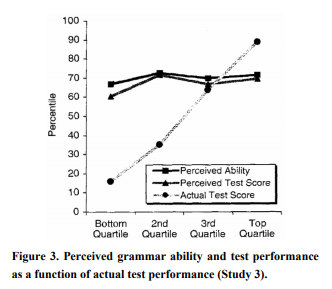
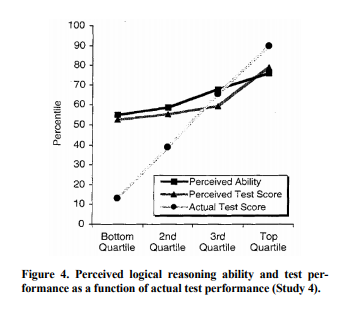
While that chart is rather funny, you should keep in mind it doesn’t really reflect the graphs Dunning and Kruger actually obtained in their study. There were 4 graphs in that study (each one from a slightly different version of the study) and they looked like this:

Humor:

Logic and reasoning (first of two):

Grammar:

And one more logic and reasoning (performed under different conditions):

So based on the actual graphs, Dunning and Kruger did not find that the lowest quartile thought they did better than the highest quartile, they found that they just thought they were more average than they actually were. Additionally it appears the 3rd quartile (above average but not quite the top), is the group most likely to be clearsighted about their own performance.

Also, in terms of generalizability, it should be noted that the participants in this study were all Cornell undergrads being ranked against each other. Those bottom quartile kids for the grammar graph are almost certainly not bottom quartile in comparison to the general population, so their overconfidence likely has at least some basis.  It’s a little like if I asked readers of this blog to rank their math skills against other readers of this blog….even the bottom of the pack is probably above average. When you’re in a self selected group like that,  your ranking mistakes may be more due to a misjudging of those around you as opposed to just an overconfidence in yourself.

I don’t mean to suggest the phenomena isn’t real (follow up studies suggest it is), but it’s worth keeping in mind that the effect is more “subpar people thinking they’re middle of the pack” than “ignorant people thinking they’re experts”. For more interesting analysis, see here, and remember that graphs drawn in MS Paint rarely reflect actual published work.


5 Things You Should Know About Orchestras and Blind Auditions

Unless you were going completely off the grid this week, you probably heard about the now-infamous “Google memo“.  Written by a (since fired) 28 year old software engineer at Google, the memo is a ten page long document where the author lays out his beliefs about why gender gaps in tech fields continue to exist. While the author did not succeed in getting any policies at Google changed, he did manage to kick off an avalanche of hot takes examining whether the gender/tech gap is due to nature (population level differences in interests/aptitude) or nurture (embedded social structures that make women unwelcome in certain spaces). I have no particular interest in adding another take to the pile, but I did see a few references to the “blind orchestra auditions study” that reminded me I had been wanting to write about that one for a while, to deep dive in to a few things it did or did not say.

For those of you who don’t know what I’m talking about, here’s the run down: back in the 1970s, top orchestras in the US were 5% female. By the year 2000, the were up to almost 30% female. Part of the reason for the change was the introduction of “blind auditions”, where the people who were holding tryouts couldn’t see the identity of the person trying out. This finding normally gets presented without a lot of context, but it’s good to note someone actually did decided to study this phenomena to see if the two things really were related or not. They got their hands on all of the tryout data for quite a few major orchestras (they declined to name which ones, as it was part of the agreement of getting the data) and tracked what happened to individual musicians as they tried out. This led to a data set that had overall population trends, but also could be used to track individuals. You can download the study here, but these are my highlights:

  1. Orchestras are a good place to measure changing gender proportions, because orchestra jobs don’t change. Okay, first up is an interesting “control your variables” moment. One of the things I didn’t realize about orchestras (though may be should have) is that the top ones have not changed in size or composition in years. So basically, if you suddenly are seeing more women, you know it’s because the proportion of women overall is increasing across many instruments. In the words of the authors ” An increase in the number of women from, say, 1 to 10, cannot arise because the number of harpists (a female-dominated instrument), has greatly expanded. It must be because the proportion female within many groups has increased.”
  2. Blind auditions weren’t necessarily implemented to cut down on sexism. Since this study is so often cited in the context of sexism and bias, I had not actually ever read why blind auditions were implemented in the first place. Interestingly, according to the paper written about it, the actual initial concern was nepotism. Basically, orchestras were filled with their conductors students, and other potentially better players were shut out. When they opened the auditions up further, they discovered that when people could see who was auditioning, they still showed preferential treatment based on resume. This is when they decided to blind the audition, to make sure that all preconceived notions were controlled for. The study authors chose to focus on the impact this had on women (in their words) “Because we are able to identify sex, but no other characteristics for a large sample, we focus on the impact of the screen on the employment of women.”
  3. Blinding can help women out Okay, so first up, the most often reported findings: blind auditions appear to account for about 25% of the increase in women in major orchestras. When they studied individual musicians, they found that women who tried out in blind and non-blind auditions were more successful in the blinded auditions. They also found that having a blind final round increased the chances a woman was picked by about 33%. This is what normally gets reported, and it is a correct reporting of the findings.
  4. Blinding doesn’t always help women out One of the more interesting findings of the study that I have not often seen reported: overall, women did worse in the blinded auditions. As I mentioned up front, the study authors had the data for groups and for individuals, and the findings from #3 were pulled from the individual data. When you look at the group data, we actually see the opposite effect. The study authors suggest one possible explanation for this: adopting a “blind” process dropped the quality of the female candidates. This makes a certain amount of sense. If you sense you are a borderline candidate, but also think there may be some bias against you, you would be more likely to put your time in to an audition where you knew the bias factor would be taken out. Still, that result interested me.
  5. The effects of blinding can depend on the point in the process Even after controlling for all sorts of factors, the study authors did find that bias was not equally present in all moments. For example, they found that blind auditions seemed to help women most in preliminary and final rounds, but it actually hurt them in the semi-final rounds. This would make a certain amount of sense….presumably people doing the judging may be using different criteria in each round, and some of those may be biased in different ways than others. Assuming that all parts of the process work the same way is probably a bad assumption to make.

Overall, while the study is potentially outdated (from 2001…using data from 1950s-1990s), I do think it’s an interesting frame of reference for some of our current debates. One article I read about it talked about the benefit of industries figuring out how to blind parts of their interview process because it gets them to consider all sorts of different people….including those lacking traditional educational requirements. With many industries dominated by those who went to exclusive schools, hiding identity could have some unexpected benefits for all sorts of people. However, as this study also shows, it’s probably a good idea to keep the limitations of this sort of blinding in mind. Even established bias is not a consistent force that produces identical outcomes at all time points, and any measure you institute can quickly become a target that changes behavior.  Regardless, I think blinding is a good thing. All of us have our own pitfalls, and we all might be a little better off if we see our expectations toppled occasionally.

5 Nutrition and/or Food Research Blogs I Like to Read

I’ve written a bit here over the years about nutrition research and my own general journey with weight management, but I realized I’ve only really referred in passing to the people who I read when I want to catch up on the field. I figured this was a pretty good time to do a post on that.

  1. For all things vegan: Anyone who followed my old old blog knows that I actually spent several years as a vegan. I eventually gave it up, but I still like to read up what’s going on in the world of plant based nutrition. Ginny Messina (aka the Vegan RD) is a registered dietitian who is a vegan primarily for ethical reasons. As such, she uses her dietitian training to help vegans be as healthy as possible, while also helping lead the charge for veganism to be more evidenced based when they stray out of ethics and in to nutrition claims. She writes critiques of other vegans work if she feels they overstate the evidence, and she even coauthored a book called “Even Vegans Die“. Overall a pretty awesome example of someone who advocates for a particular diet while also adhering to evidence.
  2. For the ancestral health crowd: If you’re paleo or just interested in how our evolutionary history influences how we think about food, Stephan Guyenet is a must read. A neuroscientist who specializes in obesity related research, his research focus is on why we overeat and what we can do about it. His book The Hungry Brain is one of the most well balanced science based nutrition books I’ve ever read, and has received quite a bit of praise for being honest and evidence based.
  3. For deep dives in to the science: There are not many bloggers that I read that make me go “holy crap did this person dig deep in to this paper”, but CarbSane is one blogger who gets that reaction from me on nearly every post. She doesn’t just read papers and give you the gist, she posts tables, cites other literature, and is basically a blog equivalent of a nutritional biochemistry class. She is probably the person most responsible for making me aware of the problem of misreprecitation in nutrition science, because she has the patience, knowledge and wherewithal to figure out exactly what commonly cited papers do and do not say. Oh, and she’s lost over 100 lbs too, so she actually has a good eye for what is and isn’t useful for real people to know. For a taste of what she does, try her posts on the “Biggest Loser Regain Study” that made headlines.
  4. For weight management and health policy: There’s really a bit of a tie here, as I really like both Yoni Freedhoff’s Weighty Matters blog and Darya Rose’s Summer Tomato for this topic.  Freedhoff is a Canadian MD who runs a weight loss center, and he blogs from the medical/health policy perspective. His book “The Diet Fix” covers evidence based ways of making any diet more effective, and he encourages people to take the approach (vegan, low carb, paleo, etc etc) that they enjoy the most. Darya Rose is a neuroscientist who also gives advice about how to make your “healthstyle” more practical and easier to stick to,  and her book “The Foodist” is on the same topic. I like them because they both continuously emphasize that anything too difficult or complicated is ultimately going to be tough to maintain. It’s all about making things easier on yourself.
  5. For those in the greater New Hampshire area: Okay, this ones pretty region specific, but the Co-op News blog from the Hanover Co-op has a special place in my heart. An online version of a newsletter that’s been going since 1936, it features frequent posts from my (dietitian) cousin and my (incredible chef) uncle. It’s a great place to check out if you need advice on anything from using up summer vegetables to figuring out if macaroni and cheese is okay to eat. It also serves to remind me that I should invite myself over to their house more often. That food looks awesome.

Bonus round: if your looking for some one off reads, this week I read this takedown of the science in the vegan documentary “What the Health” and enjoyed it. I also liked this paper that reviewed the (now infamous) Ancel Keys “7 Countries Study” and shed some light on what the original study did and did not say.

Of course if you have a favorite resource, I’d love to hear it!