A few years ago, James mentioned his idea for a “Follow-Up Gazette“, a news outlet that would report “All the things we found out later”. I loved this idea, particularly the thought of it having a science section. I think about this concept often, as it fascinates me how often we assume that we will never see things differently than we do right now.
I was thinking about this again this past week, because our drive to NYC and back meant I ended up eating some form of fast food 3 days in a row. We even stopped at McDonald’s AND Burger King in the same 48 hour timeframe, which is something I haven’t done in a long time. It reminded me of an article someone posted on Twitter recently: a Time magazine feature on McDonald’s written in 1973.
Written just over 2 decades after Ray Kroc joined McDonald’s and started its upward trajectory, the article is an interesting look at how complaints about McDonald’s have morphed in the last 5 decades. Now that critical statements about McDonald’s have become an industry of their own, its interesting to see how the initial complaints hold up. The article is 9 pages long, so I’m going to take this page by page. Lets take a look, shall we?
The article starts out pretty well, much the way an article about fast food would today, with this quote: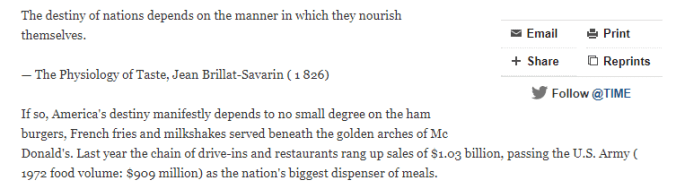
The next few paragraphs recite the key stats about McDonald’s business, most of which have obviously changed since then. It’s notable that the whole idea of mega corporations seemed much newer, as the numbers that seem sensational and the reach of McDonald’s seems more novel. The article talks about their sign reading “12 Billion Hamburgers sold”, I remember a kid noting that they’d stopped tracking around 99 billion.
Page 1 Rating: Holds up, if no longer novel. Stats were accurate at the time they were reported, though would be less impressive now.
The next section starts off with an interesting complaint: that customers don’t get “discretion”.
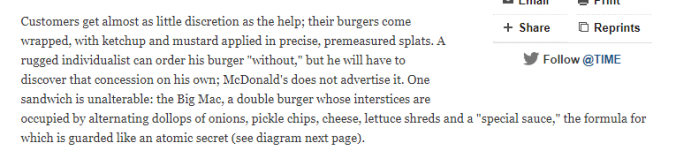
This is followed by a few paragraphs about worker standardization, high turnover, tedious conditions, and machines taking human work…pretty current complaints. They also mention “Hamburger University”, which is apparently still around.
They then drop in an interesting tidbit about the dress code:

Page 2 Rating: Mostly holds up. Fast food restaurants are so ingrained in our culture that I’m not sure I’ve heard anyone complain about the lack of menu choices in a while. You basically know what you’re getting. Worker complaints are still being made, though the dress code has apparently loosened substantially.
Page 3 kicks off with a quote from a pop sociologist about McDonald’s, claiming that it shows America is all about blandness and sterilization, and that we’re too responsive to advertising. Then comes this paragraph, which I found fascinating:

Scurvy? You can eat it without teeth? That’s a fresh take. Of course this article was prior to the obesity crisis, so they “these seem like a bad idea nutritionally” folks didn’t have much to go on.
The architectural blight charge was also interesting, and not one I’d heard before. The rest of the page talks about about the appeal of McDonald’s (you know what you’re getting, food comes fast) and the cheap price. You know, pretty much all the things people still like about it today.
There is an interesting tidbit about how McDonald’s responded to inflation rampant in the early 70s (raised prices less than others) and the trivia that McDonald’s makes its money on the fries.
Page 3 Rating: Mixed. The nutrition complaints are wrong in details, but their spirit is now widely accepted as true. The architecture concern seems to have passed, the positives are pretty much the same.
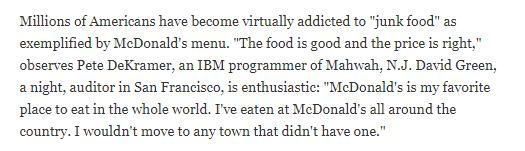
Page 4 kicks off with an amusing quote that I somehow doubt many people would say today:

In 2019, it’s both hard to imagine someone feeling this way AND finding many towns without a McDonald’s. I checked out some brand loyalty ratings, and 5 Guys is the only burger place that ranks nationally. Its interesting that while McDonald’s didn’t retain its brand loyalty, it helped change the culture enough that it and places like it still have a home.
Page 4 Rating: An interesting snapshot of the history. Those of us who grew up with these corporations already in place can’t always conceptualize that these places were once the “new thing”.
The end of page 4 and beginning of page 5 cover Ray Kroc, and his now famous issues with the McDonald’s brothers, though it doesn’t dwell on them much before moving on. They highlight his foresight in serving the suburbs (other fast food places focused on cities) and his subsequent marketing directly to children. This ranges from the obvious (Ronald McDonald as a mascot) to the less obvious (leaving napkins and straws out on the counter so children could get them).
Of course this marketing innovation has caused most of their problems for the last few decades, as more people have blamed them for increasing youth obesity and violating bans against advertising to minors.
Page 5 Rating: A little cringe-worthy.
The next section wraps up the kids marketing and then moves in to some standards that seem almost quaint in retrospect. They talk about how Ray Kroc demanded everything be clean, and used to inspect stores to make sure they were as clean as possible. While most McDonald’s I’ve been in aren’t horrible, I think the idea that they’re supposed to scrape gum off the walkways out front has gone by the wayside. McDonald’s as a paragon of high standards is an odd thought.
Page 6 Rating: Quite the throwback
Page 7 is interesting, as it talks substantially about McDonald’s dedication to charity work and the terms of their licensing agreements. While it appears the franchisee deal is still largely the same (though with a lower percentage of the profits going to corporate headquarters), it doesn’t appear the requirement to do charity work has kept up. In fact the recent controversies with McDonald’s have seemed to center around how much charity work they actually do. I couldn’t find many hard numbers about the franchisee charity work, so I’m a little mixed on this.
Page 7 Rating: Not enough data
Page 8 has some more interesting data about what it took to open a McDonald’s franchise. I was interested to find out that anyone who put up more than half the money for a franchise was actually required to work there. There’s an interesting anecdote about a former cop named Lee Dunham who opened a McDonald’s in Harlem and took on the local gangs to keep the store running. Apparently he ended up giving a bunch of gang members jobs. I Googled him and found a glowing obituary from 2011, praising his work with the community, much of which started with his McDonald’s stores.
Page 8 Rating: Glad to see this one turned out well.
Page 9 has some interesting commentary about McDonald’s expansion, particularly in to Europe. I loved this paragraph:

I’d shake my head at that, but I’m pretty sure I actually went to the McDonald’s on the Champs-Elysees. It has a marble sculpture in the middle, as one does. I also took refuge in one in Bucharest Romania after a particularly harrowing overnight ride on the train.
It continues to talk about Kroc’s aggressive plans for expansion, wondering if he can keep it up with new competitors on the horizon. Page 10 concludes with a final moment from Kroc, saying that every day was a new Broadway show.
Page 9 and 10 Rating: Good. McDonald’s expansion continued in this country until 2015, the first year in its history it closed more stores than it opened.
Overall impressions: Overall the article didn’t fair too badly, though it’s interesting to see how our norms have changed since it was written. Large multinational corporations are a standard (if not always well loved) part of our society now, and while McDonald’s survives it no longer inspires much brand loyalty in the US. However, it is still one of the most recognized brands in the world, and allegedly the golden M is more recognized than the cross.
Within the overall correctness though, it’s interesting to note that not everything has held up. Scurvy is not the big nutritional concern, workers are not really known for being the most well trained. Many previously novel things like cleanliness regressed to the mean.
Of course there’s an interesting bias in reading an article like this at all….we’re interested in articles like this solely because the growth continued and the business survived. If Time had run an article on another juggernaut that fizzled, I wouldn’t be looking it up.
One way or another, its interesting to see how people a few decades ago saw things, and to think about how our thinking may change 50 years from now about things we think today. What will fall by the wayside, what will normalize and what will prove true are always interesting questions.
On that note, I’m going to go get a hamburger.




 graph paper diaries