The AVI put up a post last week about the Extreme Male Brain Theory of Autism that had some interesting commentary about the differences between the sexes on tests measuring tendencies towards empathizing (female linked) and systematizing (male linked). Skipping over the relationship to autism theories, I was particularly interested in one part of his post and it end up sending me down a bit of a rabbit hole looking up information on it:
How would Empathising and Systematising be opposite ends of a spectrum? I don’t think they are. I think two separate things are being measured that both sexes have in different proportions. To take the hormonal stereotype, I don’t think that testosterone and estrogen are “opposite” chemicals. I think they are different chemicals. I don’t think the data shows that one extra bit of empathy means a complementary drop in systematising.
I liked this part because I have been rather fascinated by people I encounter who appear to have neither of these traits, and I wondered how common that was. So I went digging, and it turns out there’s actually quite a bit of research around the whole thing I thought was interesting. Because he will read this, I will note that none of this is a particular commentary on what AVI wrote in his original post, nor should it be taken as a criticism of anything he said. His comments just sent my thoughts off in a different direction from what he was focused on, so I wrote my own post rather than continue to respond to his. That’s a major plus side of keeping up your own site IMHO. Anyway, let’s kick it off with some clarifications and some background!
The empathizing and systematizing idea was first investigated by Simon Baron-Cohen as part of his work on autism. It was developed a lot by various researchers over the years, but the original intent was really to see if people with autism were deficient in empathy in some way and if that could help classify the disorder. Typically empathizing and systematizing are measured by giving two different tests, one for each, and then assigning you an “EQ” score and an “SQ” score. For a lot of Cohen-Baron’s work he then subtracts one from the other to figure out your gap between the two.
Now before we go on, I want to point out when talking about empathizing and systemizing type tendencies, it’s really easy to start swapping those words out for the shorter and more familiar “feelings” and “logic”. Those are close to what we’re talking about what we say empathizing and systematizing, but not actually the same thing.
In the article AVI linked to where Simon Baron-Cohen wrote about his research, he described empathizing as “Empathy is the drive to recognise another person’s state of mind and to respond to another person’s state of mind with an appropriate emotion.” While this relates to feelings, it is not the same thing as having a lot of feelings yourself. In fact, when used appropriately, it can actually help you manage your own feelings.
Imagine a circumstance in which you find out a friend or family member was up all night with a sick child, and that person now snaps at you over something minor. The vast majority of people will probably let that go or choose to deal with it at some other time. “In their shoes, I would also be short tempered” we think, and we move on with our day. In that case, empathy reduced the number of our own feelings we had to deal with. If you’ve ever dealt with a person who had no ability to do this, you probably would end up annoyed at that person pretty quickly. “Good grief man, the poor guys been up all night, could you really not let that one comment go? You had to get in to it right now? Really?” Lack of empathy can absolutely stir up a lot of feelings. None of this is to say that empathy always causes you to make the right call or can’t be taken to far, just that it is a somewhat different concept from that of having “feelings”. Everyone has feelings, and people vary in their emotional regulation. All of that is different from empathy, which is how you understand and respond to other people’s states of mind.
Conversely, systematizing is also not the same as “logic”. Per the same article as above “Systemising is the drive to analyse or build a system where a system is defined as anything that follows rules or patterns.” Again, that might be close to logic, but not identical. As anyone who has ever dealt with bureaucracy knows, just because you have a system doesn’t mean you have logic. A system that doesn’t bend with reality or is impenetrable to others may follow an internal logic, but may not get you very far if you have to interact with anyone outside your own head.
All that may sound like I’m saying empathy is better than systematizing, which is not my intention. I did want to provide a slight bit of balance to the feelings/logic shorthand, which unfortunately can unintentionally do the opposite at times, if one assumes that logic is a moral good. However, this does lead in to another distinction I was surprised to learn: good empathizing scores are more common in everyone than good systematizing scores. This gets confused easily because of a misreading of what Cohen-Baron says in his write up “The first theory, known as the empathising-systemising theory of typical sex differences, posits that, on average, females will score higher on tests of empathy than males, and that, on average, males will score higher on tests of systemising than females.” This has led many people to say that men are higher in systematizing than empathizing, but that’s actually not the case. Here’s the data from the first paper on this. The paper’s in Japanese, but the numbers are still understandable:
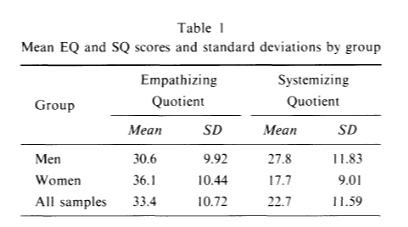
As you can see, women are higher than men in empathizing but men are higher in empathizing than systematizing. Men are also higher than women in systematizing, meaning women have a bigger gap between the two. But again, people as a group are higher in empathizing traits than systematizing traits. I checked out a few different papers and this is a pretty consistent finding. It might be a measurement tool artifact, but it turns out however you measure it, men score better on empathy than systematizing. So it is not strictly true to say that men have a systematizing brain and women have an empathizing brain, we really all have an empathizing brain but some people have that balanced with systematizing and some not so much.
I pondered this for a bit and went down a side road about how they were measuring this, but I came away suspecting this is measuring something real. While systematizing is an incredibly useful skill, any group of animals that lives together has to learn how to work as a group. Learning to respond to others mental states is a big part of that. Many men might say they are not great at reading others emotional states, but all the best business men who have ever lived are actually fantastic at figuring out how others are feeling and what to do about it. Ditto for any man working under a boss/superior officer/etc or pursuing a woman they really want. An inability to figure out how to work in those circumstances is actually a pretty good sign that you have a real deficit here.
Which brings me to what I was really curious about: how many people really score very low in one or both of these categories? Baron-Cohen’s traditional research doesn’t actually tell us, since he normally just merges the two metrics in to one by subtracting one from the other and getting the gap, but thankfully for me someone else decided to looked at just that. In the paper “Measuring Empathizing and Systemizing with a Large US Sample” some researchers decided to measure a couple thousand people for empathizing and systematizing and slice up the data a few different ways. When I read through the paper I was very excited to see that all the same questions that had occurred to me were the ones they were going after, including what this this data really looked like when you drilled down in to it. That led them to go beyond the traditional “extreme S/extreme E” framing and to try to map people on to this graph:

Now this looks exactly what I’ve been trying to figure out. So where did people fall?

Well as you can see, just about half of people of both genders are actually moderate at both empathizing and systematizing. The population I was initially curious about, those low in both, are unusual but not unheard of…a little over 2% of women and just under 4% of men. People who are high in both are about 5% of each gender. There actually weren’t a lot of huge discrepancies on the diagonals here, where you see big differences is in things like the High S/Medium E combo (3 times more common in men than women) and the Medium S/High E combo (around 4 times more common in women than men). We see similar discrepancies with the Medium S/Low E category and the Medium E/Low S category.
So overall, we see that for a majority of the population these two traits move in tandem. However, when they get discordant, they tend to skew in a predictable way for your gender. This is summarized by a different table in the paper, based on a slightly different way of calculating things, the one Baron-Cohen used originally:
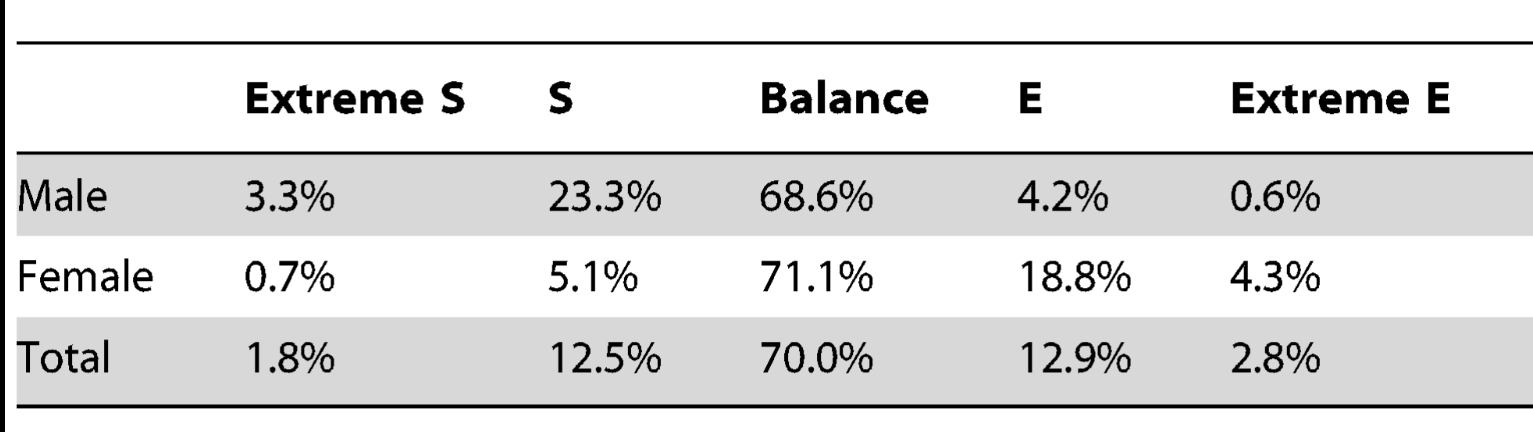
Here, “extreme” comes from having a large gap between EQ and SQ, it does not necessarily mean that one was the highest in E or S overall. As we saw in the data above, there are a good chunk of Medium S/low E men and Medium E/low S women. Having a gap does not connote hyper competence in either trait. There were also High S/Medium E men and High E/Medium S women, so the gap also doesn’t necessarily mean a deficiency either.
Similarly, “balance” here could mean those people were equally poor on both, or high on both….they just had to be equal. Interestingly, this was part of why the paper authors wanted to go through and break out the scores further. The original idea of taking two different measures and subtracting one from the other to create one measure was designed by Baron-Cohen to try to sus out an “empathy gap” to figure out if that was related autism. For that purpose it was an interesting idea. But for your every day person, it collapsed several extremely different categories of people in to one big group of “balanced” people that covers 70% of the population. Given that those people represent the large majority of the population and likely have radically different experiences of life, this is a questionable choice.
It also appears to have left people with the impression that empathizing and systematizing are more closely related traits than they really are. By choosing to highlight the 30% of cases where they are discordant you can give the impression that there’s some sort of trade off between these two traits. But that’s not the typical experience at all, at least according to this data. The typical experience is that you will be either low, medium or high in both. Based on your gender, you will then see 25ish% of your group be more extreme on one trait than the other, with 5% going in the other direction.
To put this in probability of superiority terms, if you pick a random male and female out of the population and make them take these tests, the authors say the female would have the higher empathizing score about 67% of the time. Males would have the higher systematizing score about 62% of the time. For comparison, if you did the same experiment with human height, men would be taller 92% of the time. So again, to call this a definitive “male brain” vs “female brain” trait you are looking at something about a third less compelling than human height. So overall, there’s evidence of a sex linkage here, but it’s good to keep in mind exactly what that looks like in practice.
Overall, this was a fun little side road to go down. I continue to be rather fascinated by people who appear to have neither empathy nor systematizing tendencies and think we need more research on how these people end up navigating the world. Are they more or less happy than the rest of us? Do they end up with some other trait they are compensating with? Do they have personality disorders? How about on the other end….is being really high on both of these an advantage? Or are these traits unconnected to life success at all?
Many questions here, I’ll keep poking around.
 graph paper diaries