In honor of Halloween, and crazy creative people:
If your curious about the making of this, here’s the blog.
In honor of Halloween, and crazy creative people:
With the hurricane and all, this week got weird in a hurry. My darling husband is stuck in Chicago, so I chose to ride out the storm at a hotel with my in laws. Turns out this is the hotel the electric company puts it’s on call employees in, so I’m thinking we’re keeping power.
Anyway, with all the record setting weather, I thought this post from statschat was particularly interesting.
Essentially, it backs up my previous gripes that people don’t often accurately report what they spend their time on. They included this graph from the Washington Post:

The Washington Post article that provided the graph says that people who claim to work long hours are “lying”, but it’s more complicated than that. Presumably these are people who ‘typically’ work long hours but reasonably often have to leave work ‘early’ to handle some part of the rest of their lives. Conversely, the people at the low end of the distribution may have a regular part-time job that provides their ‘usual’ hours of work, but fairly often have over-time or additional jobs so that the average week has more work than a ‘usual’ week. They aren’t lying, they just aren’t answering the question you thought you wanted to ask.
The concept of people answering what they think you’re asking or responding to different wording with different answers is something all survey makers should keep in mind.
Anyway, I’m sure for all my east coast readers, this will not be a “typical” week….no exaggeration needed. Stay safe everyone!
The AVI left me an interesting link on my last post on famous social psychology studies that have not been replicated. It’s good reading….they include the famous study that found that teacher’s expectations being self fulfilling (ie kids achievement went up or down based on how smart the teacher thought they were). That was interesting to me, as I’ve heard that study quoted many times, and never heard that larger studies had failed to replicate it.
Anyway, as I was reading that article, a headline for another article floated across the top of the screen “Sleeping more than 7 hours or less than 5 1/2 hours has been found to decrease longevity”.
No.
No.
No.
I don’t even have to read the article to tell you no study found any such thing.
The only way you could actually prove that is to randomize three groups, force one to sleep more than 7 hours, one to sleep between 7 and 5.5 hours, and one less than 5.5 hours per night (for the rest of their lives) and then see how long they lived. No one did that. We know no one did this.
Sure enough I clicked on the article and found that people who reported getting more than 7 hours of sleep/night were 12% more likely to do within 6 years than those who got slightly less (again, with the raw numbers the 12% increase might not be that impressive….how many otherwise healthy people died in the 6 year time period to begin with?). So there is a correlation, but no one proved what caused it. The most obvious caveat is that people who are sick might sleep more.
Why oh why do people still write headlines like this? I can see it when it’s on the front page of Yahoo.com or something, but shouldn’t Psychology Today have slightly higher standards?
Sigh.
Four posts in two days? This is what happens when the little one starts sleeping in 7 hour stretches.
Anyway, this one was too good to pass up….a statistical breakdown of various aspects of Lord of the Rings.
The more I think about the study I commented on yesterday, the more irritated I am they didn’t include a control group (either women over 50 or women on hormonal birth control) to give some context to their claims.
I was feeling a bit ranty in my last post about the women/hormones study, but I decided it needs a slightly more academic treatment. Despite CNN yanking the story, I managed to find the original study and read the whole thing.
A few points:
After living in New Hampshire for my entire upbringing, moving to Massachusetts when I was 18 was a bit of a surprise. Why you ask? Because my goodness are election years more peaceful here.
For those readers who aren’t from New England, New Hampshire residents are some of the most harassed people in the nation when it comes to presidential elections. Between the first in the nation primary and swing state status, the amount of effort people put in to trying to find out what New Hampshirites are going to do on election day is staggering. Massachusetts on the other hand is reliably blue, so everyone pretty much leaves us alone (Exception: the Scott Brown/Elizabeth Warren face off is really harshing my mellow this year).
Anyway, as a woman who both strongly believes it’s her civic duty to vote and who puts a lot of thought in to her vote every 4 years, I was a bit surprised to see a story on CNN yesterday about how women voted with their hormones. The link actually goes to Jezebel there because the “science” was so bad that CNN actually took the story down.
Essentially, the research claimed that during “that time of the month” women felt sexier. This led single women to want more social services (because they apparently were worried they wouldn’t be able to help but get pregnant with a random partner). Married women on the other hand apparently overcompensated and wanted to vote Republican because they….I don’t know. I really couldn’t follow the convoluted reasoning of how feeling sexy or not influenced your vote.
To note, this was an internet survey done by a marketing research person. It also apparently found that women’s level of religiousness varied based on monthly cycle.
The sheer weirdness of saying political party and religious affiliation, two of the deepest and most profound beliefs people have, is based on a few fluctuating hormones (of course only in women….I mean, have you ever heard of testosterone influencing men? I don’t think so) is just so reductionist it’s bizarre.
It also of course leaves out post menopausal women, women who are on hormone regulating birth control, and ignores better research that shows women in committed relationships are already more likely to be conservative. Oh, and it totally leaves out anyone voting for a third party candidate.
I bring this up not just because it was a bad story and because it actually got taken down, but also because it’s part of a larger phenomena of journalists inflating the effect of small differences to write a better story. I am really stunned how many times in the past week I’ve seen stories about “why Obama/Romney isn’t getting as much support as he should”. The author then goes on to talk about some line of reasoning that supposedly explains why their candidate would be creaming the other guy if it weren’t for the influence of the small factor that they and only they are acknowledging.
News flash to the media: most people not voting for your candidate are voting the way they are because they don’t agree with him, or your party, or because they like the other candidate or party better. Stop belittling large portions of the population while trying to prove otherwise.
*Gets off soapbox*
Thank you for your time.
Yesterday a facebook friend of mine put up an angry post regarding misuse of the word “decimate”. His chief complaint was that people used it as a synonym for destroy, when really it meant a reduction of 10% or so. That cleared up the “deci” part of the word for me, but I was surprised that the proper definition was so narrow….so of course I went to dictionary.com to check his facts.
Turns out the “one in ten” definition is specifically marked as obsolete. The current accepted definition is merely “to destroy a great number of”. So basically it can’t be used to sub in for obliterate, but the 10% definition was only valid through the year 1600 or so. Sigh.
I’m not a big fan of people who try to get too cute when picking on the language of others. While I certainly am irritated by some of the more obvious errors in language (irregardless makes me cringe, and please don’t mix up “less” and “fewer” in my presence), I dislike when people go back several hundred verbal years and then attempt to claim that’s the “proper” way of doing things. This annoys me enough that my brother bought me this book a few years ago, just to help me out. I believe language will always be morphing to a certain extent, and while rules are good we just need to accept that all language is pretty much arbitrary. Thus, I refer to myself as a linguistic pragmatist. Adhere to the rules, but accept that sometimes society just moves on.
Why am I bringing this up? Well, after going through that internal rant, I found it very interesting that this study is being reported with the headline “Popular kids who tortured you in high school are now rich“.
Basically, researchers assessed how popular kids were in high school, based on how many people gave you “friendship nominations” and found that those in the top 20% made 10% more money 40 years later than those in the bottom 20%.
Now I think this makes a certain amount of sense. While the outcast nerd makes good story is appealing, it stands to reason that many of the least popular kids in high school might be unpopular because of real issues with social skills that hurt them later in life (to note, social skill impairment is a co-morbidity with all sorts of things that could make this worse….ADHD, depression, etc). Conversely of course, those with more friends probably have skills that help them maintain networks later. Basically, I think this study tells us that the number of friends you have in high school isn’t totally random.
My issues with the reporting/reading of this study is in the semantics. I think there’s a disconnect between our common interpretation of “popular in high school” and the actual definition of “popular in high school”. The researchers in this study weren’t assessing the kids other kids aspired to be, they were assessing the kids who actually had lots of friends and were well liked. While the classic football player who beats up kids in the locker room may get referred to as a popular kid, it’s likely he would not have had many people naming him as a friend on a survey. So basically, the study had a built in control for those kids who were temporarily at the top of the social ladder, but lacked actual getting along with people skills. I had an incredibly small high school class (<30) and I could name several kids who fell in the "perceived popular" category but not the "actually popular" category.
All this to come back to my original point. Words mean different things depending on context, and this should always be taken in to account when assessing research and reading subsequent report. It’s not bad data, just a different set of definitions.
Little known fact: I once spent a summer watching every James Bond movie ever made, in order.
Thus, I enjoyed this chart from the Economist about the differences between the Bonds.

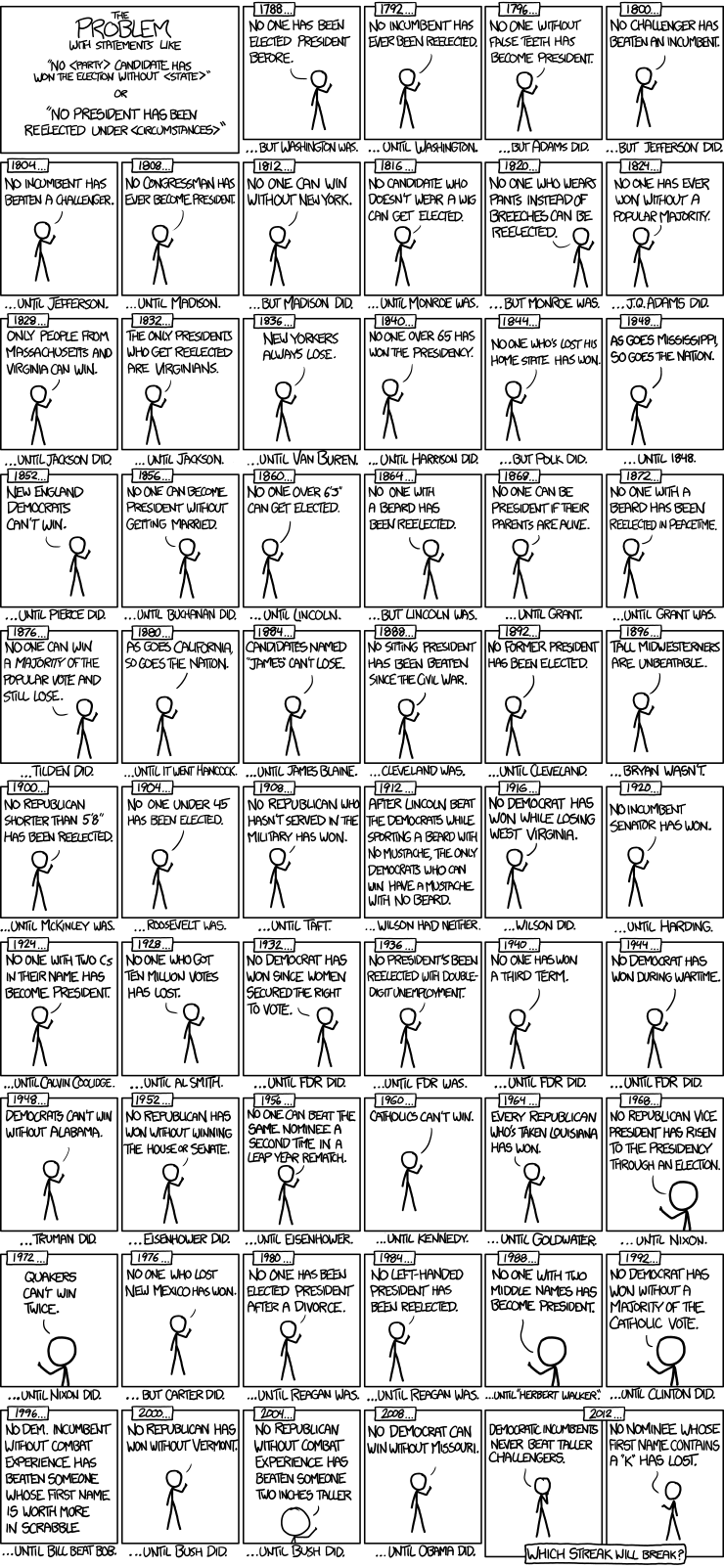
XKCD hits the nail on the head yet again with a great commentary on election year “no one has ever _____ and won the White House” musings.
These drive me nuts because obviously we have an incredibly small sample size. Our country may have been around for quite some time now, but we’ve only had 44 presidents. Think about how few people that really is.
Additionally, states change, demographics change, and the electoral college system is ridiculous. This gives rise to all sorts of statistical “anomalies” that really are quite probable when you think of how few events we’re looking at.
The sports world does this too, baseball probably more than the rest of them. While watching the post season this year with my long suffering Oriole’s fan husband, we got quite a kick out of pointing out how specific some of the stats they brought up were. “He’s 1 for 3 when facing Sabathia during the post season over the last 3 years”. Four at bats over a whole career and we’re supposed to draw some sort of conclusion from this? Sigh.
Anyway, here’s the comic. Happy Thursday.
 graph paper diaries