You Are Number Six

Happy almost Thanksgiving everyone! I hope your travels are safe, your turkey is well done, and that your refrigerator doesn’t die with all of your Thanksgiving meal contributions in it like mine did yesterday.

If the thought of me cleaning a Popsicle sludge flood off my floor doesn’t cheer you, perhaps this will:

At a recent family party, an older relative asked my son how old he was. My son, currently 4, looked at her and said “I am NOT a number!”

My husband is convinced he’s quoting the Prisoner, which is a pretty advanced pop culture reference for a 4 year old IMHO, even if there is an Iron Maiden song that uses the clip. I personally think he’s either lashing out at me or following in my footsteps. One of the two.

Regardless, that kid has a way with words. Happy Thanksgiving!

And for those of you getting shown up on your pop culture knowledge by someone born in 2012, here you go:

Voter Turnout vs Closeness of Race

I’ve seen a lot of talk about the Electoral College this past week, and discussion about whether or not the system is fair. I’m not particularly going to wade in to this one, but I did get curious if the closeness of the presidential race in a state influenced voter turnout overall. Under the current system, it would stand to reason that voters in states that have large gaps between the two parties (and thus know ahead of time which way their state is going to go) would be less motivated to vote than those living in states with close races. While other races are typically happening in most states that could drive voter turnout, we know that elections held during the presidential election have better turnout than midterm elections by a significant margin. The idea that being able to cast a vote for the president is a big driver of turnout seems pretty solid.

What I wanted to know is if the belief that you’re going to count a potentially “meaningful” vote in an election an even further driver of turnout. With all the commentary about the popular vote vs electoral college and with some petitioning to retroactively change the way we count the votes, it seemed relevant to know if the system we went in to voting day with had a noticeable impact on who voted.

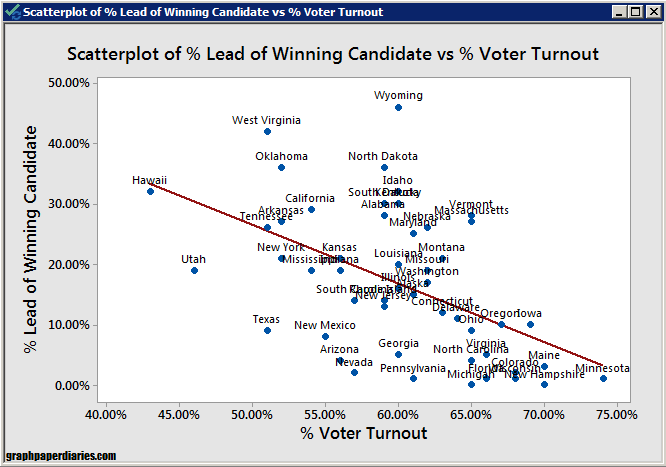
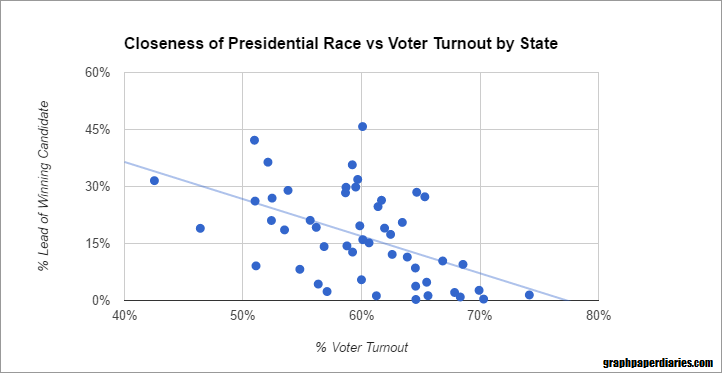
While not all the numbers are final yet, I found voter turnout by state here, and the state results here.  I took the percent of the vote of the winning candidate and subtracted the percent of the vote of the second place candidate to get the % lead number, and plotted that against the voter turnout. Here’s the graph:

votingdiff

The r-squared is about 26.5% for an r of .5.  I didn’t take in to account any other races on the ballot, but I think it’s safe to at least theorize that believing your state is a lock in one direction or the other influences voter turnout. Obviously this provides no comment on how other systems would change things from here, only how people behave under the system we have today.

For those curious, here’s an uglier version of the same graph with state names:

votediffstatenames

It’s interesting to note that the Utah vote got split by McMullin, so the percent lead there is a bit skewed.

A few other fun facts:

  • The average turnout in states where the presidential race was close (<5% between the winning candidate and second place) was 65% vs 58% for all other states. A quick ANOVA tells me this is a statistically significant difference.
  • Once the gap between the winner and second place gets over 10%, things even out. States with a gap of 10-20% have about 58% voter turnout, and those with an over 20% gap have about a 57% voter turnout. Some of this may be even out as states with large gaps also likely take their time with counting their votes.
  • My state (Massachusetts) is one of the weird lopsided but high turnout states, and we had some really contentious ballot questions: charter schools expansion and recreational marijuana.

Again, none of this speaks to whether or not the process we have is a good one, but it’s important to remember that the rules in play at the time people make a decision tend to influence that decision.

I’ll update the post if these margins change significantly as more votes are counted.

3 More Examples of Self Reporting Bias

Right after I put up my self reporting bias post last week, I saw a few more examples that were too good not to share. Some came from commenters, some were random stories I came across, but all of them could have made the original list. Here you go:

  1. Luxury good ratings Commenter Uncle Bill brought this one up in the comments section on the last post, and I liked it. The sunk cost fallacy  says that we have a hard time abandoning money we’ve already spent, and this kicks in when we have to say how satisfied we are with our luxury goods. No one wants to admit a $90,000 vehicle actually kind of sucks, so it can be hard to figure out if the self reported reliability ratings reflect reality or a desired reality.
  2. Study time Right after I put my last self reporting bias post up, this study came across my Twitter feed. It was a study looking in to “time spent on homework” vs grades, and initially it found that there was no correlation between the two. However, the researchers had given the college students involved pens that actually tracked what they were doing so they double checked the students reports. With the pen-measured data, there actually was a correlation between time on homework and performance in the class. It turned out that many of the low performing kids wildly overestimated how much time they were actually spending on their homework, much more so than the high performing kids. This bias is quite possibly completely unintentional….kids who were having a tough time with the material probably felt like they were spending more time than they were.
  3. Voter preference I mentioned voter preference in my Forest Gump Fallacy post, and I wanted to specifically call out Independent voters here. Despite the name and the large number of those who self identify as such, when you look at voting patterns many independent voters are actually what they call “closet partisans”. Apparently someone who identifies as Independent but has a history of voting Democrat is actually less likely to ever vote GOP than someone who identifies as a “weak Democrat”.  So Independent is a tricky group of Republicans who don’t want to say they’re Republicans, Democrats who don’t want to say they’re Democrats, 3rd party voters, voters who don’t care, and voters who truly have no party affiliation. I’m sure I left someone out, but you can see where it gets messy. This actually also effects how we view Republicans and Democrats, as those groups are normally polled based on self identification. By removing the Independents, it can make one or both parties look like their views are changing, even if the only change is who checked the box on the form.

If you see any more good ones, feel free to send them my way!

5 Things About the Doomsday Algorithm

I mentioned last week that I’m currently reading a biography of John Conway, and I came across something interesting during the discussion of his version of the Doomsday Algorithm. Otherwise known as the “perpetual calendar” problem, it’s a method for mentally calculating what day of the week any given date fell on. Conway was so obsessed with this problem and improving his time for the mental math that he had his computer set up to make him solve ten of these before he got in. Supposedly his record was 10 dates in 15 seconds. #lifegoals. Anyway, this whole discussion got me poking around about this mental math trick, and I wanted to share a few things that I found:

  1. Lewis Carroll published on this problem Yeah, the guy who wrote Alice in Wonderland also came up with a perpetual calendar algorithm, and it was published in Nature in 1887.
  2. By “Doomsday” we mean “anchor day” John Conway has an excellent flare for the dramatic, and the title of this algorithm proves it. However, it’s a misleading title for what’s really going on. Basically, Conway realized that a whole bunch of easy to remember days (4/4, 6/6, 8/8, 10/10 and 12/12) all fall on the same day of the week in any given year. If you can figure out what day that was, you get an “anchor day” in those months. From there, he realized that 5/9, 9/5, 7/11 and 11/7 all fall on the same day as well, so you now have one known date in each month. As you can see, this simplifies further calculations considerably.
  3. Do you bite your thumb at us sir? Conway does. One of his tricks for remembering his full trick is to use his fingers as prompts and bite his thumb to remember the number he got there. This link also has some very helpful videos of Conway explaining his method.
  4. Others have improved on the method The gamesmanship of this method has been inspiring to a lot of mathy folks, and some of them continue to try to find simpler/better/faster ways for people to calculate the day of the week. This method looks like the current favorite for simplicity, and is the one I think I’m going to start with.
  5. Don’t try to calculate anything from 1752 At least if you’re in the US or England, this is a trap. September 2nd-Sept 14th of that year don’t exist. Now there’s a trivia question for you.


The Cynical Cartoonist Correlation Factor

I love a good creative metric:

dilbertplan

From the book “Results Without Authority” by Tom Kendrick.

In case you’re curious, this hangs on the wall behind my desk at work:

Happy Friday everyone!

What I’m Reading: October 2016

My stats book for the month is “Statistics Done Wrong“, which honestly I haven’t actually started yet. I got sidetracked in part by a different math related book “Genius at Play: the Curious Mind of John Horton Conway”  He’s a pretty amazing (still living!) mathematician, and the book about him is pretty entertaining. If you’ve never seen a simulation of his most famous invention  “Game of Life”, check it out here. Deceptively simple yet endlessly fascinating.

Moving on, this Atlantic article about why for profit education fails was really interesting. Key point: education does best when it’s targeted to local conditions, which means it actually becomes less efficient when you scale it up.

This list of the “7 deadly sins of research” was also delightful. It specifically mentions basic math errors, which is good, because those are happening a really concerning amount of the time.

Related to deadly sins, Andrew Gelman gives his history of the replication crisis.

Related to the replication crisis, holy hell China, get it together.

More replication/data error issues, but this time with a legal angle. Crossfit apparently is suing a researcher and journal who 1. worked for a competitor 2. published data that made Crossfit look bad that they later clarified was incorrect 3. had evidence that the journal/reviewers implied that they wouldn’t publish the paper unless it made Crossfit look bad. The judge has only ruled that this can proceed to trial, but it’s an interesting case to watch.

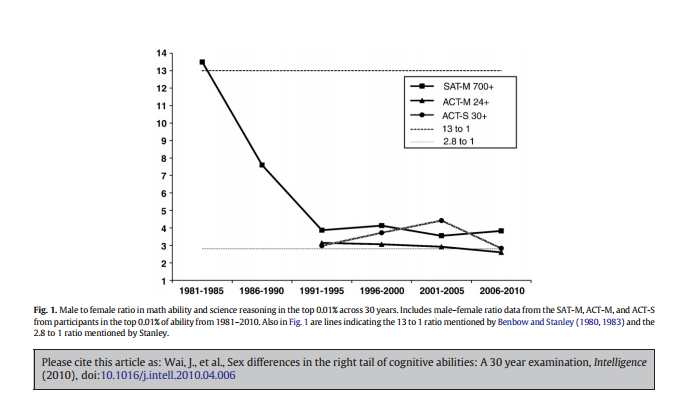
This paper on gender differences in math scores among highly gifted students was pretty interesting. It takes a look at the gender ratios for different SAT (and ACT) scores over the years (for 7th graders in the Duke Gifted and Talented program) and the trends are interesting. For the highest scorers in math (>700), it went from extremely male dominated (13:1 in 1981) to “just” very male dominated (4:1 by 1991) and then just stayed there. Seriously, that ratio hasn’t gone lower than 3.55 to 1 in the 25 years since. Here’s the graph:

mathbygender

In case you’re curious, top verbal scores are closer to 1:1. Curious what the recruitment practices are for the Duke program.

Also, some old data about Lyme Disease resurfaces, and apparently there may be a second cause? An interesting look at the “Swiss Agent” and why it got ignored.


Vanity Sizing: The Visual Edition

I’m swamped with homework this week, but after my post about vanity sizing a few weeks ago, I thought this picture might amuse a few people: fullsizerender-1

The white-ish sparkly dress on the top is one my grandmother gave me when I was a little kid to play “princess dress up” in (it was a floor length gown when I was 5!). Someone set it aside for me after she died, and I found it this week while sorting through some boxes. I checked the tag out, and it’s marked as a size 14. The dress below it is a bridesmaids dress I wore about 6 years ago at my brothers wedding….also marked a size 14. I don’t know how long my grandmother had the top dress when she gave it to me in the 80s, but my guess is it’s from the late 70s.  That’s 4 decades of size inflation right there folks.

If it followed this chart at all, the top dress would be a size 4 by today’s standards. The bottom dress would have been a size 20 in the late 70s.

My own vanity now compels me to mention that I don’t actually fit in the 2010 size 14 any more, I’m a 1987 size 14 thank-you-very-much.

A Quick Warning About Biotin Supplements (aka Numbers Still Aren’t Magic)

Now that I have my new shiny “Numbers Aren’t Magic” tag, I thought I’d use it for a bit of a PSA. I’m on a lot of laboratory testing related email lists for work, and I recently got a notification from the College of American Pathologists with a rather intriguing headline “Beauty Fad’s Ugly Downside: Test Interference“.

The story was about biotin (also called Vitamin H) a supplement widely touted as a beauty aid because it (allegedly) makes your hair and nails look better (example here). Unfortunately, it turns out that quite a few widely used immunoassays actually use biotin  to capture their target antibodies during testing, and unusually high levels in the blood interfere with this. In other words, high doses of biotin in your supplement could interfere with your lab results. Uh oh.

The news of this first broke in January, when it was discovered that some patients were getting bad thyroid test results that had resulted in an incorrect diagnosis of Graves’ disease. Since then, the awareness among endocrinologists has grown, but there’s concern that other potentially affected tests are being missed. Apparently cardiac markers, HIV and HCV tests could also be affected.

The problem here is really megadoses. These assays were designed to work with normal blood levels of biotin. The recommended daily amount is only 30 micrograms, but supplements like the one I linked to above actually give doses of 5000 micrograms….166 times higher, and in to the range of test interference. You only have to stop taking it for a day or two before the interference issues go away, but most people and doctors don’t know this.

I’m bringing this up for two reasons:

  1. I didn’t know it, and I think more people should be aware of this.
  2. It’s a good reminder that almost every number ever generated is based on a certain set of assumptions that you may or may not be aware of.

Numbers don’t often spring out of the head of Zeus fully formed, they are almost always assessed and gathered in ways that have vulnerabilities. For anyone attempting to make sense of those numbers, recognizing vulnerabilities is critical. If even lab tests (some of the most highly regulated medical products we have) can have issues like this, imagine what numbers with less stringent requirements could fall prey to.

PS: I couldn’t find biotin on the Information is Beautiful Supplement Visualization, but here’s the link anyway because it’s still pretty cool.

On Clothing Sizes (aka Numbers Aren’t Magic)

Last week I wrote a post that was sort of about denominators and sort of about abortion. At the end of that post I touched briefly on the limits of data, what the data will never tell us, and how often people attempt to use data to bolster beliefs they already have. That’s been a bit of a running theme on this blog, and it’s something I think about a lot. People seem to give numbers almost a magical power at times, and I’m not entirely sure why. It seems to get down to the  idea that numbers and statistics are objective information and that as long as their on your side, you can’t be too wrong. Now, I really wish this sort of confidence was well founded, but quite frankly anyone who’s spent any time with numbers knows that they’re a little too easily influenced to be trusted without some investigation.

I was thinking about that this week when I got in a discussion with a coworker about one of the worst examples of “numbers are magic when they tell me what I want to hear”: vanity sizing.

For those of you not aware of this phenomena, vanity sizing is when clothing manufacturers increase the size of their clothes, but keep the number of the smaller size on it.  The theory is that people like to say/believe they are a certain size, so they will gravitate towards brands that allow them to stay in that size even as they gain weight.

This is not a small problem. The Washington Post ran an article on this last year that showed the trend with women’s clothes:

Keep that in mind next time someone tells you Marilyn Monroe was a size 12.

While individual clothing manufacturers vary, my friends and I have definitely noticed this. Most of us are in smaller sizes than we were a decade ago, despite the fact that it’s really not supposed to work like that.

Anyway, this makes discussing women’s clothing a little difficult. It was recently reported that the average American woman wears a size 16 , but which size 16 is it?  A size 16 from 2011 has a waist size 4 inches bigger than the 16 from 2001. Tim Gunn recently wrote an op-ed in which he blasted the fashion industry for not designing for anyone over a size 12, but he never mentions this trend. If you look at that chart again, you realize that any retailer accommodating a size 12 today is covering would would have been a size 16 a decade ago. Weirdly, this means the attempt to cater to vanity means the fashion industry isn’t getting credit for what they are actually doing.

And lest you think this is a women only problem men, sorry, that “36 inch” waist thing? Not at all accurate unless you’re shopping high end retail. Here’s what a “36 inch” waist can mean:

I think that’s actually worse than women’s clothes, because at least we all sort of know “Size 8” has no real definition. “36 inches” does leave one with the strong impression that you’re actually getting a specific measurement.

Anyway, I don’t really care what the fashion industry does or doesn’t get credit for, or what the sizes actually are. The broader point I’m trying to make is that we do give numbers a bit of a magical power and that we heavily gravitate towards numbers that make us feel good rather than numbers that tell us the truth.

Keep this in mind the next time someone says “the numbers are clear”.
What I’m Reading: September 2016

My book for this month was supposed to be “In Pursuit of the Unknown: 17 Equations That Changed the World“, but I actually read that a few months ago.  It was really good though….an interesting history of mathematical thought, and how some of the famous equations you here about actually influenced human development.

This article is a few years old, but it covers the role of “metascience” in helping with the replication crisis. Metascience is essentially the science of studying science, and it would push researchers to study both their topic AND how experiments about their topic could go wrong. The first suggestion is to have another lab attempt replication before you publish, so you can include possible replication issue in your actual paper right up front.

….and here’s a person actually doing metascience! Yoni Freedhoff, MD is one of my favorite writers on the topic of diet and obesity. He has  a great piece up for the Lancet on everything that’s wrong with research in those areas.

On another note entirely….for reasons I’m not even going to try to explain, I am now the proud owner of a Tumblr dedicated to rewriting famous literary quotes to include references to Pumpkin Spice Lattes. It’s called Pumpkin Spiced Literature (obviously), and it’s, um, an acquired taste.

Okay, a doctoral thesis focused on how politicians delete their Tweets is kind of awesome. And yes, Anthony Weiner gets a mention by name. Related: a model of alcoholism that takes Twitter in to account.

On the one hand, I am intrigued by this app. On the other hand, I get sad when people want to shortcut their way out of building better problem solving skills.

This Vanity Fair article about the destruction of Theranos and the downfall of Elizabeth Holmes is incredible, fascinating and a little sad. Particularly intriguing was the quote that undid her: “a chemistry is performed so that a chemical reaction occurs and generates a signal from the chemical interaction with the sample, which is translated into a result, which is then reviewed by certified laboratory personnel.” That made WSJ reporter John Carreyou sit up and say “Huh, I don’t think she knows what she’s talking about”. Seems obvious, but he apparently was the only reporter to figure that out.

Underrated political moment of last week: the New York Times wrote a story about Gary Johnson’s “What is Aleppo?” moment, then has to issue two corrections when it turns out they’re actually not entirely sure what Aleppo is either.