Deceptive charting: stop it with the firearm death category

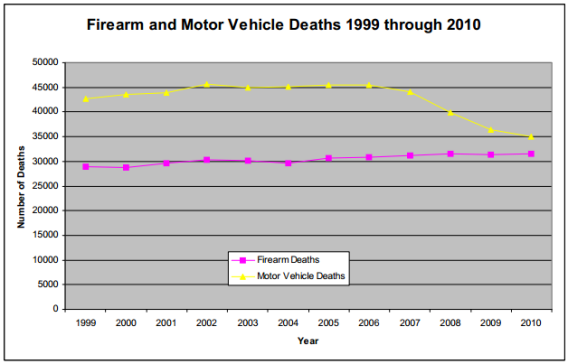
On Slate this morning there was a headline about how firearm deaths have surpassed motor vehicle deaths in 10 states.  The article cited a report by the Violence Policy Center that showed that between 1999 and 2010 there was a  decrease in motor vehicle deaths nationwide, and a slight increase in firearm related deaths.  Thus, the report and article argued, we are heading towards a day when firearm deaths surpass motor vehicle deaths.

I’ve blogged before about how deceptive I think the term “firearm deaths” is (as it lumps in police action, homicides and suicides as one group), and it turns out this is the same report that annoyed me the first time.  This time however, I was struck by the chart they included in the article:

I was curious about this chart….what would it look like if the firearm deaths were broken out in to categories? The VPC report said it used WISQARS to generate the data, so I took a look.  WISQARS actually has 5 categories for death by firearm:  homicide, suicide, unintentional, legal intervention and undetermined intent.  
Here’s what those look liked graphed out:

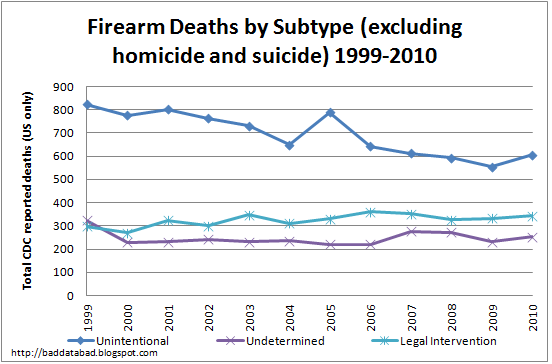
Essentially, homicides by gun have not changed in the 11 year period covered here, though they did tick up in the middle.  Suicides have gone up.  If you’re curious what the other three categories look like when they’re not all bunched up:

So unintentional fatalities are decreasing, and the other two categories appear to be fairly constant.

As a reference point, the population was 280 million in 1999, and was 309 million in 2010.

To be honest, I don’t have a strong opinion about gun control, but I do hold data integrity at a premium.  If we’re going to talk about regulating guns in order to keep people safe, you have to either include suicide prevention as one of your foremost points, or you have to start using the homicide data only.  I do not believe it is intellectually honest to quote total firearm death statistics when the national conversation is clearly focusing on homicides.

If we don’t start with the right data, how will we know if any interventions actually work?

Medical errors and reporting mechanisms

I got in to an interesting discussion today over at sciencebasedmedicine.org about medical errors and the huge variety of numbers that are out there.

It reminded me of a project I started to work on a few years ago at work, where I attempted to correlate low staffing levels to an increased error rate.

When I finished the graph, I discovered that the trend was completely in the wrong direction….low staffing levels actually appeared to be correlated with fewer errors.  When I did some fishing around, it became obvious what had happened.  The error reporting system is all self reporting by staff.  When they don’t have enough staff to cover all the work, they also don’t have time to fill out error reports, and thus many small to mid sized errors went undocumented.*  When there was more staff available, people were more compliant in their error reporting.

This is yet another risk of self reported data.

I will admit, it still amuses me that somewhere deep in my documents file, I still have a spreadsheet that suggests that the fastest way to get rid of errors would be eliminate most of the staff.  Correlation does not equal causation, and graphs are only as good as the source data.

*Hospital policy dictates that we should record “near miss” errors…..situations where nothing actually went wrong, but almost did.  The theory is that we need a record of these issues so we can address things before they actually cause a real problem.  However, if no one documents them at the time, they are nearly impossible to find later.

On Scotsman, feminists, and logical fallacies

Hope everyone had a merry Christmas….mine was most definitely lovely.  I got an iPad and a garbage can full of manure.  I’m relatively sure I’m one of only a handful of people on the planet to get that combination of gifts (and love them both!).

Anyway, I recently ran in to an interesting logical issue that I’ve been mulling over.  
I’ve done a few posts lately on benevolent sexism and some of the annoying research that tries to assess it lately, but I’d like to make it clear that I am actually a feminist.  While I find some attempts at measuring sexism a little less than intellectually rigorous, I also can’t ignore that much of my educated/working mom/non last name changing life is due to those strong women who came before me.
So it was with interest that I read this Quora interview with Gayle McDowell (republished on Slate) on “Why Do Some Women Hate Feminism?”.  
In this piece,  she talked about her view of feminism and why it inspired hatred from many people.  
Now the piece itself was good, but not groundbreaking.  What interested me was one of the comments, where someone accused her of engaging in the “no true Scotsman” fallacy.  You can read more about it at the link, but here’s the original story that coined the phrase: 

Imagine Hamish McDonald, a Scotsman, sitting down with his Glasgow Morning Herald and seeing an article about how the “Brighton Sex Maniac Strikes Again”. Hamish is shocked and declares that “No Scotsman would do such a thing”. The next day he sits down to read his Glasgow Morning Herald again; and, this time, finds an article about an Aberdeen man whose brutal actions make the Brighton sex maniac seem almost gentlemanly. This fact shows that Hamish was wrong in his opinion but is he going to admit this? Not likely. This time he says, “No true Scotsman would do such a thing”.

I thought this was an interesting accusation.  If taken seriously though, I wondered how this allows anybody to protest any characterization of any group they happen to belong to?  I mean for the moment we’re talking about feminists, but nearly every religious/ethnic/cultural group has to defend themselves from people who claim that their group is inherently violent/bigoted/crazy.

What always gets me in these claims is that people want to keep with sweeping generalities rather than even admit the data they’d need to ever make that particular claim provable.  Are feminists out to destroy men?  Well, in order to ever assess that, you’d need to figure out approximately how many women define themselves as feminists (using a population representative sample of course) and then figure out how to assess whether or not they wanted to destroy men.  This would get you in to assessing “hidden” agendas as well, as many would likely not admit it, meaning you’d have to ask tricky questions to sort through it, and likely get some false positives.  That’s a lot of work.

Anyway, I’m not a philosopher, but I’d guess the “no true Scotsman” fallacy is one that should be hurled with care.  Group identity is any area where we will almost never have data to back up our feelings, and that needs to be kept in mind.

Have yourself a curiosity driven Christmas

If that’s what you celebrate of course.

No big post today, as I’m cooking Christmas brunch, but I did want to highlight a few good Christmas gifts.

We didn’t go crazy on Christmas gifts for the little lord this year, opting instead for some books.   He’s just starting to get interested in books put in front of him (mostly to shove in his mouth) but I have a feeling by this time next year he’ll enjoy Dr Suess almost as much as I do (for my money “barbaloot suites” is one of the most fun phrases to say, possibly ever).

Also promising is the book Big Questions from Little People (and Simple Answers from Great Minds).  It’s the kind of book I loved as a kid, and in fact I’m reading it now (he doesn’t seem to mind that I borrowed it).

My favorite Christmas present I can remember was the Big Book of Amazing Facts, which I read so often the cover fell off.  Not actually sure that Amazon link goes to the right book….it seems to be a fairly common title, but the publishing date on that one seems about right.

If you want to see some more fun reminiscing about curiosity inducting gifts, see this NYT article today on “gifts that keep on giving, if not exploding“.

And most of all, happy holidays to you and yours.  Thanks for stopping by.

A very Mayan Christmas

I know we’re all supposed to stop talking about the Mayans, seeing as how the world was supposed to end on Friday and today’s Monday and all….but this link was too good to pass up.

You enter your birthday, and it tells you how many (major) apocalypse predictions you’ve lived through.
I’ve got 59 under my belt, and my husband has 60.  I kind of want an ev psych person to do a study on the stability of marriages as a function of lifetime apocalypse prediction differentials.  I’d read that paper.
Link includes gratuitous profanity.

Benevolent Sexism Part 3: Tradition?

A fiddler on the roof. Sounds crazy, no? But here, in our little village of Anatevka, you might say every one of us is a fiddler on the roof trying to scratch out a pleasant, simple tune without breaking his neck. It isn’t easy. You may ask ‘Why do we stay up there if it’s so dangerous?’ Well, we stay because Anatevka is our home. And how do we keep our balance? That I can tell you in one word: tradition!

I didn’t used to care much about tradition.  Then I got married.

I don’t know exactly what happened, but somewhere on my way down the aisle, I got totally overwhelmed by the idea that I was about to partake in a ceremony that literally billions of people had gone through for thousands of years.  According to Stephanie Coontz,  there is only one documented culture throughout all of history that did not build it’s society on marriage (can’t remember the name now….though I believe it was somewhere in Asia and formed family structure based on siblings all living in the same household).  It was the most connected I’ve ever felt to the rest of humanity (until I had my son), both to those here and the faithful departed.

Since that time, I’ve always been a little dubious of those who want to evaluate cultural tradition as though those deeper roots shouldn’t count.  In case you can’t see where I’m going with this, this happens a lot in sexism research.  Recently, a study performed at UC Santa Cruz suggested that men and women still think men should do the proposing.  The most cited reason by the participants was “a desire to adhere to gender role tradition”.

This whole thing caused some hand wringing, with my favorite Slate writer, Amanda Marcotte commenting that it is “benevolent sexism that leeches women of much of their autonomy beyond just the right to say yes or no”.

Sigh.

Alright, here’s the thing.  We’ve kept the tradition, but the whole back story?  It’s changed.  Nobody gets engaged at random anymore(okay, someone must).  People talk about this stuff first.  Women even initiate a lot of these conversations.  The tradition has stayed, but a woman’s agency to ask where the relationship is going, to discuss rationally if marriage makes sense as a next step, has developed.  This study did not ask men or women what they envisioned leading up to the proposal, just what that one moment would look like. All the articles I read about this talked about “how little had changed” in the realm of marriage when it came to equality for women.  Poppycock.

The traditions haven’t changed, but all the behavior around them has.

One of my favorite advice columnists is Dan Savage, a liberal gay male who is most notable for creating Rick Santorum’s “google problem”.

I listen to his podcast, and he routinely gets callers that say things like “I’ve been living with my boyfriend for 5 years, and now I want to get married but I can’t propose because I’m really traditional so I don’t want to bring it up” or “my boyfriend of 2 months and I are having sex problems, and I think it’s because he’s a really traditional Christian guy”.  He gets straight to the point with these people:  a traditional Christian does not have sex with someone they’ve been dating for two months.  A traditional couple does not live together for 5 years before talking about marriage.  Those things were unacceptable for most of history, and you need to come to grips with that.  People love to call themselves “traditional”, but most of them don’t like to act like it.

So give the college kids a break.  Women have an unprecedented level of say over who they marry and when, they’re just trying to keep their balance.

Saturday Fun Links 12-22-12

I was going to post this yesterday, but then I thought maybe the world was going to end.

Oops.

Seemed like such a lock too.

So here we are, a day late, with some entertaining links for your viewing pleasure:

First a bit of holiday cheer from reader Andy….how many elves would Santa need on his staff to get it all done?  12 million, apparently.

In data news:  This week the Sunlight Foundation released a new data app called Sitegeist.  It downloads 5 pages worth of data about your surroundings, including demographic and housing data, political contributions, and interesting things to do.  I’ve been using it for a few days, and it’s pretty interesting.  Apparently my neighborhood donates twice as much to Republicans as Democrats.  Who knew.

Speaking of Republicans….are you conservative?  Do liberals tell you that means your anti science?  Here’s a fast retort….ask them what was up with this.

I’ve had a weird uptick in the number of designers emailing me asking me to share their infographics on my blog.  Don’t they know infographics are dangerous AND I HATE THEM?

All right, I’m a bit of a hypocrite, I did think the top 10 sports infographics of 2012 were pretty cool

(Legal) Truth or Consequences

I’m still putting together some more for my previous series, but in the mean time:

Since starting my current job (where I primarily analyze how to solve operational problems), when I hear a public policy debate, my first question is always something along the lines of “will this solution work?”  
However, there seem to be many people whose first question is “is it Constitutional (or otherwise legal)?”.
On the one hand, I think the “will it work?” question is good to establish first, because then you could potentially use the answer to change the law/amend the Constitution.
On the other hand, I generally believe the Constitution was set up to protect us from a variety of natural consequences from particular legislative overreaches….so perhaps the Constitution question is the more important one and I’m just projecting because of what I do for work.
Obviously the ideal is to consider both, but it seems to me that many people have a knee jerk reaction to consider one or the other first.  And no, I’m not considering people who seem to not consider EITHER the usefulness OR the legality….though their number is legion.  This question came up because of the recent events at Sandy Hook, but this doesn’t need to be limited to the gun control debate.
So which approach do you prefer?
Does it depend on the issue?

Benevolent sexism Part 2: Who’s defining this thing anyway?

Definitions are important.  REALLY important.  I’ve blogged before about how confusing things can get when researchers choose to define a word in a way most people wouldn’t think to, and this topic is no exception.

Benevolent sexism is not a term most people use in their daily lives, and thus we should be especially cautious when approaching this term.  When Charles Murray wrote a recent critique of a study (scratch that, an abstract of a study) on benevolent sexism, he defined it up front as “think gentlemanly behavior”.  People in the comments section went on to talk about how great it was to hold doors for people/have people hold doors for them. 
Thus, as my first step, I decided to take a look at what the actual researchers definition of benevolent sexism is.  Not their one sentence summary either, I wanted the assessment test.  After combing through quite few papers, I found that the most common assessment for benevolent sexism appears to be from a 1996 paper* that Google scholar tells me has been cited over 1200 times.  I couldn’t find a free version of the paper, but I found the test here.
Basically the test asks 22 questions….11 designed to assess hostile sexism, and 11 designed to assess benevolent sexism (this test was only designed to test sexism against women, btw).  Before going any further, I decided to take it myself.  It’s a 0 to 5 scale, and you’re scored on the average.  Below 2.5 on either is considered “not sexist”.   Here’s the cheat sheet of which questions assess benevolent sexism, along with the answer that qualifies you as a non-sexist:

  1. No matter how accomplished he is, a man is not truly complete as a person unless he has the love of a woman. (Disagree)
  2. In a disaster, women ought not necessarily to be rescued before men. (Agree)
  3. People are often truly happy in life without being romantically involved with a member of the other sex. (Agree)
  4. Many women have a quality of purity that few men possess. (Disagree)
  5. Women should be cherished and protected by men. (Disagree)
  6. Every man ought to have a woman whom he adores. (Disagree)
  7. Men are complete without women. (Agree)
  8. A good woman should be set on a pedestal by her man. (Disagree)
  9.  Women, compared to men, tend to have a superior moral sensibility. (Disagree)
  10.  Men should be willing to sacrifice their own well being in order to provide financially for the women in their lives. (Disagree)
  11.  Women, as compared to men, tend to have a more refined sense of culture and good taste. (Disagree)
This actually confused me more than it enlightened me.  I mean, I feel I need some context for these questions before I can actually answer them.  I mean, like number 10….is the woman sick?  Is she your wife?  Your daughter?  A cousin?  For #1 and #3….are we excluding gay people on purpose or what? Also, I’m actually pretty cool with single people who are single by choice. And #8, for those of us not alive in the 60’s, what’s up with the pedestal thing?  For #6….I would kinda hope they at least adore their mom, right?  It would kind of worry me if a man didn’t have any women in his life he felt that way about.  To get to Charles Murray’s definition though, how many of these really cover “gentlemanly behavior”? I count two (thought you could persuade me as high as 4)….and there’s no holding doors thing in there at all.
Anyway, vague questions aside, this test is pretty darn standard when it comes to assessing benevolent sexism for research purposes.   So keep this list in mind, and you’ll have a better idea of what’s being referenced here.**
*Glick, Peter, and Susan T. Fiske. “The Ambivalent Sexism Inventory: Differentiating hostile and benevolent sexism.” Journal of personality and social psychology 70.3 (1996): 491.
**In my search for this particular assessment I found a really cranky critique of this assessment test over at Psychology Today.  This test confused me more than made me mad, but I thought the critique was kind of funny.

Benevolent sexism (part 1) OR why no one will give me the good drugs

Today, for the first time in my life, a doctor refused to write me a prescription for a medication I actually needed.

It was an interesting decision on her part, one I agreed with actually, but it fit in to some thoughts I’ve been having lately quite well, so I’m sharing it here.
I mentioned yesterday that I took a nasty tumble down the stairs, and it appears that I’ve severely bruised my tail bone and have some muscle spasms going on to boot.  I went in to the doctor today to verify that nothing was broken and to see if there was anything I should be doing.  I knew going in to this that any medication options would be limited (I’m an absolute lightweight when it comes to pain meds so I decline most of them anyway, and I’m still nursing to boot).  All was going as expected until she got to the part about the muscle spasms.  At that point she told me that normally she’d write me a prescription for muscle relaxers but she “felt uncomfortable giving them to a new mom”.
Now let me be clear:  I agreed with her reasoning.  She knew that I would be holding a small child quite a bit (true), and that I was likely doing a lot of the night time feeding (also true) and that I was unlikely to surrender this duty (once again, true).  Thus, she felt it likely that I would (intentionally or not) end up using the drugs improperly by taking them and then at some point in the next 8 hours holding my child.  Thus, she refused to write me the script.
Now again: she did the right thing.  She was not accusatory, but merely realistic, I told her I understood completely, and we agreed on a different plan that involved ibuprofen and lots of ice.  This is not my regular doctor (she was on vacation) but I thought she did an excellent job of tailoring her medical knowledge around my current life circumstances.  
I bring this up because in the past few months 3 different people have sent me research studies (or commentaries on research studies) around the issue of “benevolent sexism”.   Benevolent sexism is the basic concept of sexism that comes in a “positive” form.  I put positive in quotation marks because some would argue that this is a negative disguised as a positive, and others argue that positive is, well, actually positive.
The complicating factors for this research are twofold.  First, almost all of those doing the research are part of the gender studies crowd and believe benevolent sexism is a bad thing.  Second, recent studies suggest it makes people happier.  
I think this is one of those areas of research where definitions are absolutely crucial.  In reading over various articles that study it, I’ve found definitions that range from the benign (men opening doors and paying for dinner) to the more substantial (refusing to promote women because you assume they would prefer more time with their kids or giving men raises over women because men need to provide for a family).
I’ve read dozens of these studies in the last couple weeks, and as I drove away today, I was pondering how some of these researchers would have viewed my interaction with my doctor.  What would she have said to my husband if he were in the same circumstance?  Would her actions have been coded as paternalistic or realistic?  Would the conclusions have said she was judging me or assessing me?  I know how I would answer these questions, but it was an interesting thought experiment.  
I’m going to put up a few specific examples in the coming days (this post is getting too long as it is) so if you have any thoughts/studies/etc you would like to see included or addressed, leave it in the comments.