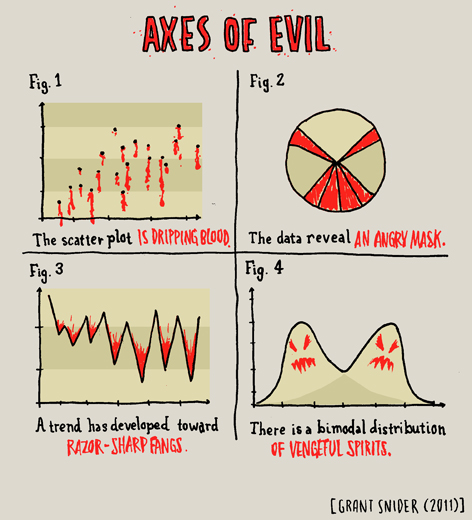
Weekend moment of Zen 6-9-12

If you are a baseball fan who hasn’t yet read Mark Lisanti’s “Derek Jeter’s Diary” over at Grantland yet, go now.  Enjoy.

Though I don’t often do sports stats, “Jeter” has a few words about stats blogs:

I don’t read those blogs, they’re just negativity disguised as indisputable math…

That does about sum it up Derek.  I kind of want that stitched on a pillow.

He also has some words of wisdom on the limitations of statisticss:

The stats guys are always trying to tell you there’s no such thing as clutch, that there’s no special skill to it, it’s all probabilities and math. Look: I also know that math exists. I’ve taken math classes, I’ve seen numbers be added and subtracted in front of my very eyes. Those symbols on the back of baseball cards mean something real.  

But you can’t tell me that there’s not some magic ability some players have that makes them rise to the occasion when it counts most. I’ve seen Alex Rodriguez fail in huge situations too many times not to believe what I have is special. 

Have a good weekend everyone!

Sexism and stay at home moms

I was just thinking I wanted to find a good marriage and family research paper to sink my teeth in to.

This one came across my inbox today, and I didn’t have to get much further than the abstract before I knew it was going to be a doozy.  Read for yourself:

In this article, we examine a heretofore neglected pocket of resistance to the gender revolution in the workplace: married male employees who have stay-at-home wives. We develop and empirically test the theoretical argument suggesting that such organizational members, compared to male employees in modern marriages, are more likely to exhibit attitudes, beliefs, and behaviors that are harmful to women in the workplace.

*Bias Alert*
My mother was a stay at home mom.  Therefore my father would have qualified for this study, and it is hard for me to even read their hypothesis without remembering that.  I happen to credit my father with giving me my passion for statistics and data analysis, and he has never once discouraged me from doing anything I wanted to professionally (with the exception of when I mentioned law school….that he soundly discouraged as a waste of talent….and this was  15 years before anyone was talking about a law school bubble).  I will not go in to all the details of my parents marriage here, but I doubt you could find anyone who would call my parents marriage anything less than an equal partnership focused on doing what was best for the family.

As an extra level of bias, I will be continuing my (full-time) job post baby.
*End Alert*

I’ve noticed a disturbing trend in both the general population and academic research: people seem to get very hung up on conflating “stay at home mom” with “traditional marriage”.  The study authors do this openly….they admit that they classify a marriage as “modern” based solely on whether or not the wife works full time.  The only criteria for “traditional” is that she doesn’t work at all, and part time work is all classified as “neo-traditional”.

To ignore the economic realities that drive families to make decisions about work seems to me to be an immense oversight.  I have met plenty of stay at home mothers who were in very equitable marriages, and I have met quite a few working mothers whose primary source of stress was their husbands continued expectation that they were still responsible for all child care/household duties.  I believe that using only one metric to rank a marriage as “traditional” or “modern” is a horrible over generalization….especially since most women with small children would prefer to work part time.  In fact (from the Pew study):

The public is skeptical about full-time working moms. Just 14% of men and 10% of women say that a full-time job is the “ideal” situation for a woman who has a young child. A plurality of the public (44%) say a part-time job is ideal for such a mother, while a sizable minority (38%) say the ideal situation is for her not to work outside the home at all.

So 90% of women don’t think the “modern” setup is ideal when there are young children involved.  If one of these women than chooses to stay home with her kids, has her husband truly regressed from “modern” to “traditional”?

For both the economic reasons and the “women’s choice” reasons, I reject studies that try to tie stay at home motherhood to anything else.  The sample is just too broad, and the reasons too varied.  It also undermines exactly how expensive child care can be….by my estimate, my mom would have had to bring home at least $4000 a month (in today’s dollars)  to pay for child care for 4 children.  $4000 after tax is a pretty hefty before tax salary.

I don’t argue that personal life can affect professional attitudes, and I would never advocate for sexism in the workplace.  In this study however, I really had to question the motives.  Is it really the best idea to fight gender stereotypes with stereotypes about very broad choices?  Is the point here that the workplace will only be fair when women participate as much as men?  Isn’t it a bit sexist to totally disregard the role women play in the decision to work or not work?  Shouldn’t we all just be able to do what’s best for our families, no questions asked?

Quote of the week and more recall coverage

Statistics are like bikinis.  What they reveal is suggestive, but what they conceal is vital.  ~Aaron Levenstein


I’ve been reading more of the Scott Walker recall election coverage, and was struck by the frequent references to Walker being “the first governor to survive a recall election”.  Of course this made me curious how many governor’s had been recalled.  I remembered the California governor a few years back, so I had been imagining it would be at least a dozen or so.

Nope.

It’s two.  Lynn Frazier from North Dakota in 1921, and Gray Davis from California in 2003.

I had to laugh at my own sampling bias.  My assumptions were pretty understandable….I’ve been of voting age since 1999, and in that time this has happened twice.  Therefore it was reasonable to assume this happened at least occasionally.   I figured about once every 10 years, which would be 23 or 24 in American history.  I was pretty sure not every state had a recall option, so I halved it.  12 felt good.

This is the problem when data leaves out key points….it relies on our own assumptions to fill in the details.  Engineers are normally trained to get explicit with their assumptions when estimating, as evidenced by the famous Fermi problem.  However, even the most carefully thought through assumptions are still guesses.

That’s why it’s important to remember the quote above: what you’re shown is important, but it’s not half as interesting as what’s hidden.

More adjectives, more problems

I’ve written before about the dangers of adjectives, but today on Instapundit there was a link to a great example of a misused adverb.

The headline on CNN late last night apparently described Scott Walker as “narrowly defeating” Barrett.  Ultimately he beat him by 7% of the vote.

Now, some may call that narrow, but most would not.  Words like that are dangerous because they can obscure your view of the real numbers.  Other words that can skew your view are “spike” “surge” “plummeted” etc.

While all probably at least indicate the direction of the change, there is no standard for how big the change must be to use one of these words.  If possible, check the numbers first, then the headlines.

It’s better than trusting journalists.

More on metrics: what about college?

After my post yesterday on metrics, the AVI left a good comment, and then wrote his own follow up post using  sports as an example.  It’s worth a read.

I’ve been thinking more about metrics today, and wondering about other areas where there’s no consensus on outcomes.  Before I get in to the rest of my thoughts, I wanted to mention a quick anecdote I once heard a pastor give.

Back when he was in high school, this man’s class had been handed a poll.  In it, they were asked what they most wanted to be in life:  rich, successful in their field, famous, successful in love, well traveled or happy.  According to him, when the teacher wrote the results on the board, he was the only one who had put “happy”.  As he discussed this with his classmates afterwards, he realized this was because they all had so closely associated happiness with one of the other metrics that it had never occurred to them that checking off “rich” might not be the same thing as checking off “happy”.

This occurs to me as a common mistake with metrics….we start associating two traits so closely that we forget they do not actually have to coexist.

This brings me to college.

In the student loan debates, there’s been much wailing over how much debt undergraduates are taking on, while the ability to obtain salaries that enable repayment has decreased.  In reading these articles, one would be left with the impression that we had some sort of national consensus on what the point of college actually is: to get a good job.

This is wrong.

According to the Pew Research Center:

Just under half of the public (47%) says the main purpose of a college education is to teach work-related skills and knowledge, while 39% say it is to help a student grow personally and intellectually; the remainder volunteer that both missions are equally important. College graduates place more emphasis on intellectual growth; those who are not college graduates place more emphasis on career preparation.

Even college presidents don’t agree on what they’re trying to do:

(College) Presidents are evenly divided about the main role colleges play in students’ lives: Half say it is to help them mature and grow intellectually, while 48% say it is to provide skills, knowledge and training to help them succeed in the working world. Most heads of four-year colleges and universities emphasize the former; most heads of two-year and for-profit schools emphasize the latter.

So half of the people heading up colleges never thought that their primary goal would be to get kids good jobs, and 40% of the public didn’t prioritize getting a good job.  Loans are generally based on an ability to repay, but a good chunk of those taking out the loans weren’t focused on ability to repay when they signed on.

My guess is that this is not what actually went through these people’s heads, at least not in those words.  My guess is that maturing and intellectual growth is so conflated with being qualified for a good job that it’s unfathomable to some people that they’re not the same thing.

Maybe they should start asking this on student loan applications.  I certainly think it should be at least be part of the conversation.

Outcome metrics and the research we do not do

I’ve spent most of last week at work trying to perfect a grant proposal that pretty much everyone in our program has to sign off on.  On Thursday, Friday and today there was a great deal of discussion about what metrics we could use to measure our outcomes, should we get funding.

It’s actually not an easy question, as the project we’re working on is a general good thing (patient education) designed to address a multitude of issues, as opposed to something more targeted.

Watching half a dozen people go back and forth about all this got me thinking about how often it is taken for granted that somewhere out there is a definition for “success” in various topics.

When I took a child development class in grad school, I remember in one of the first classes someone asked what the best parenting methods were.  Our professor replied that there really couldn’t be a consensus, because no one could agree on what would qualify as a success.  He proceeded to use religion as an example:  for parents of strong religious persuasion, a child who grew up a financially successful atheist would not necessarily be what they were going for.  Conversely, secular atheist parents might be distressed at a strong religious conversion.

There are probably scores of good studies that could have been done on parenting methods if we actually had a definition of success we could all agree on.  Too frequently, I think people overlook this point.  The reason so many strange fads in parenting can get going is because it is really really hard to prove anyone right or wrong.  Even if you try, you might just wind up with the dodo bird verdict.

If you can’t agree on where you’re going, you most certainly can’t tell people how to get there.  The studies you don’t do are often as important as the studies you do.

New Nassim Taleb

Apparently Nassim Taleb has a new book due out in November.

Farnam Street has a bit up from him that I liked quite a bit regarding how we process excessive data, most often to our detriment.

Best quote:

If you want to accelerate someone’s death, give him a personal doctor.

Cutting and pasting OR always check the source data

I’ve mentioned before that I don’t like infographics.

Normally this is because the infographic itself is misleading, but today I found an equally hideous incarnation of this.

It all started over at feministing.com, where I was greeted with this graph:

This pretty much set off my alarm bells immediately.  I had quite a few questions about all of this, as the graph obviously said very little about the methodology.  Who was included?  How did they account for gaps in years worked?  Most importantly, did they control for profession?

I clicked on the link provided, which took me to this blog post on the New York Times website.  It shows the same picture as above, with an intro of the following two sentences:

We’ve written before about how the gender pay gap grows with age. Generally speaking, the older a woman is, the wider the gap between what she earns and what her male counterpart earns.

I was struck by that phrase “male counterpart”.  Were we really talking about counterparts here?  I was curious again about the profession question.  It struck me that many female dominated professions are actually “terminal” professions….i.e. the job you enter can remain pretty unchanged for years: teachers, nurses, therapists, etc.  On the other hand, many male dominate professions have far more steps on the ladder, which would be a pretty non-sexist explanation for the continued growth seen throughout the decades.

With this in mind, I went to find the methodology for the graph.  I not only found the methodology, but the rest of the infographic.

As it turns out, the profession issue was directly addressed on the original….but it was completely edited out in subsequent reprints.  Profession does have an effect on earnings growth, and the original captured that.  I’m a little concerned about how far this graphic went without all of the important qualifying information they took care to include.

 Interestingly, the NYT columnist did actually write a more comprehensive article on the topic 2 years ago that she linked to in this article, but I’m surprised she didn’t do a recap.  With the ease of transport of info on the web, I don’t think the cut and paste job is an okay thing to do.  It sets up less diligent bloggers to merely reprint, and it undermines the original work.  Someone out there is quoting this right now, having no idea that they’re missing 2/3rds of the information.

Bad data, bad.

Friday Fun Links 6-1-12

Last time I did a list of fun links, my most curmudgeonly reader informed me they weren’t fun enough.

Fine, I’ll try again.

I don’t even attempt to touch on economic stats on this blog.  Frankly, they make me dizzy.  However, I’m excited to see that George Mason’s Stats.org is launching an Econostats website soon.  Their regular site is pretty darn good for going behind the headlines, and I’m hoping this one will be too.  Here’s a post from the guys who will be running it.

If you’re looking for summer reading for your local math/logic puzzles nerd, this might be a good choice.  Even for those not on the job market it looks fairly interesting. (Fixed the link)

Nate Silver feels about acronyms what I feel about infographics.

I’ve been trying to improve my data visualization skills lately, and I’ve been noticing huge variances in examples on the web.  Thus I liked reading this proposal for creating three different categories: data visualization, data illustration, and data art.

Speaking of data art, I bought David McCandless’s book, which is very pretty, very fun, and answers the burning question “what can facebook teach us about peak break-up times?”

Facebook breakups not of interest to you?  Maybe you’re a tennis fan?  Watching the French Open?