Author: bs king
Fun thoughts for Friday

Some infographic love for my little brother
My wonderfully liberal little brother is having a rough week, so I thought I’d cheer him up in the best way I know how….by criticizing a Republican infographic.
He sent me this one this morning, and while it’s a little sparse, the bottom right hand corner caught my eye:

Now, I have no idea how much was given to Solyndra, or how many jobs wind energy has left, but I do know a thing or two about gas prices and infographic figures.
First, those gas pumps are totally deceptive. $3.79 is almost exactly 2 times $1.85. Fine. However, let’s look closely at those gas pumps:
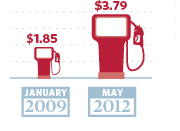
I pulled out the ruler when I cropped the photo, and confirmed my suspicions. The larger pump in the picture doubles both the height and the width of the first pump. That’s not twice as big….that’s four times as big. I’m sure they’d defend it by pointing to the dashed lines in the background and saying only the height was supposed to be reflective, but it’s still deceptive. Curious what a gas pump actually twice as big would look like? Here you go….original low price on the left, original “double” price on the right, actual double in the middle.

Graphics aside, let’s look at the numbers.
2009 was just not that long ago, and I know that $1.85 was quite the anomalous price at the time. I’ve seen that stat more than once recently, and I have been annoyed by it every time. Tonight, I decided to check my memory on it, and see if that dip really was the aberration I remember it being. Don’t remember either? Here’s the graph of average gas prices since 1978, per the BLS generator:

That dip towards the end there with the arrow? That hit right as Obama was taking office. In July of 2008, gas was an average of $4.15 per gallon. By January of 2009, it was $1.84. I have not a clue why that drop happened, but I do know that to treat that $1.85 number as though it was standard at the time is a misrepresentation.
You can see this a bit better if you isolate George W Bush’s presidency:

Now, you could accurately say that George Bush took office with gas prices at $1.53 and left with them at $1.74….but clearly that would ignore a whole lot of data in between.
Now here’s the averages and standard deviations for each term of the presidencies:
| GWB – 1st term | GWB – 2nd term | BHO – current term | |
| Average Gas Price | 1.63 | 2.78 | 2.99 |
| Standard Deviation | 0.22 | 0.56 | 0.56 |
Now, none of this adjusted for inflation. By adjusting the yearly averages to 2010 dollars, I got the second term of GWB to $2.99, and the current term for BHO to $3.00.
You don’t have to like Barack Obama, and you certainly don’t have to like gas prices. No matter what your political affiliation, I think we can all agree on one thing: ALWAYS beware of infographics.
What I missed
Apparently in my travels, I missed the series premier of a new History channel show: United Stats of America.
I was hoping it would be up my alley, but reading the synopsis makes me suspicious it’s going to be more about reciting cool numbers than figuring out if those numbers have any accuracy. Sigh.
Greetings from Maine
After a treacherous journey up Route 1 (over an hour to clear the city of Boston), I’m pleased to tell you that we’re coming to you tonight from Portland, Maine.
I’m running a conference tomorrow at University of Southern Maine about bone marrow transplant patients who have to travel long distances….or as it’s more flourishingly called “Improving Patient Pathways for Complex Care Across Multiple Healthcare Systems”. This is not my forte, and thus I have nothing long winded tonight….but after the stress of conference planning, I’m sure I’ll have to spend several weeks with nothing but numbers and spreadsheets before I calm down.
While we wait to see where that takes me, I thought I’d continue my pattern of figuring out a good Google Ngram for the trips I take. This time I decided to run all the New England states to see who got mentioned the most.
I’m happy to see Massachusetts made a strong showing. Connecticut managed to eek a win over Maine, and it looks like Vermont, New Hampshire and Rhode Island have just been hanging out for years.
Who represents you best?
Another day, another infographic:
Via: TakePart.com
Sigh. It’s an election year, so I know I’m going to be seeing a lot of these types of things and I should just get over it but…I can’t.
I really dislike this one, because while the data may be good (I haven’t checked it), I think the premise is all wrong and perpetuates faulty ideas.
Congress is a nationally governing body that is split up by state. Thus, even if Congress was perfectly representative on a state to state basis, it would still very likely not look like the USA as a whole.
For example, let’s take Asian Americans and Pacific Islanders. According to the census bureau, 51% of this demographic lives in just 3 states: California, New York and Hawaii. Nine states pull fewer than 1% of their population from this demographic: Alabama, Kentucky, Mississippi, West Virginia, North Dakota and South Dakota, Montana, Wyoming and Maine. 4.2% may be the national average, but Hawaii is 58% Asian, and West Virginia is 0.7% Asian. For one, it would be ethnically representative to have at least half of their reps be Asian every year, for the other it’s statistically unlikely to happen.
If you wanted a really impressive infographic, you’d take each state’s individual ethnic breakdown and cross reference it with how many representatives they had in Congress to figure out what a representative sample should be. Adding those up would give you the totals for racial diversity when judged on a state level, not a national level.
Of course, that’s only the racial numbers, though the same could apply to the religion questions. This doesn’t work for the gender disparity…gender ratios are pretty close to 50/50 (Alaska has the highest percentage of men, Mississippi has the lowest). I think that’s a more complex issue, since you have to take in to account the number of women desiring to run for office (lower than men), and then the counterargument that fewer women want to run because they believe they’re less likely to win or more likely to be crticized. It’s a tough call how many women there should be to be truly representative since both sides can argue the data.
The income, age, and education numbers I’d argue are all due to the nature of the job. Campaigning is expensive, and neither Representative nor Senator are not exactly entry level jobs.
As the comments from yesterday’s post showed, one of the least representative parts of Congress is profession. Lawyers make up 0.38% of the population, and yet 222 members of Congress have law degrees (38% of the House, 55% of the Senate). That seems highly unrepresentative right there.
At the end of the day, we vote for people who represent our state, not necessarily our gender, religion or race. In Massachusetts, our current Senate race is between a 52 year old white male lawyer and a 62 year old white female lawyer. The biggest difference demographically in my eyes? One has lived in Massachusetts for decades, and the other….lived here long enough to qualify to run. No one’s going make a pretty picture out of that factor, but it’s pretty important when it comes to getting adequately represented.
Are Republicans Stupid?
One of my favorite things about blogging is it’s potential to actually change the way I personally think about things. I don’t mean just through the comments section, though that is immensely helpful, but more so through the process of researching, writing, posting and following up. A few posts on one topic, and suddenly I find myself passionate on topics that had previously been mere blips on my radar. God bless the internet.
All that is to say, a month ago I didn’t really care what people said about politics and science. Sure, in my own blog rules, rule number 2 said I would stay non-partisan:
I will attempt to remain non-partisan. I have political opinions. Lots of them. But really, I’m not here to try to go after one party or another. They both fall victim to bad data, and lots of people do it outside of politics too. Lots of smart people have political blogs, and I like reading them…I just don’t feel I’d be a good person to run one. My point is not to change people’s minds about issues, but to at least trip the warning light that they may be supporting themselves with crap.
Even so, if someone had casually made the comment that Republicans were anti-science, I probably would have let it go. After all, I spent most of my pre-adulthood years in a Baptist school that had plenty of Republican voting ignorants to color my view.
But…..then I did this post.
And this one.
And of course this one.
And now I don’t feel those comments are quite as innocuous as I once did.
My feelings on this were backed up by this article from Forbes magazine (where this posts title came from), which I really really recommend if you have the time.
I’m not going back on my non-partisan premise, but as Mr Entine so eloquently posits, one party laying claim to “science” does nobody any good. Science never fares well when put in the hands of politicians (does anything really?) and giving one party the moral upper hand in a subject as broad as “science” can cause damaging oversights.
To be honest, I don’t know which party is more “pro-science”. The data required to prove that one way or the other would require compiling a complete list of scientific topics, ranking them in order of possible impact to both people and the world at large, ranking the conclusiveness of the data, and conducting public opinion polls broken down by party and controlled for race, class and gender. That’s an enormous amount of work, and nobody has done it.
Thus, until further research is done, I will stick with the following conclusions:
- Politicians will exploit everything they can if they think it will get them more votes
- Ditto for journalists (sub “readers” for “votes”)
- Saying you’re “pro-science” is not the only requirement for being “pro-science”
- Increasing the general level of knowledge around research methods, data gathering and statistical analysis is probably a good thing
Seriously though, read the Forbes article.
Weekend Moment of Zen 5-5-12
From PhD comics
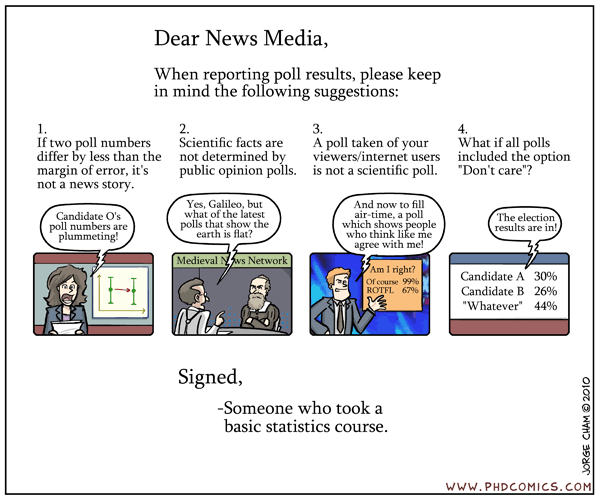
You are getting sleepy….
It’s been one of those weeks. I feel I would pay good money to be able to fast forward through tomorrow and jump straight to the weekend, as I’m pretty sure my brain is leaking out of my ear.
Given that, the headlines about this announcement by the CDC caught my eye. The headline reads “30% of US Workers Don’t Get Enough Sleep”.
Now, I’m in a pretty forgiving mood towards that sentiment. I’m tired today, and I know when I got in this morning most of my coworkers were dragging too. Any comment on sleep deprivation would have most certainly gotten lots of knowing looks and nods of commiseration. This study backs us up right? We’re all veeeeeeeeery sleepy.
Except that studies like this are almost all misleading.
Several years ago, I read a pretty good book by Laura Vanderkam called 168 Hours: You have more time than you think. It was through this book that I got introduced to the Bureau of Labor Statistics American Time Use Survey.
Now, most time use surveys….the type that people use to give reports about how much we sleep or work….are done by just asking people. Now that’s great, except that people are really terrible at reporting these things accurately. The ATUS however, actually walks people through their day rather than just have them guess at a number. It’s interesting how profound these differences can be. In another survey using time diary methodology, it was found that people claiming to work 60 – 64 hours per week actually averaged 44.2 hours of work. More here, if you’re interested.
Unsurprisingly, sleep is one area that people chronically underestimate how much they’re getting. The CDC study, which it admits was all data from calling up and asking people “how many hours of sleep do you get on average?” found that 30% of workers sleep fewer than 6 hours per night. The ATUS however, finds that the average American sleeps 8.38 hours per night….and that’s on weekday nights alone. Weekends and holidays, we go up to 9.34.
I couldn’t find the distribution for this chart, but I did find the age breakdown, so we can throw out those 15-24 and those over 65 (all of whom get about 9 hours of sleep/night). We’re left with those 25 – 65 who average roughly around 8.3 hours of sleep per night.
Alright, now lets check the CDC number and figure out how much sleep the other 70% of the population would have to be getting in order to make these two number work.
If we take some variables:
a = percent of people sleeping an average of fewer than 6 hours per night
x = the maximum number of hours to qualify as “fewer than 6 hours”
b = percent of people sleeping more than 6 hours per night
y = average amount they are sleeping to balance out the other group
c = average amount of sleep among workers according to the ATUS survey
We get this: ax + by = c
And then substituting: (0.3*5.9) + (0.7*y) = 8.3
Solving for y: y = 9.33 hours of sleep per night
Are 70% of Americans of working age actually getting 9.33 hours of sleep per night? That would be pretty impressive. It would also mean that instead of a normal distribution of sleep hours, we’d actually have a bimodal distribution….which would be a little strange.
There is, of course, the caveat that those answering the ATUS represent the whole population while the CDC targeted working adults. It’s a little tough figuring out how profoundly this would affect the numbers since the BLS reports workforce participation rates for those 16 and up. The unemployment rate for 2010 (the year the survey was completed) hovered just under 10%, but the “not in labor force” numbers are a little harder to get without skewing by the under 25 or over 65 crowd. The CDC also didn’t report an average, so I can’t compare the two….but given the 30% number, the six 6 hours or less would be less than half a standard deviation from the mean (if the sleep data was roughly normal).
So does this mean I’m not as tired as I think I am? Nope, I’m pretty sure I’m still going to bed early tonight. I will however, be aware that a tiring week does not necessarily mean a sleep deprived one.
Hey, at least someone’s thinking
Best idea I’ve seen all day….people taking Congress to task for having no system for vetting scientific testimony. (H/T to Maggie’s Farm)
Apparently what sent them over the edge was when a scientist misquoted his own paper during testimony, skewing his own research. Yikes.
One of the authors website is here….haven’t had time to look around much.

