Accidental Polymath Problems: 10 Subjects You Study Before You Find the One

After my comment last week that I’d sort of friend-zoned physics, I got to thinking about how many different subjects/career choices I stumbled through during my 20s. It’s incredibly interesting to me that even though society has started allowing (and frequently even encouraging) people to wait longer and longer before finding “the one” for marriage, we still put a lot of pressure on people to know exactly what they’re interested in by the age of 18…or 22 if you’re a little behind. Clearly college debt is a huge driver of this, but I do meet a bizarre number of high school students who really think most people figure out “their passion” before they’re even old enough to drink. While clearly there are plenty of people who find what topics they want to study early, I’d like to propose that the whole thing is a little more like dating then we normally think of it.

When I mention “subjects” here and “study”, I am covering a lot of ground. Studying could mean formally studying in school, or getting books out of the library, watching documentaries or talking to a lot of people in the field. While I mention careers, I’m not directly equating intellectual pursuits to careers or work because some people really don’t get to equate those two. It’s an unfortunate reality that many of us have to prioritize paying the bills over feeding our minds, and if you ever find yourself doing both at once you are incredibly lucky. With those caveats, and the knowledge that this is based on nothing but my own experience and that of my friends, here’s the 10 types of subjects you study before you find “the one”:

  1. The Celebrity Crush  Grey’s Anatomy. ER. Bones. CSI. Law and Order. Let’s face it, some professions get all the girls. No seriously, who among us with a television set hasn’t at some point hasn’t developed a crush on an entire profession/field of study? When I was 4 years old I watched a PBS special and spent months telling everyone I wanted to be a paleontologist and begging my parents for dinosaur books. Two decades or so later I binge watched the first 5 seasons of Bones I spent a solid 3 weeks desperately wanting to be a forensic anthropologist and reading every book my library had on the topic. While sometimes these can spark real career choices, most of the time the fantasy is better than the reality. I mean, I still adore dinosaurs but I would NEVER have the patience to catalogue a dig site. Some things just look better from afar.
  2. The Challenge Subject Similar to the celebrity crush, but you actually encountered it in your real life. This is the subject or path you pursue because you’re not sure you can actually get it. It’s not that you’re not legitimately interested, but if you’re honest with yourself it’s really your competitive streak that’s pushing you through. The truth will hit you when you finally mastered the subject, only to promptly realize that now you really never want to talk about it again. Want an example? Ask me about my biomedical engineering degree.
  3. The One that Requires Way Too Much Commitment Okay, so you found a subject you really like, and you think “hey, maybe I’d like to consider this as a profession”…and then you realize exactly how much work that would take. You like the subject, but the idea of working hundreds of hours or going to school for a decade to study it further strikes you as waaaaay too much commitment.  It’s ready to settle down, and it looks nice, but you just can’t be tied down like that. You have too many other interests, and there’s only so many hours in the day.
  4. The Summer Fling This is the subject you absolutely love, but only because of the setting you encountered it in. Maybe you got to learn about archeology while studying abroad in Egypt or you had an amazing professor who made an otherwise boring subject unbelievably interesting. When you try to pick this subject back up again, you realize that in a more mundane environment it actually is kind of boring. Ah well, at least you have the memories.
  5. The Artist This is the subject you love with all your heart, but you realize it will always be a bit of a free spirit. Maybe it’s literally an artistic field mashed up with another topic, or maybe it’s a subject you’re just kind of making up as you go along (like, say teaching people how to read science on the internet) but it doesn’t fit neatly in any sort of traditional box. It’s more exciting to you than almost any other topic, but no one else understands what you see in it and it’s DEFINITELY not a program of study anywhere.
  6. The Friend With Benefits This is the subject that comes really naturally to you without ever really having to put much effort in. It doesn’t excite you much, but people will pay you to do it and the effort is minimal. For me, this is quality and regulatory. You want someone to memorize obscure regulations, recite them at you when you step out of line, check your work and tell you your faults? I’m your girl. I can do that in my sleep. Ask anyone who’s ever lived with me. Anyway, this one doesn’t require a lot of investment either because it comes so naturally or you’re already qualified for it, but you know you could walk away at any time and never think about it again.
  7. The Safe One Related to the friend with benefits, but you committed to this one. It doesn’t excite you, but you think you can always find work in this field and it’s not terribly stressful. You sometimes think about leaving, but everything else seems less certain. Tends to work out pretty well unless the field totally collapses on you.
  8. The Friend Zoned This is the thing you always enjoying hearing about, but simply never want to commit to doing much reading about…..despite a bit of a feeling you should give it a chance. Maybe it’s a field where you could make a lot of money, or something your parents think you should try, but you just can’t bring yourself to try it out.
  9. The “We’re Better As Friends” A little like the friend zone, but this one is a mutual decision. It’s the subject you like studying and love to be around, but as soon as anything formal or structured was required you did terribly and bailed. Still, having it in your life makes your life richer, as long as it’s on low pressure terms. Interestingly, I try to convince many people that statistics should fall in this category for them. You don’t have to like studying math formally in order to benefit from having a little more statistics in your life.
  10. The “why did we never work out” This is the subject you always think is pretty great, but really spend very little time studying. You like it, but every time you find a free moment, you forget it exists, or it’s only offered as a class the one semester you’re already overloaded, etc etc. For me this is epidemiology. I’ve taken classes in it, it’s a natural fit, but I never quite seem to follow up. I really should give it a call sometime soon.

Of course the nice thing about intellectual pursuits is that you actually can juggle multiple different subjects at once with a lot less potential for drama than if you tried that while dating. For example, my current job is a mash up of my true love (statistics, analytics and process improvement) my friend with benefits (quality and regulatory) and the safe one (computer systems). My blogging is The Artist, and it gives me a place to research all my thoughts that don’t fit in any other box. I think acknowledging how many different types of intellectual pursuits there are (and how much you can learn from all of them!) could be useful for kids still trying to figure things out. Just like dating can help you hone in on what you want in a spouse, studying a lot of subjects can help you find that sweet spot of “things you want to talk about” and “things people want to pay you to talk about”.

Plus, isn’t the world a little more fun when you consider every new book a low key blind date?
Men, Masculinity Threats and Voting in 2016

Back in February I did a post called Women, Ovulation and Voting in 2016, about various researchers attempts to prove or disprove a link between menstrual cycles and their voting preferences. As part of that critique, I had brought up a point that Andrew Gelman made about the inherently dubious nature of anyone claiming to find a 20+ point swing in voting preference. People just don’t tend to vary their party preference that much over anything, so they claim on it’s face is suspect.

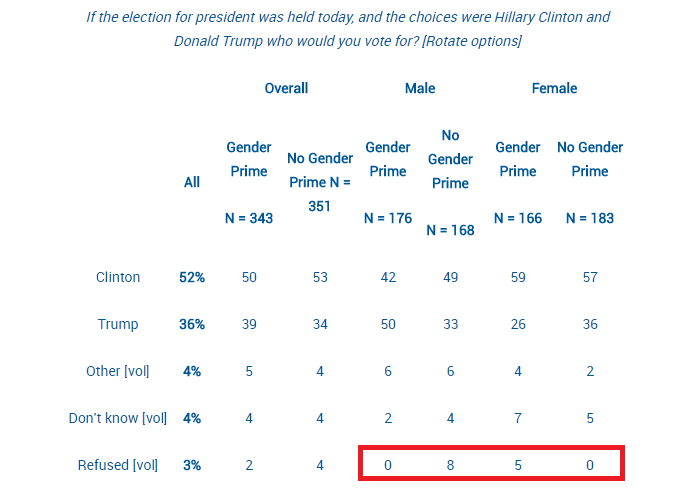
I was thinking of that this week when I saw a link to this HBR article from back in April that sort of gender-flips the ovulation study.  In this research (done in March), they asked men whether they would vote for Trump or Clinton if the election were today. For half of the men they first asked them a question about how much their wives made in comparison to them. For the other half, they got that question after they’d stated their political preference. The question was intended to be a “gender prime” to get men thinking about gender and present a threat to their sense of masculinity. Their results showed that men who had to think about gender roles prior to answering political preference showed a 24 point shift in voting patterns. The “unprimed” men (who were asked about income after they were asked about political preference) had preferred Clinton by 16 points, and the “primed” men preferred Trump by 8 points. If the question was changed to Sanders vs Trump, the priming didn’t change the gap at all. For women, being “gender primed” actually increased support for Clinton and decreased support for Trump.

Now given my stated skepticism of 20+ point swing claims, I decided to check out what happened here. The full results of the poll are here, and when I took a look at the data there was one thing that really jumped out at me: a large percent of the increased support for Trump came from people switching from “undecided/refuse to answer/don’t know” to “Trump”.  Check it out, and keep in mind the margin of error is +/-3.9:

ClintonvTrump

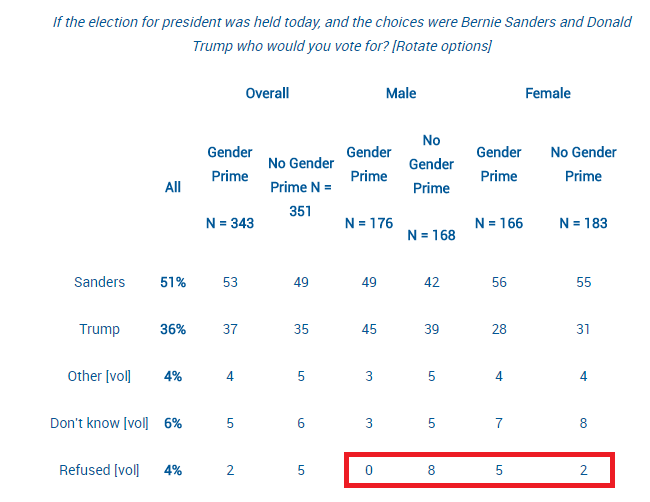
So basically men who were primed were more likely to give an answer (and that answer was Trump) and women who were primed were less like to answer at all. For the Sanders vs Trump numbers, that held true for men as well:

SandersvTrump

In both cases there was about a 10% swing in men who wouldn’t answer the question when they were asked candidate preference first, but would answer the question if they were “primed” first. Given the margin of error was +/-3.9 overall, this swing seems to be the critical factor to focus on…..yet it was not mentioned in the original article. One could argue that hearing about gender roles made men get more opinionated, but isn’t it also plausible the order of the questions caused a subtle selection bias? We don’t know how many men hung up on the pollster after being asked about their income with respect to their wives, or if that question incentivized other men to stay on the line. It’s interesting to note that men who were asked about their income first were more likely to say they outearned their wives, and less likely to say they earned “about the same” as them…..which I think at least suggests a bit of selection bias.

As I’ve discussed previously, selection bias can be a big a big deal…and political polls are particularly susceptible to it. I mentioned Andrew Gelman previously, and he had a great article this week about his research on “systemic non-response” in political polling. He took a look at overall polling swings, and used various methods to see if he could differentiate between changes in candidate perception and changes in who picked up the phone. His data suggests that about 66-85% of polling swings are actually due to a change in the number of Republicans and Democrats who are willing to answer pollsters questions as opposed to a real change in perception. This includes widely reported on phenomena such as “post convention bounce” or “post debate effects”. This doesn’t mean the effects studied in these polls (or the studies I covered above) don’t exist at all, but that they may be an order of magnitude more subtle than suggested.

So whether you’re talking about ovulation or threats to male ego, I think it’s important to remember that who answers is just as important as what they answer. In this case 692 people were being used to represent the 5.27 million New Jersey voters, so any the potential for bias is, well, gonna be yuuuuuuuuuuuuuuuuuuge.

What I’m Reading: August 2016

This month my stats book is Teaching Statistics: A Bag of Tricks by Andrew Gelman and Deborah Nolan. I’m part way through it, but it’s really good. If you’ve ever had to explain statistical concepts to a group of uninterested people, this is GREAT.

Recently someone on Facebook mentioned that they were surprised that increased knowledge of unethical politician behavior seems to change the mind of absolutely no one. Turns out it may be even worse than that….there’s evidence that informing people of your potential conflicts of interest makes them more likely to follow your recommendations.

Somewhat related to that, I’m still chewing on this piece from the Atlantic about how our political process went insane. It seems over hyped to me, but if even a quarter of it’s real we should probably be nervous.

This New York Times story about a skinny woman with all of the markers of obesity was one of the more fascinating health stories I read this month.

Another good NYTs story about bad concussion data the NFL has been using. Apparently the group who did the study gave them the preliminary results, but never told them that the final results actually didn’t bear out the initial findings.

Speaking of initial data, I was bummed to hear that the reports of the Ice Bucket Challenge leading to a major ALS breakthrough are probably jumping the gun.

The six types of peer reviewers made me laugh more than a little.

Okay, some of these experiments aren’t quite as straightforward as presented here (see the Stanford Prison Experiment), but this was a really weird list.

Medical Marijuana and Painkiller Overdoses: Does One Reduce the Other?

I’ve talked before here about the issues with confusing correlation and causation, and more recently I’ve also talked about the steps needed to establish a causal link between two things.

Thus I was interested to see this article in the Washington Post recently about the attempts to establish a causal link between access to medical marijuana and a decrease in painkiller related deaths. There had been studies suggesting that access to medical marijuana was associated with lower rates of overdose related deaths since this JAMA paper was published in 2014, and those findings were repeated and broadened in 2015 with this paper. Both papers found increased access to medical marijuana reduced painkiller related deaths by up to 25% over states with no such access. This showed at least some promise of moving towards a causal link, as it established a reproducible consistent association.

This was not without it’s critics. When the Washington Post covered the story about the 2015 paper, they interviewed a skeptical researcher who pointed out that painkiller users are at higher risk for overdose when they use medical marijuana as well. Proponents of medical marijuana pointed out that this only studied those who were prescribed painkillers. If it could be established that access to medical marijuana reduced the number of painkiller prescriptions being written, then you could actually start to establish a plausible and coherent theory….2 more links on the chain of causality.

Long story short, that’s what this new paper did. They took a look at how many prescriptions your average physician wrote in states with legal medical marijuana vs those without, and found this:

As a balance, they also looked at other drugs that had nothing to do with medical marijuana (like antibiotics or blood thinners) and discovered there was no difference in those prescription rates.

While the numbers for anxiety and depression medication are interesting, they may only translate in to a handful of patients per year. That pain medication number on the other hand is pretty damn impressive. 1,826 doses of painkillers could actually translate in to at least half a dozen patients per physician (if you’re assuming daily use for a year) or more if you’re assuming less frequent use. This gives some pretty hefty proof that medical marijuana could be lowering overdose rates by lowering the number of patients getting a different painkiller prescription to begin with.

I’d be interested to see if there’s a dose response relationship here….within the states that have legal medical marijuana, do states with looser laws/more access see even lower death rates? And do those states with the lower overdose death rates see an increase in any other death rates, like motor vehicle accidents?

Interesting data to ponder, especially since full legalization is on my state ballot this November. Regardless of the politics however, it’s a great example of how to slowly but surely make a case for causality.

Two Ways to Be Wrong: I Swallowed Batman

I’ve often repeated on this blog that there are really two ways to be wrong. I bring it up so often because it’s important to remember that being right does not always mean preventing error, but at times requires us to consider how we would prefer to err.

I bring all this up because I had to make a very tough decision this past Saturday, and it all started with Batman.

It was 3 am or so when I heard my 4 year old son crying. This wasn’t terribly unusual…between nightmares or other middle of the night issues this happens just about every other week. I went out in the hall to see what was happening, and I found him crying hysterically. I picked him up and asked him what was wrong, noticing that he seemed particularly upset and very red. “Mama, I swallowed Batman and he’s stuck in my throat and I can’t get him out” he wailed. My heart shot to my throat. He had a small Batman action figure he had taken to bed with him. I had thought it was too big to swallow, and he was a little old for swallowing toys….but in his sleep I had no idea what he could have done. Before I could even look in his mouth he started making a horrible coughing/choking sound l’d never heard before and was gasping for air through the tears. I looked in his mouth and saw nothing, but thought I felt something.

I woke my husband up, and we briefly debated what to do. Our son was still breathing, but he sounded horrible. I was unsure what, if anything was in his throat. I had never called 911 to my own house before, and I ran down the other options. Call the pediatrician? They could take an hour to call back. Drive to the ER? What if something happened in the middle of the highway? Call my mother? She couldn’t do much over the phone.  Google? Seriously? Does “Google hypochondriac” have an antonym that means “person googling something that’s way to important for Google”?

Realizing I had no way of getting a better read on the situation and with my son still horrifically coughing and gasping in the background, I took a deep breath and thought about being wrong. Would I rather risk calling 911 unnecessarily, or risk my child starting to fully choke on an object that might be a funny shape and tough get out with the Hemleich manuever? Phrased that way, the answer was immediately clear. I made the call. The whole train of thought plus discussion with my husband took less than two minutes.

The police and EMTs arrive a few minutes later. My son had started to calm down, and they were great with him. They examined his mouth and throat, and were relatively sure there was nothing in the airway. They found the Batman toy still in his bed. Knowing that his breathing was safe, we drove to the ER ourselves to make sure he hadn’t swallowed anything that was now in his stomach, and that his throat hadn’t gotten irritated or reactive. He still had the horrible sounding cough. He brought Batman with him.

In the end, there was nothing in his stomach. He had spasmodic croup (first time he’s  had croup at all), and the doctor thinks that his “I swallowed Batman” statement was his way of trying to explain to us that he woke up with either a spasm or painful mucus blockage in his throat. The crying had made it worse, which was why he sounded so bad when I went to him. While we were there he picked up Batman, pointed to the tiny cloth cape and said “see, that’s what was in my throat!”. We got some steroids to calm his throat down, and we were on our way home. We all went back to bed.

In the end, I was wrong. I didn’t really need to call 911, and we could have just driven to the hospital ourselves. We needed the stomach x-ray for reassurance and the steroids so he could get some sleep, but there was no emergency. But I tell this whole story because this is where examining up front the preferred way of being wrong comes in handy: I had already acknowledged that being wrong in this way was  something I could live with. My decision making rested in part on being wrong in the right direction. I can live with an unnecessary call. I couldn’t have lived with the alternative way of being wrong.

911

Written out here, this seems so simplistic. However in a (potential) emergency, the choices that go in to each box can vary the calculation wildly.

  1. Can you get more information to increase your chances of being right? (I couldn’t, it was 3 in the morning)
  2. How soon will the consequences occur if you’re wrong? (Choking is a minutes and seconds issue)
  3. How prepared are you to deal with the worst outcome? (I know the Heimlich, but have never done it on a child and was worried that an oddly shaped object might make it difficult)
  4. How severe are the consequences? (Don’t even want to think about this one)

That’s a lot to think about in the middle of the night, but I was glad I had the general mental model on hand. I think it helped save some extra panic, and if I had it to do over again I’d make the same decision.

As for my son, the next morning he informed me that from now on “I’m going to keep my coughs in my mouth. They scare mama.” Someone clearly needs his own contingency matrix.

Death and Destruction: The Infographic

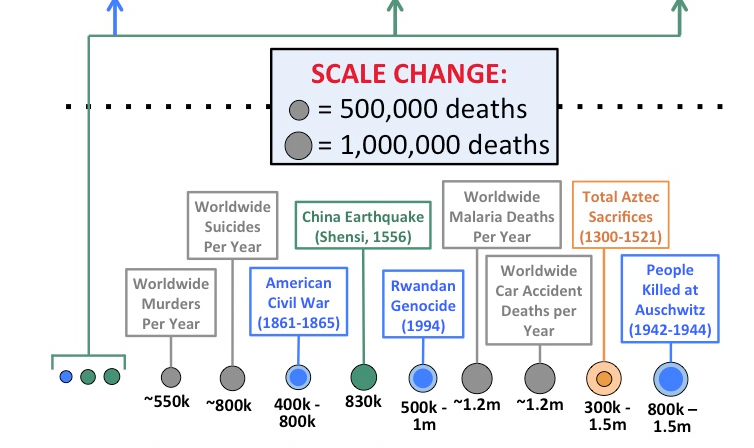
I am rather notoriously skeptical of infographics, but I found this one from Wait But Why today and it’s completely fascinating. It’s a comparison of how many people die/have died by various causes, some natural, some not so natural.

The whole thing is huge, but here’s a taste:

Deathtoll

I’ve been perusing this for about half an hour now, and I’ve learned about the Masada suicides, the Shensi Earthquake, and the Mao Era in China. It’s not a definitive list, but a really interesting one!

What I’m Reading: July 2016

This month my book was The Signal and the Noise,  which I enjoyed enough that I’m doing a chapter by chapter contingency matrix series on it over at the other blog.

Sampling strategy and research design can sound really boring, until you blow through $1.3 billion dollars and have nothing to show for it. This article on the long slow death of the National Children’s Study should be assigned reading for anyone who ever wanted to know why it was so damn hard to get good research done.

Did you hear the one about all the Brexit voters furiously Googling “What is the EU?” after they voted to leave it? Yeah? That was pretty bogus. It was about 1000 people total, no one knows if their Googling was “furious”, how they voted, or if those people were even eligible to vote.

This article is from a few months ago, but it’s an interesting look at motivations and political bias. It turns out people do better on “political fact” tests when you offer them money for right answers than when they take them with no incentives.  The Volokh Conspiracy discusses implications for our understanding of political ignorance.

Also from a few months ago: the Quartz guide to bad data. More properly it might be called “guide to cleaning up your spreadsheet”. If you ever actually get a large data file and don’t know how to find potential problems before you analyze it, this is a good start.

Another good guide is this list of data science books from Stitch Fix. Stitch Fix is an online personal stylist service that I just so happen to use to get most of my work clothes. They also have a REALLY active data science division that helps come up with clothing recommendations. Good stuff.

This is an interesting data visualization of the changing American obesity rates.

I actually listened to this one, but there was an interesting piece on Science Friday about “differential privacy” and response randomization. The transcript is available here,  and there’s some interesting discussion about honesty, privacy, and research in the big data era.


The Fallibility of Journalistic Memory, a Play in Three Acts

If you’re looking for a little fun reading on this long holiday weekend, I would like to point you to a series of posts Ann Althouse has put up over the past couple of days. It’s not stats related, but touches on some of my other favorite topics: bias, certainty, and memory.

Act 1: Poetic Justices and Questionable Citations

Linda Greenhouse writes an Op-Ed for the New York Times, in which she complains about the “lack of poetry” in the recent Supreme Court Whole Women’s Health vs Hellerstedt decision.  Greenhouse compares it to the decision Planned Parenthood vs Casey, written 24 years earlier.

The next day, Ann Althouse blogs about the article, noting that Greenhouse attributed the line “Liberty finds no refuge in a jurisprudence of doubt” from Planned Parenthood vs Casey  to Anthony Kennedy.  Althouse points out that the line was taken from a jointly written decision, and that to attribute it to only one justice (Kennedy) is not correct.

Act 2: Challenge Accepted

Ann Althouse posts a follow-up post after Linda Greenhouse emails her to dispute the quote mis-attribution charge. In her email, Greenhouse cites her source for attributing the line to Kennedy: the Jeffrey Toobin book “The Nine” and her own presence in the courtroom the day the justices read the Planned Parenthood vs Casey decision 24 years earlier. She recounts Kennedy leading off with the line in question, and the stir it created in the courtroom. She asserts that the act of reading the line verifies that he was the author. She ends the email with the line “Of course you are completely free to trash my opinions and my writing style.  I would caution you against challenging my facts.”

Althouse, choosing to ignore that last part,  located the original recording of the reading of the decision. She discovers that not only did Kennedy not lead off, but neither he nor anyone else reads the line that Greenhouse so clearly remembers hearing.

The book in question does attribute the line to him, but has no named source for that information.

Part 3: We’re All a Little Wrong Sometimes, Aren’t We Though?

Confronted with the recording that shows her memory was incorrect, Greenhouse emails Althouse again, conceding that “I guess it’s fair to say that each of us was right and each of us was wrong.”

Althouse posts that email, along with her complete rejection of Greenhouse’s conclusion here. She (Althouse) ends her post with “I didn’t say anything that was wrong. I have a way of blogging that keeps me out of trouble like that. I don’t make assertions about things I don’t know.”

Epilogue: One of my favorite books is Mistakes Were Made (But Not By Me) by Carol Tavris1. There’s a tremendous amount of research in to how and why we rewrite memories, and the book covers a lot of those reasons. The main takeaway here though is that we all need to guard against created memories and overconfidence in our facts….ESPECIALLY if you’re going to be writing for the New York Times and PARTICULARLY if you’re challenged.

The point of who exactly wrote that original line is a minor one to many people. Kennedy was certainly involved in with the decision, so naming him as a solo author isn’t that out there. If Greenhouse had merely cited the book that mentioned the line as his, I would never have thought twice about it. However, when she cited her own vivid recollection that turned out to be completely wrong I have to imagine nearly everyone reading the saga started questioning her more seriously.

To her credit, Greenhouse did fully admit her shock at discovering her memory was incorrect. Hopefully the lesson for all of us here is to be very cautious when we rely on an emotionally charged memory, and  EXTRA cautious when we tell someone not to challenge our facts.

1. Conservative readers be warned: in the very first chapter of the book Tavris lets some pretty liberal biased statements through as fact. She cuts this out (I think) after the first chapter, but it’s really bugged at least one person I’ve recommended the book to. I think it’s worthwhile despite that, but YMMV.

What I’m Reading: June 2016

This month, my book was Beautiful Data: The Stories Behind Elegant Data Solutions . It’s more on the technical side (some stories include the code used to analyze the data), but it’s pretty good if that’s what you’re in to.

Speaking of book lists, I’ve updated my list of recommendations.

Also, I’ve been having fun with those 2×2 matrices, so I started another site to play around with more of those.  It’s called Two Ways to be Wrong, and I’m pretty much just experimenting with different topics/colors/etc, but I’m having fun. Feel free to swing by!

Okay, this was an interesting article about EurekaAlert, the cite that publicizes recent published studies.

I’ve been playing around with Image Quilt ever since I took Edward Tufte’s seminar a few years ago, and it’s pretty great. Here’s a good article about it from it’s release.

Speaking of data visualization, here’s a promising looking guide to learning R, one of my next goals for the year.

How math helps fight epidemics. 


Lost in Translation: Survey Edition

I ran across an interesting article from Quartz today that serves as an interesting warning for those attempting to compare cross-cultural survey results.

People from multiple countries were asked the same question “Would you personally accept a refugee into your own home?”, and the results were compared to find the “most welcoming” country.  China came out ahead by a large margin: 46% of residents said yes, as compared to 15% of US residents.

However, when the question was more closely examined, it was discovered that the English word “refugee” does not have an exact translation in Chinese. While in the US “refugee” almost always refers to someone from another country, in Chinese the word has a more neutral “person who has experienced a calamity” definition. Depending on the situation, it is then modified with either “domestic” or “international”.  The survey question did not contain either modifier, so it was up to the respondent’s personal interpretation.

So basically, people in different countries were answering different questions and then the results were compared. Surveys are already prone to lots of bias, and adding inexact translations into the mix can obviously heighten that effect. Interesting thing to be aware of when reading any research that compares international responses.