Fluoride in the water (fire in the sky)

My Dad sent me an article today about Portland’s ongoing debate about putting fluoride in their water.

There’s a lot of interesting science around water fluoridation, but that’s not what caught my eye.  What I noticed was this paragraph:

 Almost every credible national, state, and local health and science organization—private and public—gives its blessing to optimal levels of water fluoridation: The American Medical Association, the American Dental Association, the Environmental Protection Agency, the World Health Organization, American Academy of Family Physicians, and  the Center for Disease Control and Prevention, which named the measure one of the 10 greatest public health achievements of the 20th century. They all agree that fluoridated water is perfectly safe and extremely effective at preventing tooth decay.

I was intrigued by that paragraph because the link they provide for the organizations that support water fluoridation has 11 pages of organization names and their statements supporting it.

While there’s many well known names on there, I was thinking about how hard it really is to know about lesser known organizations, and how easy it is to confuse various organization names.

Example: the American Medical Association is one of the biggest medical groups in the country.  The Association of American Physicians is a group dedicated to furthering biomedical research.  The Association of American Physicians and Surgeons is a group dedicated to “fighting socialized medicine and the government takeover of medicine”.

Now you might recognize the difference between the first one and the other two, but my guess is most people will not remember which one is which 20 minutes after you finish reading this blog post.

Now I’m certainly not saying that these 11 pages are crap…there’s some big names on that list.  What I am saying is that random names of groups is something people must take some due diligence to investigate.  I’m sure that the anti-fluoridation people could also come up with a long list of organizations that support them, even if it represented far fewer people.  In this age of propaganda, we must remember that organization names alone may not be enough to convince people.   Too much data causes overload, and we can’t blame people for this.  Now go brush your teeth.
Weekend randomness

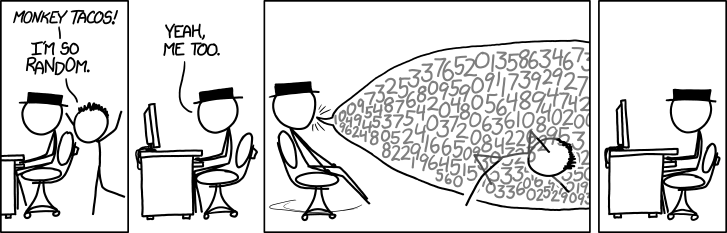
Every time I hear someone say they’re random, I think of 14 year old girls Myspace pages, and I remember why Facebook won.
I also think of computer programming classes, and how I always get way too interested in how different programming languages come up with their random numbers.  Some use a digit somewhere in the computers time stamp.  This website uses atmospheric noise.  Now that’s random. 
Want to see how good you are at being random?  
Try these tests.  

Friday Fun Links 5-17-13

Hey it’s Friday!  And Arrested Development’s almost back!  Here’s a graph of all the running jokes!

Speaking of which, want a text the second Netflix posts the next season?  Instructions for text notification here.

Now seriously, Friday is tough.  Here’s the 21 stages of Friday.

On a down note, the cicadas are coming.  Here’s how far they’ve gotten.

Oh well, apparently they’re edible.  Here’s how to cook them.

Does that gross you out?  Fine.  Here’s how much money it would take to build the Starship Enterprise.

Race and wealth, relative or absolute?

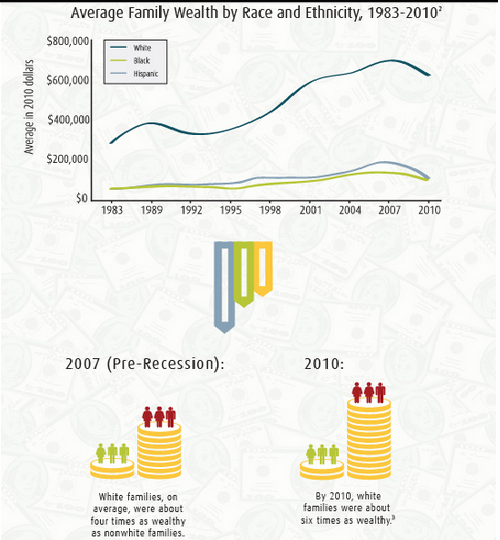
Recently, my brother was a contributor to an infographic his organization put together about race and the wealth gap.   Despite knowing that I am inherently biased against infographics, he called me and asked my opinion on some criticism it had received.  The whole thing’s fairly large, so I’m only posting the piece that caused the controversy:

The graph at the top had caused some commenters to question the use of “average” in lieu of median, and if it was skewing the results.  
Luckily, since my brother has listened to me rant for years about people not sourcing their facts, he had mad sure this graphic included the source of the numbers…a report from the Urban Institute that can be found here
I was interested to see that they not only acknowledge that they use average over median, but also give the median numbers to show that the trend is essentially the same.  Here they are for 2010: 
                       
                       Average               Median 
White             632,000                124,000                                                                                         
Black             98,000                  16,000                                                                                        
Hispanic        110,000                15,000
Using average numbers, the absolute gap between incomes is larger…however I was interested to see that using median the ratio of incomes would have looked larger (8 times lager vs 6 times larger).  Honestly, there’s pluses and minuses to using either angle.
Absolute inequality generally favors the gap (higher value – lower value) as the important measure.  This can make sense in some situations, but it tends to depend on where you start.  The difference between a person who makes $20,000/year and someone who makes $90,000/year is very different from the difference between someone who makes $90,000/year and someone who makes $160,000/year.  
Relative inequality looks more at the ratio between two numbers.  It also really depends on where you start, and is skewed by small starting numbers.  If I change the price of something from 50 cents to a dollar, it’s doubled, but you still can likely afford it.  If I change it from $20 to $40, I’m going to lose some customers.
So given that, did they use the right one here?  Well, I think it was probably a toss up choice.  Picking average made the graph and some numbers below look larger, but they made the 2010 ratio numbers look smaller.  If they had switched from average to median depending on what was more substantial, I would have taken issue, but as it is I don’t think there was anything deceptive going on.  After all, had they used the median numbers, they would have also changed the axis and the difference would have looked just as dramatic.  
There’s always the possibility that they could have put both to prove this point, but I’m pretty sure only someone like me would have enjoyed that.  

Wednesday Brain Teaser 5-15-13

What digit is the most frequent between 1 and 1,000 (inclusive)?

What digit is the least frequent?

Also, can you beat the AVI’s score on GeoGuesser?  Apparently he hit 28,000.  I think I created a monster on this one.

Whoa unto you, you generation of vipers

I saw an interesting study today that claimed that 51% of Christians were actually acting more like Pharisees than Christ.  It was based on a survey given to almost 800 people of a variety of Christian persuasions (practicing Catholic, practicing Protestant, notional (identifies as Christian but does not go to church), Evangelical, and born-again but non-Evangelical), and it asked them a series of 20 questions to assess their attitudes and actions, and gave them a score of “Pharisee-like” or “Christ-like”.  Here’s what they found:

They did some interesting breakdowns here, and had some good documentation of their methods.  My only qualm really, is how did they get the assessment questions?  
Here they are:
Actions like Jesus:
  • I listen to others to learn their story before telling them about my faith.
  • In recent years, I have influenced multiple people to consider following Christ.
  • I regularly choose to have meals with people with very different faith or morals from me.
  • I try to discover the needs of non-Christians rather than waiting for them to come to me.
  • I am personally spending time with non-believers to help them follow Jesus.
Attitudes like Jesus:
  • I see God-given value in every person, regardless of their past or present condition.
  • I believe God is for everyone.
  • I see God working in people’s lives, even when they are not following him.
  • It is more important to help people know God is for them than to make sure they know they are sinners.
  • I feel compassion for people who are not following God and doing immoral things.
Self-Righteous Actions:
  • I tell others the most important thing in my life is following God’s rules.
  • I don’t talk about my sins or struggles. That’s between me and God.
  • I try to avoid spending time with people who are openly gay or lesbian.
  • I like to point out those who do not have the right theology or doctrine.
  • I prefer to serve people who attend my church rather than those outside the church.
Self-Righteous Attitudes:
  • I find it hard to be friends with people who seem to constantly do the wrong things.
  • It’s not my responsibility to help people who won’t help themselves.
  • I feel grateful to be a Christian when I see other people’s failures and flaws.
  • I believe we should stand against those who are opposed to Christian values.
  • People who follow God’s rules are better than those who do not.

Now I don’t know how many of these statements most people would or would not agree with, but I thought a more interesting list could have been generated by asking various scholars in each of the surveyed denominations what their definitions were.  Different people have different interpretations of things, and statements like “I find it hard to be friends with people who seem to constantly do the wrong things.” seem pretty likely to mean different things to different people.  I mean, I’m not friends with people who steal my stuff or are continuously mean to me.  Is that self-righteous?

Beard research

Last week I ran in to two different studies about beards.  This was interesting, as it’s not normally a hot topic in academia.  

My Dad has a beard, and except for two brief occasions, has had one my entire life.  Thus I was interested to see that beards might actually help keep you young.  Apparently the block UV rays from getting to your skin and help prevent skin damage.  My only question would be if this helps your whole face or just the part covered by the beard (Dad you could be like 23 under there!)
Second, there was this report on two studies where researchers tried to find out which type of facial hair women found most attractive.  Apparently it’s stubble.  The study that ruled out beards apparently took women from cultures where men did not traditionally wear beards (Somoan/Polynesian) and showed them pictures of men clean shaven, and pictures of the same men after 6 weeks of growth.  The rated clean shaven more highly.
Studies that focus on attractiveness levels like that are always a little strange to me, especially with something like facial hair.  While having a control group is good for a study, most people do not choose their facial hair style at random…they go for what they’re comfortable with/what looks good on them.  Some men can rock a beard, some look goofy.  There’s a context here that a controlled study misses.  
Also, beards not trimmed for 6 weeks are gross.  I’ve seen sports teams during winning streaks.  Things get yucky in a hurry.  
While we’re on the topic, apparently there’s a website called Awesome Beards.  Enjoy!

Saturday Fun Links 5-11-13

Would you care to ponder your place in time and space?  Here’s a good visualization.

As for space, I have my favorite new game.  It’s called Geo Guesser.  It gives you a random picture of a spot somewhere in the world, and you have to guess where it is.  The closest I’ve been is 1800 km off.  My high score is 7329.

If that games got you tripped up, explore your neighborhood while running away from zombies here.

Speaking of geography, check out this infographic on which state employee makes the most money in each state.  Spoiler alert: it’s coaches.  But who should be the best paid?  Jonathan suggests the state house tour guides.  I like that.

Hey, it’s my first Mother’s Day!  Husband’s out of town on business, so I’m spending the day babysitting (can you still call it that when he’s yours?)  Anyway, here are some animal moms that deserve a break.

Oh, and a very happy graduation day to my little sister who’s getting her bachelors of nursing today!  Your patients are lucky to have you!

Details details

I have some fun links for later in the day, but looking at the news this morning I wanted to ponder something that’s truly bugging me.

I’ve been reading about the “happy they were found but horrible it happened” situation in Cleveland (if you don’t know what I’m talking about, try here, but not if you don’t want your day wrecked).  When I first read about it, I was horrified, as I think most people were.  At the time the story broke, I took a look in the comments section, and I was really surprised to see how many people latched on to wildly speculative details that have turned out to be incorrect.  
Why do people still do this?
In the age of the internet every major story that breaks suddenly has severe factual inaccuracies reported in the first 24-48 hours.  It happens over and over again, and yet there are still people dedicating time and keyboard space to long screeds about whatever unconfirmed detail they think is relevant.  
Is it really so hard to just say “that’s awful” for the first 2 days until the facts start coming in?  

Wednesday brain teaser 5-8-13

8898=7

4566=2

1203=1
2313=0
4566=2
5464=1
7774=0
1003=2
9856=4
9955=2
1886=5
1231=0
8764=3
4500= ?

If you’re stumped, here’s a hint: an average five year old could get the answer….quite possibly more quickly than an adult could.