Kill your television

I saw an interesting headline today: “Broadcasters Worry about ‘Zero TV’ homes”.  At first, this confused me…why was “Zero TV” in quotes?  Is this some new grammar issue I’m not aware of?

So despite my better judgement, I decided to read the article.  I discovered that “Zero TV” does not, in fact, mean a house with zero TVs.  Apparently it’s a marketing category for people who don’t pay for cable, satellite TV, or a digital antenna.  Thus, they can own a TV, but must use it in a “non-traditional” way…like for watching movies on DVD or streaming online or something.

I was pretty disappointed by that definition.  I mean, when I think of using a TV in a non-traditional way, I think of things like this:

or this:

But using a TV for watching movies or shows that you’re downloading or streaming as opposed to buying cable?  That’s hardly avant garde.

Also, anyone with a TV, should not be called “zero TV”.  That’s just annoying.

I was, however, happy to find out that the Nielsen Company apparently has a “Senior Vice President of Insights”.  That manages to sound both pretentious and like something out of a cartoon all at the same time.

I like it.

Friday Fun Links 4-5-13

I have a very narrow taste in April Fools Day jokes.  I don’t like jokes that attempt to humiliate others for laughs, make people looks stupid, etc.  I do however, like a good kitty in a backpack joke.

Who pays for daycare?  This article covers the issue of headlines that state that the cost of childcare is a mother’s problem/women’s problem.  Kudos for mentioning that this leaves dads out of the picture.  Language matters, give fathers their due!
With all the de-extinction talk lately, I think we need to ponder this article.  Could you outrun a t rex?

If you can’t out run them, take a cab.  Here’s a visual of how cab drivers earn their money.

For your education this week: 7 misused science words.

Now just for the hell of it, infomercial gifs.  I kind of really love gifs.

Wednesday Brain Teaser 4-3-13

This is one of the more interesting puzzles I’ve seen in a bit.  I liked it.  Also, I put up the rationale for the second answer to last weeks problem in the comments section there.  

Alright, read this left to right, top to bottom, and tell me what the next two rows are (the question marks show the current number of numbers for the missing rows:

       1
1 1
2 1
1 2 1 1
1 1 1 2 2 1
? ? ? ? ? ?
? ? ? ? ? ? ? ?

Sex, models and housework

Sorry, not sex with models (or models doing housework) but mathematical models about sex and housework.  The first study I wanted to look at in my discussion of the use of models in data reporting actually got sent to me a while ago.  The headlines around this were things like “Want to have more sex?  Men, stop helping with the chores!“, and a concerned (male) reader sent me the link with a “what’s up with this???”.

Essentially, the study took answers from a large survey that asked people about their household division of labor, their marriages in general, and their sexual frequency.  The authors were attempting to prove or disprove several notions about how housework and sex relate in marriage. They came to the conclusion that the more housework conformed to traditional gender roles, the more sex was had by all.  A few notes about the study up front:

  1. The data was collected in 1992, with a mean age of 43 for women/46 for men.  This is notable because people’s expectations for marriage have change dramatically over the past few decades (divorce rates peaked in the 80s), so the generalizability may be limited.  However, this data set was used because it’s the largest in existence that has all this information.  The authors acknowledge this limitation.
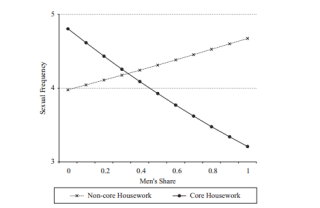
  2. The authors divided chores in to traditionally female (core) and traditionally male (non-core) tasks.  Core tasks include meal prep, cleaning, grocery shopping, etc and non-core tasks include lawn maintenance, bill paying and driving.  The finding was that the more men did the core work, the less sex the couples had, but the more non-core work they did, the more sex they had:So the headlines that more chores = no sex are wrong…it was the “wrong” kind of chores that influenced things.
  3. The authors never studied (nor claimed to study) the effects of changing chore arrangements on sexual frequency.  In fact all of their conclusions are based on the entire marital arrangement, so do NOT take the headline writers advice and start shaking things up assuming that this will have a particular result.  
  4. I found it fascinating that the authors specifically ruled out coercion as a factor here.  Satisfaction was fairly high across the board. 
  5. As the data is presented here, I do not argue with their conclusion.  While I think we could all quibble about the mechanism that causes this to be true, the data as presented in the paper supports what they say it does.
Getting back to the modelling stuff….the graph above shows the model they came up with, after controlling for all other factors.  Kind of nifty, right?  But what concerns me about this is that it’s so nice and linear.  When I look at graphs that are supposed to model certain phenomena, I take a look at the extremes.  Now, I know quite a few super-egalitarian couples, but I actually don’t know any couple in which the male does 100% of the cooking, cleaning, laundry, etc.  Even with over 4000 couples in this survey, how many did they really have at that end?  What would cause that arrangement to evolve?  Unemployment? Disability? I would be very suspicious that any couple would actually settle in to that arrangement long term…so I’d wonder how things would really behave at that end of the chart.  
Another note on this model: the key phrase is “controlling for all factors”.  From a research perspective, the researchers appear to have done this quite diligently.  From a real life perspective though, people attempting to extrapolate this data for their own lives would do well to remember we don’t live in vacuums (no pun intended).  Spending time with your spouse, having a higher income, not having small children, and being religious all are positively correlated with higher sexual frequency.  When I was researching this article, I was interested to find that the WSJ had taken a different tactic with their article, and mentioned that those who do more total chores also have more total sex.  Work hard, play hard they called it.
Finally, we have to consider why the researchers likely went with a mathematical model at all over just reporting the data directly.  My guess is outliers.  When I followed up with the guy who sent me the study, I mentioned that it was key to remember that this was not a straight up reporting of data, but rather an extrapolated model.  He asked why they would do that.  The only response I could think of is that it’s likely the data simply wasn’t this clean when they put it together the other way.   That doesn’t mean the conclusions are wrong, it just mean the reporting isn’t quite as direct as we might presume from the headlines.  
Blame the journalist.

Now if you’ll excuse me, I have to go do some dishes.

Church attendance and predictive models

Happy Easter, to those of you who celebrate!

I did in fact make it to church this morning, which weirdly enough got me pondering predictive models.  The connection’s not as tenuous as you might think.  The church I’ve been going to is incredibly large…the building that is.  My best guess is it could easily hold 1000 people.  From what I’ve counted*, there seems to be about 100 people there on typical Sunday mornings, which makes the place seem quite cavernous.  This morning I was not able to do my normal count (I let a seven year old pick where to sit, and ended up in the front row), so I was only able to get a brief glance at the crowd.  It occurred to me that it’s extremely hard to estimate the size of a crowd that is in such an outsized space, especially when that crowd distributes themselves as New England churchgoers tend to.
All of this got me to browsing around the web, looking for any data on church attendance, which led me to this article for church leaders about attendance trends.  It’s a bit long, but it has some interesting research in to who goes to church and who says they go to church.  What struck me as interesting though, was point number 7, on page number 5.  If you don’t feel like clicking on the link, it’s a model of how church attendance in America will look by 2050 (percentage of population down, raw numbers up).
What struck me about this was what a funny thing this was to model.  In order to model church attendance, one must fundamentally presume that it is a purely sociological phenomena that is likely to trend consistently for 40 years.  While I think that can make for some interesting numbers on a screen, it actually seems to violate some assumptions most Christians themselves would hold (i.e. that there is a Divine force involved that might not work on a linear scale).  I’m not saying he shouldn’t have modeled this, but it did get me thinking about what types of behavior lend themselves to modeling and which ones do not.  Some phenomena change linearly, some exponentially, some decrease/increase step-wise.  I’m not sure which one church attendance fits in to, but I’d be interested in seeing the rationale for picking one over the others.
I’ve had a few people send me some studies that relied on models, and I think I’m going to try to take a look at some of them this week.  This could get interesting.
*I count people during hymn singing time.  I probably started doing this when I was about 4, as far as I can recall. 

Friday Fun Links 3-29-13

Oh man, here’s one that’s appropriate…a gif of winter disappearing!!!

This one’s personal, because this is my field.  Even if this doesn’t quite live up to expectations, every weapon in the arsenal gives all of us a better shot.

This is possibly the most interesting theory I’ve seen on why women don’t stay in STEM.  In case you’re curious, using SAT scores as a measure, my math and verbal skills are identical to within one point.

This is my pick for gif of the week.

Now here’s my favorite dinosaur site this week.  It might even teach mr how to say archaeopteryx correctly!

Brain freeze

I don’t have time for a regular post tonight, ironically because I spent most of my night taking a statistics midterm.  I’d make a joke about 95% confidence intervals, but I don’t want to jinx anything.

Wish me luck.

The Power of a Question

I’ve been spending the past few weeks working on a survey for work, and it’s been some interesting work.  The survey itself took a few hours to write, the rest of the time has been attempting to reword the questions so that we make sure we’re actually asking what we want to ask without affecting the respondents opinion or leading to any particular answers.  We’re trying to get some data no one’s ever gotten before, so we have no motivation to guide the questions anywhere in particular.

I was thinking about this when I saw this story today.  Apparently the British Humanist Society is going after the Church of England for putting out a press release that said that 81% of British adults believed in the power of prayer.  The BHS is taking issue with this because apparently this data was taken from this survey.   The question that so many people answered in the affirmative was not actually “do you believe in the power of prayer?”, but rather “Irrespective of whether you currently pray or not, if you were to pray for something at the moment, what would it be for?’.  

Now that seemed like a bit of a stretch, so I looked a little further.  

It turns out that one of the options on the survey was “I would never pray for anything”.  15% of people answered that, and 4% answered that they didn’t know.  Thus, the accurate statement really would have been “81% of people don’t say they don’t believe in the power of prayer” not “81% of people believe in the power of prayer”.  

I thought this was a bit of interesting story because I don’t often see survey question nuances/reporting make the news, the Church of England did in fact twist the results, but the BHS did leave out the fact that there was actually a “I wouldn’t pray” option.  

It’s not the question, it’s how you ask it.