The True Crime Replication Crisis Part 2: Problems With the Publication System

Welcome back! Last week we covered the proposed historical and sociological causes of the replication crisis and applied it to things we see in the true crime genre, and this week we’ll be doing a similar analysis with the group of causes under “problems with the publication system”. As a reminder, I’m loosely following the order in the replication crisis Wiki page, so if you want more you can go there. There’s about 6 reasons listed under the “problems with the publication system” section, so we’ll be taking those one at a time.

Publication Bias

Publication bias in science is a topic I’ve written a lot about over the years, but perhaps my most succinct post was when I covered it during my review of the Calling Bullshit course, where they did a whole class on it. I think the second paragraph I wrote during that post broke it down nicely:

This week we’re taking a look at publication bias, and all the problems that can cause. And what is publication bias? As one of the readings so succinctly puts it, publication bias  “arises when the probability that a scientific study is published is not independent of its results.” This is a problem because it not only skews our view of what the science actually says, but also is troubling because most of us have no way of gauging how extensive an issue it is.  How do you go about figuring out what you’re not seeing?

In science, some of the findings were skewed by people being more interested in doing novel research rather than trying to replicate others findings, the “file drawer effect” where papers that didn’t find an association between two factors were much less likely to be published, and (outside of science) the fact that the media will mostly focus on unusual findings rather than the full body of scientific literature. My guess is you already see where this is going, but lets think how this applies to true crime.

One of the first thing anyone who looks at true crime as a genre starts to realize is that the crimes covered by traditional true crime are almost never the most common type of crimes. While there’s no “average” homicide, there is certainly a “modal” one! If you were going to describe a typical homicide in the US, most people would pretty quickly come up with something close to this: a young adult man, shot with a handgun, by another young adult man he knows, during an argument or dispute, in a city setting.

Looking at the stats, we see why this would come to mind: about 80% of homicide victims are male, about 90% of perpetrators are male. Age-wise, crime is dominated by the young. The FBI data also tells us that firearms are used in about 73% of homicides, that you are much more likely to be killed by someone you know than someone you don’t know, and just based on population density alone we would assume most homicides happen in crowded cities. I didn’t include race in the “modal” case because it’s actually closer to 50/50 black vs white, but both homicide victims and perpetrators are disproportionately black. Now there’s a lot of holes in this data because we don’t always know who killed someone, but I think most people would agree based on the general news that these data match what we assume.

If you listen to true crime though? You won’t find that type of crime represented almost at all. I think nearly everyone who’s ever glanced at the news knows if you go missing, heaven help you if you’re anything other than a young attractive white woman, and true crime’s racism problem has been remarked upon for years. I asked ChatGPT which 20 true crime cases it thought got the most media attention in the US (post-1980), and it’s pretty clear these cases caught fire in part because they are so unlike the “typical” crime:

  1. OJ Simpson Trial (1994-95): famous defendant, white female victim, knife violence
  2. JonBenet Ramsey (1996): white female child victim, wealthy family, beauty pageants, strangled
  3. Menendez Brothers (1989): Wealthy family, kids murdering parents
  4. Jeffrey Dahmer (1991): Male victims, gay sex, cannibalism
  5. Casey Anthony (2008): Attractive female defendant, white female child victim, strangulation
  6. Scott Peterson (2002): White female pregnant victim, knife victim
  7. Central Park Five (1989): white female victim, not murdered
  8. Amanda Knox (2007): white female victim, white female defendant, stabbed
  9. Michael Jackson child abuse trials (1993, 2005): celebrity defendant
  10. OJ Simpson Robbery case (2007): famous defendant, already accused of a crime
  11. BTK Killer (2005): Serial killer
  12. Richard Ramirez “Night Stalker” (1980s): serial killer
  13. Waco Siege (1993): Mass death, cult
  14. Columbine high (1999): large school shooting
  15. Unabomber (1996): Mass death
  16. Tylenol murders (1982): multiple dead, unknown culprit
  17. Jodi Arias (2008): white female defendant
  18. Gabby Petito (2021): white female victim, social media star victim
  19. Michael Skakel/Martha Moxley: Kennedy connection for defendant
  20. Pamela Smart (1990): white female defendant

What’s interesting about this list is immediately a few things jump out: gun violence is very underrepresented with only a few cases (Menendez brothers, Pam Smart, Columbine, sort of Jodi Arias) involving a firearm. Outside of the mass deaths/serial killers, almost all of the cases involve someone who was at least middle class or higher. Very few cases involve a solo male victim, it’s mostly solo females or men dying in mixed groups. The exceptions are actually 2 cases where there were accusations of homosexuality (Dahmer, Jackson), and the remaining one is Pam Smart’s husband. There’s also a dearth of black or Hispanic victims by themselves, they only appear in groups. In other words, it’s pretty clear the true crime genre does not get hooked on your “average” crimes, they want the unusual ones. I asked Chat GPT what the modal true crime case was, and it summed it up this way: A White, female (often young) victim, killed in a domestic or intimate context, often by a male partner/family member, in an otherwise “safe” suburban setting. The perpetrator is either wealthy/celebrity or a seemingly ordinary middle-class person hiding darkness. The case includes salacious details, a highly publicized trial, and often an ambiguous or polarizing outcome.

Seems about right.

The problem here is if one pays attention to true crime, you are getting an inaccurate view of how crimes are committed and who the victims are. I think this not only skews people’s perception of their own risk of being a victim, but also people getting weirdly judgmental of police departments. Once I started poking around at older true crime cases, I found that an incredibly common criticism is when police treat a big unusual case as though it was going to be a normal case. Well, yeah. Even large police departments may not be prepared for a celebrity perpetrator, simply because we don’t have too many celebrities running around killing people. The day the call comes in for a surprisingly big case, no one flags for the police “actually better send your best guys down there and double the amount of resources available, this case is going to be on Dateline next year”. They are operating under the assumption they will be responding to the modal crime story, true crimers believe they should have been prepping for the modal true crime story.

I also think it’s very relevant how many of these cases happen in quiet suburbs or small towns. In the case I’ve become familiar with, we’ve had 4 murders here in 40 years, and our county has a murder rate of 1/100,000 a year. That’s on par with the safest countries in the world. The idea that taxpayers were going to pay through the nose to keep our police department in a constant state of readiness for unusual events disregards how most taxpayers actually function. Indeed, there was an audit done on our local police department during all this, and one of their conclusions was “if you want your police trained for unusual events, you’re going to have to increase their training budget so they can go do that” and people FLIPPED OUT. And these were the people who were most viciously critiquing the police! Even after years of unrest they were still unwilling to increase the training budget, believe that (as one person actually publicly put it) “you can just watch CSI to know what you should do”. Sure, and you can skip medical school if you watch old ER reruns.

And finally, I think a lot of people justify the focus on white wealthy attractive people with a sort of “trickle down justice system” type philosophy. If we can only monitor how the police handle the most vaunted in our society, this will somehow trickle down to help the poor and the marginalized. The problem is, I’ve never seen particular evidence that’s true. How did the myriad of resources poured in to JonBenet Ramsey’s case help anyone? I grew up near Pam Smart, and I don’t recall that case making much difference after things settled down. Indeed, I think these cases often give us a false impression of what accused killers and victims “worthy” of sympathy look like. Indeed, attractive people are much more likely to get preferential treatment in every part of the justice system. They are arrested less often, convicted less often, and get shorter sentences when they do. It’s hard to get numbers on what percent have a college degree, but even the most generous estimates suggest it’s around 6% of inmates compared to 37% of the general population. The pre-jail income average for prisoners is about $19k a year. Wealthy educated attractive people have very little trouble getting their stories boosted, the people who need help are those not in those groups.

All of this to say, listening constantly to a non-random assortment of cases is not going to give you a good sense of how our justice system works on a day to day basis, any more than only publishing (or pushing) flashy science results gave us a sense of scientific fields. As a pro-tip, when you hear about a case that’s gaining traction, it’s not a bad idea to try to find a couple similar non-famous cases with victims/perpetrators who aren’t wealthy or attractive to see how those cases were handled. Your concerns may remain, but at least it will give you a baseline to work from that typical true crime reporting lacks.

Mathematical Errors

One interesting issue that has played in to a few replication attempts seems almost too silly to mention, but typos and other errors can and do end up influencing papers and their published conclusions. Within the past few days I’ve actually seen this happen at work when we found out that an abstract had the wrong units for a medication dose we wanted to add to a regimen. The typo was mg vs g, so it would have been a very easy typo to make and a pretty disastrous issue for patients. So at least a few replications might fail due to simple human errors in pulling together the information. For example, an oft quoted study saying that men frequently leave their wives when they are diagnosed with cancer was quickly retracted when it was found the whole result was a coding error. The error was regrettable, but what’s even worse is I still see the original finding quoted any time the topic comes up. It’s not true. It was never true, the finding would definitely not replicate. Even the authors admit this, but the rumor doesn’t die.

So how does this relate to true crime? In almost every major case I’ve peaked at, rumors get going about things that did/didn’t happen, and it is very hard to kill them once they’ve started. One good example is actually the Michael Brown/Ferguson case, where it was initially reported he said something like “Hands Up, Don’t Shoot”, a phrase so popular it now has it’s own Wikipedia page. The problem? It doesn’t exist. When the DOJ looked in to the whole thing, the witness who initially said it happened no longer said it did, none of the evidence matched this account, and it’s considered so debunked even the Washington Post ran an article titled “Hands up Don’t Shoot Did not happen in Ferguson“. For the public though? This is considered gospel. I’ve told a few people in the past few years that this didn’t happen, and they look at me like I kicked a puppy. When I’ve pulled up the WaPo headline, Wiki page or DOJ report, they’re still convinced something is wrong. How is it possible something so repeated just…didn’t happen?

I’m not sure but this is way way way more common in true crime reporting than anyone wants to believe, especially on the internet. Shortly after my local case was resolved I saw a Reddit thread about it on a non-true crime subreddit, and people were naming the evidence that most convinced them of their opinion, 7 out of the first ten things listed didn’t occur. And I’m not talking “are disputed” didn’t occur, I’m talking “both the defense and prosecution would look at you like a crazy person if you made these claims in court” stuff. People were publicly proclaiming they’d based a guilt or innocence opinion on stuff they’d never checked out. Since then I play a game in my head every time I talk to someone about the case, I count how many pieces of evidence they mention before they get to one that’s entirely made up. 90% of people don’t get past their third piece of evidence before they quote something made up. That is…not great.

Interestingly when I’ve corrected people, they generally look at me like I’ve missed the point and I’m dwelling on trivialities. To that I have two responses:

  1. If it’s worth your time to lie about it, it’s worth my time to correct you.
  2. If I were being accused of a heinous crime I didn’t do, whether in court or just in public opinion, I would want people to correctly quote the evidence against me. So would you. So would everyone. These are real people’s lives, this is not a TV show plot you’re only half remembering.

It’s totally fine in my mind not to be super familiar with any famous public case btw, but if you’re going to speak on it and declare you have a strong opinion, you may want to make sure all of your foundational facts are true. With the internet providing so much of our information now, it is really easy to mistakenly quote something you saw someone tweet about rather than something you actually saw testified to.

Publish or Perish Culture

When you take up a career in science, publication is key to career advancement. One of the issues this leads us to is that papers with large or novel findings are far more likely to be published than those that don’t have those qualities. And what’s less interesting than spending tons of time and resources on a study that someone already did just to say “yeah, seems about right, slightly smaller effect size though”. If there’s no particular reward for trying to replicate studies, people aren’t going to do it. And if people aren’t going to do it, you are not going to spend too much time worrying about if your own study can be replicated or not. One can easily see how this would lead to an issue where studies replicated less often than they would in a system that rewarded replication efforts.

So with true crime, the pressure is all on people to make interesting and bold claims about a story to catch eyes. The remedy for this has basically always been defamation claims, and if you think replications are slow and time consuming, boy have I got news for you about defamation claims. Netflix got incredibly sloppy with it’s documentaries and has a stack of lawsuits waiting to get sorted out in court, but progress is glacial.

This problem has been heightened by the influx of small creators who don’t actually have a lot to lose in court. If you work for the NYTs and report something wrong, your employer takes the hit. If you have a tiktok account you started in your parents basement, you can pretty much say whatever you want knowing no one’s going to spend the cash to go after you. This is starting to change as people realize they need to send messages to these content creators who make reckless accusations, but change is slow. Even true crime podcast redditors have wondered how some of the hosts get away with saying all the stuff they do and why more people don’t sue. Oh, and now the mainstream media can just report on the social media backlash rather than report on things directly. Covington Catholic helped set some better guidelines for this, but the problem remains that none of this has improved the accuracy of reporting.

Even if the content creators confine themselves to facts, they often aren’t their facts. Like all social media, pumping out weekly content is king, and most people simply do not have time to thoroughly research cases themselves. A surprising number of true crime podcasts have been hit with plagiarism accusations, including one where they were just reading other people’s articles on air without attribution. Given that podcasts often end up licensing their content, this drives a lot of possibly sticky legal issues. So what are the consequences for this? As of right now almost nothing. The podcast named in the article above just removed the episode, and as of this writing is the 6th most listened to podcast in the world. Publish or perish, good research be damned.

All right we have a few more publication issues to cover, but I think I’ve gone on long enough and will save that for next week. Stay safe everyone!

To go straight to part 3, click here.
The True Crime Replication Crisis: Part 1

Welcome back folks! Last week I started to introduce a new series on the relationship between the issues in true crime and the issues in scientific publishing that led to the replication crisis. I am going to start working through some of the proposed causes for the replication crisis in science, and connecting them to similar issues in true crime. I’m going through these in the order the Wikipedia page on the replication crisis, and today we start off with some big picture stuff: historic and sociologic causes. So what did we see in science?

Scientific Senility, Overflow Theory, and the Enemies of Quality Control

The first thing that caught my eye is that the replication crisis in science was predicted all the way back in 1963 by a man named Derek de Solla Price, who might have been one of the first scientists to study, well, science itself. Solla Price became alarmed at the exponential growth of scientific publication and the inability of science itself to police a body of knowledge that was doubling every 10-15 years. Indeed, we see that the amount of money sunk in to scientific research has jumped over the years:

He was afraid the science would reach the point of “senility” after it saturated, where further findings were simply nonsensical. He also grew concerned that increased participation in science would not inherently mean more of the best and brightest would enter science, but rather that the best scientists would get bogged down working in a competitive field and the quality of your average scientist would decrease.

These predictions seem prescient, as decades later scientists are indeed bemoaning scientific “overflow“, or the phenomena when the “quantity of new data exceeds the field’s ability to process it appropriately”. Additionally, it’s been noted repeatedly that the huge influx of money in to science meant that doing research that got funding was as important as doing good research.

Finally, they wrap up by noting that science was subject to three forces that can compromise the ability to prioritize quality control on any topic: mediatization, commodification and politicization. All of those factors have only increased the competing forces in science, and made it all the harder for people to focus on the original purpose.

So How Does This Apply to True Crime?

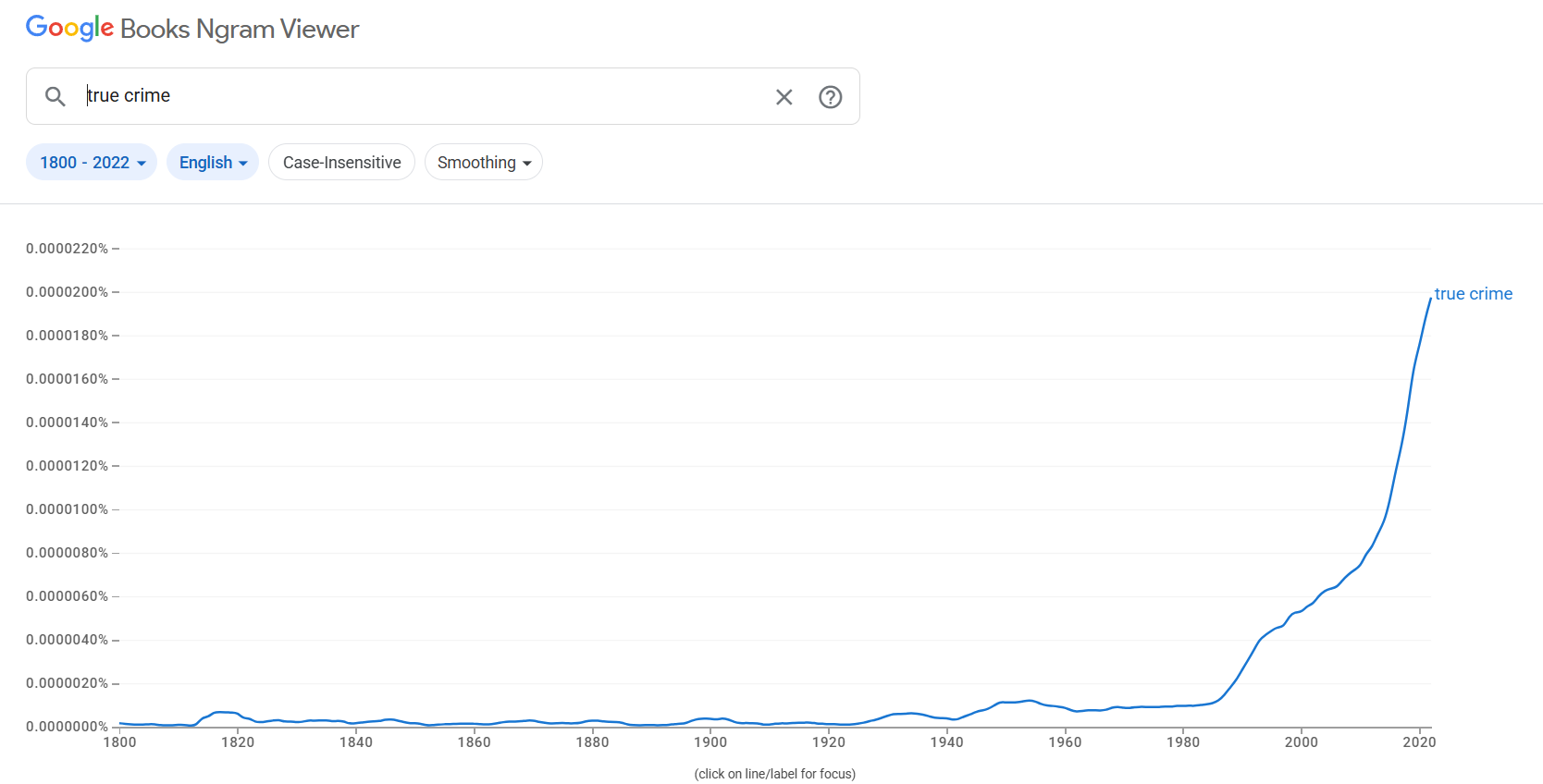
The exponential growth of science has been almost nothing in comparison to the exponential growth of true crime content. Google ngram has an interesting visual of the number of times the phrase “true crime” has been mentioned in books over the years:

Yup, looks like exponential growth to me! Additionally we know that the number of true crime podcast listeners has tripled in the last five years (6.7M (2019) to 19.1M (2024), and that true crime content is fueling the documentary boom on streaming services (6 of the top 20 in 2020, 15 of the top 20 in 2024). Now if science, whose stated goal is to aim for truth with a pre-existing system of peer review to screen work, can’t handle keeping up with the enormous influx of new information, how is true crime supposed to keep track of it’s quality while pumping out new content? After all, with science you still have multiple barriers to entry (education, institutional affiliation, etc) and a set format for your work. With true crime, literally anyone can hook up a microphone and start a Tiktok or podcast, and the stated goal is often story telling, with truth as a secondary aim.

This also suggests that de Solla Price’s concern about a massive influx of scientists degrading the average quality also has some applicability to the true crime space. While there are many well credentialed and thoughtful true crime content producers, they will always be competing with others who may be trying less ethical ways of getting attention. Indeed, as my town got flooded with true crime content producers, I was somewhat fascinated to look in to the backgrounds of some of these people. A surprising number of the smaller creators were people who literally could not hold regular jobs due to their own prior run ins with the law. Over the course of watching some of the feuds that started between them, I learned at least one podcast host had confessed in writing to others she’d ended up realizing a lot of the story being peddled was unsupported by evidence, but unfortunately she had a lot of debt and her podcast was now the most successful it had ever been so she couldn’t stop. She ended up pairing up with one of the biggest true crime podcasts going and gets 10s of thousands of views on Youtube, in case you’re curious. Trafficking in other people’s pain is big business.

While I point some of this out just because it annoys me, I am not sure many people are aware of how big this ecosystem has gotten. For every major Netflix documentary, there are thousands of TikTokers and Youtubers doing secondary reporting/commentary, and millions of people viewing their content. Learning all the facts of a lengthy and complicated case is probably just as hard as many scientific fields, and getting everything right takes an extraordinary amount of effort most people don’t have time for in the YouTube/Tiktok era. So we’re left with the three challenges mentioned above:

  • Mediatization: “If it bleeds it leads” has been a truism in media since William Randolph Hearst popularized the phrase in the 1890s. When trying to capture eyeballs, you are going to have to make whatever you are saying entertaining. If scientists can be sucked in to overstating their own findings based on the siren call here, do you really think a documentary film makers are going to overcome this temptation? After all, science has it’s own hierarchy and prestige/awards, true crime is nothing without the media. It is media. Additionally, the media environment for true crime has changed recently from “those experienced enough to get a newspaper job or book deal” to “those who can host a podcast or Youtube channel”, which opened up the floodgates to anyone who wanted to jump in.
  • Monetization: Most scientists have a base salary they are working with and then competing for grants, almost every true crime content creator is reliant on the popularity of their content for money. I made a personal rule not to listen to any content creator who doesn’t maintain a day job, otherwise bending to your audience is not just a temptation, but a financial necessity. Additionally, some of the top content creators have ended up making millions, so there’s a real upside here if you can get your content to hit well enough. Most scientists can only make that kind of money if they hit a blockbuster drug or something like that.
  • Politicization: Just like science got sucked in to a lot of political fights, so has true crime. The most classic case of this might be OJ Simpson, where the case got massive play in part as a way of people expressing their racial anxiety. The impact of politics on this case can be seen clearly by the profound increase in people who believe OJ was guilty by year. As the political conditions changed, so did people’s assessment of the evidence:

While the OJ case is perhaps the clearest example of this, we also know that sensational crime tends to follow the anxieties of the age. Serial killers dropped as mass shootings increased. We may now be entering an era of political assassinations. Some of the true crime “truther” type movements seem to reflect a general distrust of “official” stories, as we see even suspects who plead guilty get rabid fanbases that maintain their innocence.

I think it’s safe to conclude that in both science and true crime, a large influx of participants, money and eyeballs combined with political anxieties have had an impact on the quality of content. Interestingly, I actually encounter more people currently who are willing to be skeptical of science than those who are willing to be skeptical of crime reporting. I think there’s a feeling that the average lay person can suss out a guilty person vs a not guilty person, but I’m not sure that’s true if you’re not hearing all the facts. Our assessment of stories and their truthfulness can often hinge on small details, so it’s important to note that all the same forces that acted on science are present in even larger amounts in true crime.

That’s all I have for now, in the next installment we’ll be looking at problems with the publishing system for both science and true crime.

To go straight to part 2, click here.

The True Crime Replication Crisis: Intro

I started stats and data blogging back in 2012. Those were heady days back then, as the scientific replication crisis (which called in to question the validity of many published scientific findings) was just being uncovered and would indeed would first be called a crisis in November of that year. It was a fun time to be a blogger who knew a thing or two about research, and while I was always a little niche blog with a small but excellent set of readers, I did get the occasional nod from bigger accounts for some of my work. Topics to comment on were plentiful, a good number of people were interested, and it was overall a good way to improve my scientific communication skills.

Over the next decade+, life got busier, my health got more difficult, and my blogging trailed off. A lot of people even in non-stats and research fields knew to question numbers, and blogging was replaced by shorter form social media. I was pretty content just hanging out on the sidelines. I didn’t much expect to revisit that, until a rather unexpected event got me thinking about data blogging and the replication crisis again: I found myself near the epicenter of a true crime shit storm.

If you’ve followed this blog long enough to have some familiarity with me personally and have any familiarity with true crime, you might be able to guess which case. I don’t plan on publicly naming it due to the extreme toxicity around it, but if you’re a regular feel free to shoot me a message and we can chat privately. For everyone else I will only reassure you that neither I nor anyone close to me was directly involved, but I was physically extremely close to the location of the crime and most of the major players, enough that it was extremely hard to ignore even if we’d wanted to. It’s a weird feeling to watch national media descend on mundane places you’ve been to hundreds of times, and to suddenly have people commenting on your town as though it’s their new favorite TV show. We couldn’t check in for appointments without people catching their breath when they saw the town name, and everyone wanted to know your opinion. It was WEIRD. I also got a first hand look at a genre of media I hadn’t spent much time with: true crime. It was rather eye opening, but I couldn’t shake the feeling that I had seen a lot of these issues before. I started looking around at other true crime cases to see how they were handled in the media, and I slowly put it together. This was the replication crisis all over again. Many of the same errors, many of the same issues, sucking a whole different group of people in with various logical fallacies, questionable motivations, and creative data twisting.

I couldn’t find anyone else drawing this comparison, so I decided I needed to blog about it. I want to write the guide I wish I’d had before I had to assess a true crime case from the ground up.

Ready? Ok, let’s go!

So how are we going to do this?

I’ve been trying to figure out how to lay out all the reasons for the replication crisis, and really the most comprehensive thing I’ve found is the Wikipedia page. I’ll be using this archive page from September 10th, just so no one rearranges the article on me halfway through this series. I’m mostly going to focus on the causes and how I think statistical issues actually apply more broadly to the way we evaluate all evidence even outside of traditional scientific study.

I will not, generally speaking, be commenting on court procedures or rules of evidence etc. There are many other people much better placed to do that than I. What I will be covering is how I’ve covered data here in the past: how should you as a media consumer evaluate a claim you hear? If you watch a true crime documentary or listen to a podcast, what should you look for? How should you think about the different claims? One of the reasons I’m not naming the specific case I got familiar with is because I think most of this should apply to every case you hear about.

But wait I’m not totally sure what the Replication Crisis is!

Oh, yeah. Sorry about that, I should have clarified earlier. The replication crisis, broadly speaking, was the slow realization that in many scientific fields published research couldn’t always be replicated. This a cornerstone of scientific research, and having a study not replicate is a bad sign your initial findings may not have been all that correct. For example, if I tell you that on average men are taller than women, it shouldn’t matter if you get a sample from Montana, Maine or Minnesota. If your sample size is large enough and random, you should find the same thing. The problem that started to occur is people would get very large and compelling findings that would disappear during subsequent studies. There were a lot of reasons for this, which we will go in to going forward but also feel free to search “replication crisis” on this blog for a lot of my prior writing on the topic. Here’s a sample.

Great thanks, but what do you mean by “true crime”?

True crime is not crime in general, but rather that genre of media that covers crime. This includes books, movies, podcasts, documentaries and other media that goes more in depth in to crimes, perpetrators or trials. The genre is actually pretty broad, while we typically think about murders or other sensational cases, it can also include fraud cases like John Carreyrou’s Bad Blood reporting on the Elizabeth Holmes/Theranos scandal. It can involve missing person cases or open cases, or it can revisit cases where we already have a conviction. The vast majority (about 75%) of fans are women, and it’s the third biggest genre of podcast on iTunes. It has extremely high market penetration, with about 85% of people saying they’ve consumed at least some true crime content. True crime is the number one podcast content choice for women and your average true crime podcast listener consumes more content than your average podcast listener in general. There’s also a heavy social aspect, true crime podcast listeners are far more likely to recommend their favorite podcasts to others. Overall it’s a several billion dollar market with individual podcasts making millions per year. My Favorite Murder literally calls their fans “the Fan Cult” and “Murderinos”.

I’ll start in next week with more historical and sociological causes, but I want to point out we’re already seeing some similarities. It was at exactly the moment scientific research started becoming more lucrative and in demand, and scientists started becoming superstars that we started seeing cracks form. That’s not a coincidence, but I will follow up in a future post.

To go straight to part 1, click here.

Index:

The True Crime Replication Crisis: Part 1

The True Crime Replication Crisis Part 2: Problems With the Publication System

The True Crime Replication Crisis Part 3: More Problems with the Publication System

The True Crime Replication Crisis Part 4: Questionable Research Practices

The True Crime Replication Crisis Part 5: Fraud

The True Crime Replication Crisis: Part 6 Statistical Errors

The True Crime Replication Crisis Part 7: Random Other Issues

The True Crime Replication Crisis Part 8: Consequences

State and Country Level Can Be Excellent Plausibility Checks for Your Pet Hypothesis

I was on Twitter/X recently and ended up following two rather interesting conversations started by Tweets with strong claims. Of course I can’t find them again, but one asserted that teachers unions were the cause of our educational problems in this country, and the other asserted that the only way to fix the falling birth rate was to raise the status of men in this country. Both of these were interesting enough for me to start following the thread, and people quickly countered them both.

For the teacher’s union claim, it was pointed out that there are 5 states where teachers can unionize, but they are not allowed to do any collective bargaining: Texas, Georgia, North Carolina, Virginia, and South Carolina. One would assume without this power, these unions are pretty weak and indeed that’s what we see. So are these the areas with the best educational outcomes? No. According to this ranking they are 40th, 30th, 34th, 9th and 38th respectively. Those rankings are all over the place, but it’s hard to see a compelling case in that data that defanging a union is a simple solution to our educational woes.

Similarly with the claim that raising the status of men will raise the birth rates, we can actually look at the countries that are worst on the gender equality index. Yemen is currently considered the worst country in the world for this, and here’s how their birthrate has gone in the last few decades:

Here’s Afghanistan, Syria and Iran:

Now while these birthrates are higher than the US, it’s hard to miss that they are also falling. Even if one could overthrow the US and install Afghanistan style gender relations, it’s not clear that line would stop falling at all.

Now none of this is to say these hypotheses had no value, changes to unions or to male status might actually help the intended issues, but it’s important to be aware of their limitations from the jump. In both of these tweets these solutions were presented as clear and obvious with no caveats, but a quick look at real world data suggests they are not going to be silver bullets. For example, you say that Afghanistan is confounded by the unrest there, but how do you suggest you boost male status more effectively than the Taliban with less unrest? What damage are you suggesting unions are doing outside of their collective bargaining? Whatever your hypothesis is, let’s find a place that’s already doing it and see if it worked. If a strong effect doesn’t jump out at you, you have to temper your expectations.

We see this all over the place too, to the point where it’s a good first test for any hypothesis you have. Do you think people aren’t having babies because we don’t have a generous social safety net, free daycare or ample maternity leave? Let’s find some countries that have those things already:

Uh oh, that’s lower than the US. Again, maybe those things will help, but they clearly can’t be the full problem.

The Assistant Village Idiot recent put up a post about the belief by RFK Jr and others that psychiatric meds. The countries with the top anti-depressant consumption are Belgium, Greece, Spain, Iceland and Canada. These countries don’t come anywhere near the US for public mass shootings. We have 8-9 times Canada’s population and 27 times the number of public mass shootings. So we now have to explain why these medications would have a large impact in one country but not another. It’s possible! But it does involve invoking a bunch of other factors not part of the original statement.

Got time for one more example? I’ve spent the past 2+ years hearing that my state (Massachusetts) had a super corrupt police force and an aggressive justice system based on one high profile case that happened in my town. It might surprise you to hear then that Massachusetts actually has the lowest incarceration rate in the country. We incarcerate 241 people per 100,000 residents. I’ve had to talk about this with people from Virginia (679 per 100k), Alaska (744 per 100k) and Illinois (433 per 100k). None of them were aware how high their incarceration rates were, comparatively speaking. Can we come up with a story where Massachusetts has an incredibly corrupt police force and aggressive justice system that only incarcerates people at a fraction of the rate of other states? Maybe, but it’s challenging. Add in the fact that we are bottom 5 for police involved killings, and your job gets even harder.

Like I said, state and country level data may not entirely disprove a hypothesis, but it does give a good first glance in to how compelling your case is. When I’ve pointed this out to people in various situations in real life, the first response I often get is “oh well of course there are other factors”. But normally we started this whole conversation because they made a statement that there was just one compelling factor. We can certainly back off to “it’s a bunch of things”, but that’s not typically where the conversation started. I understand in the social media age declarative statements are king, but state and country comparisons are pretty good at moderating conversations rather rapidly. Highly recommended.

On Hoarding

I am now at the age where I, along with most of my friends, have retired parents. This has led to a natural increase in the discussions of the problems of aging, some of which I expected and some of which I did not. One thing I’ve been surprised by is the number of people I’ve had mention to me recently that their parent(s) have a problem with hoarding. This piqued my interest because I have no direct experience with this (my parents have made a big point of continuously going through their stuff), but when I started to mention that I was hearing this a lot more, I started to get more stories of people’s parents or friends parents who were struggling with this. And these stories were bad. This wasn’t “moms house is a little more cluttered than I’m comfortable with”, these were stories of rooms being rendered fully unusable, important things going missing, and fears of having to be the one to clean it up after they pass away. So what’s going on here? Is this a case of increased awareness, expanded definitions or a real uptick? Turns out it might be all three! Let’s dig in.

What is Hoarding Disorder?

Hoarding disorder is actually a fairly new diagnosis, first introduced in to the DSM in 2013. Prior to that it was considered a subset of obsessive compulsive disorder. The full criteria is here, but it’s basically the psychological inability to get rid of stuff in a way that ends up negatively impacting your life or health. People keep accumulating stuff whether through compulsive overbuying or just refusal to discard anything in such a way that their homes fill up. The estimates are that about 19 million Americans reach the criteria. It’s estimated about a quarter of all preventable fire deaths happen due to hoarding.

One of the more interesting things I found while looking in to this is that a group called Hoarding UK actually publishes something called the “Clutter Index Rating“, a visual guide to what level of clutter might require help or intervention. They recommend that a 4 or above might require help. Here’s an example of their visual for the kitchen:

I was relieved to discover my house does not fall in the problem zone.

Why are we hearing more about this now?

Well, a few reasons. Between the reality show “Hoarders” debuting in 2009 and the new diagnosis being added in 2013, the public did start having a new level of awareness of this disorder. This led to more people talking about it, which tends to lead to more people identifying that their dads inability to throw out any newspaper he’d ever gotten had a real name.

Next, there’s the obvious issue that stuff is easier to accumulate now than ever before. Could you fill up a house with random stuff back in 1900? Sure but it would have taken a lot longer. Interestingly this post was inspired by someone encountering a (likely) hoarder who tried to pick up some stuff they’d left our for free by the side of the road, and despite her whole car being full of random stuff, she started asking if they had anything else laying around she could look at.

But finally, hoarding is not evenly distributed across the lifespan: it is far more common in those over 65. People who just had a clutter problem in their younger years may turn in to full blown hoarders later in life, so as the baby boomers cross age 65 we can expect to see an increase in those impacted. Interestingly despite the initial link to OCD, it actually seems it’s more closely linked to depression. People who have divorced, lost a spouse or are otherwise isolated may be even more vulnerable. Unsurprisingly, this also means that the pandemic boosted the problem, though it’s not clear if that persisted. Sadly, some major cases of hoarding aren’t discovered until the affected person passes away.

So what do we do about this?

Well, much like any difficult psychological problem, there’s not one clear answer. My local council on aging has resources and my state also supplies support, particularly to landlords who may need to evict a hoarder. There are 12 step programs and traditional therapy options, there are services that will clean your house out. However, it is noted that cleaning the house out has a 100% recidivism rate if no other support is given. My state provided this interesting little decision tree, which I appreciated:

But overall this will depend a lot on local resources and exact circumstances. Not an easy spot to be in if you’re a loved one.

Is Life Expectancy the Right Way to Measure Health Care Success?

On my last post, I gave a few scattered thoughts about the UKs healthcare system vs the US system. In the comments, a very astute commenter mentioned that life expectancy was not a great way of measuring how well your health care system was working. This is an excellent point that I think deserves some discussion.

If you start looking in to the US healthcare system, you will very quickly run across a graph like this one that shows health care spending vs life expectancy:

There’s a variety of these charts but they all show the same thing: the US spends the most on health care per capita by a good margin, but does not have the highest life expectancy in the world. We’re about 5 years behind a country like Japan (84.7 years vs US 79.3 years), despite us spending 3 times what they do ($4k vs $12k per capita). I think it’s worth diving in to why this is, and why it may or may not be an accurate measure of how our healthcare system is doing.

Life Expectancy Calculations

There’s a actually a few different ways to calculate life expectancies, and the exact details of what you’re trying to do matter quite a bit. But one thing most ways of calculating it have in common is that they are all impacted quite a bit by people who die young. This is an issue a lot of us are familiar with when looking at historic life expectancies, which tend to be weighed down by the high number of children who died before their 5th birthday. This is a big enough issue that the UN actually looks at both life expectancy from birth and life expectancy at age 15, just to account for both child mortality and mortality at older ages.

So the point is, if you’re in a developed country and you want to understand why your life expectancy looks like it does, the first thing to take a look at is what kills your young people. So what kills young people in the US? Guns, drugs and cars.

Guns, Drugs and Cars

Ok, so before we go any further, I want to acknowledge that the topics of guns, drugs and cars tend to get people a little worked up. Given this, I want to clarify why I’m going in to this. I am NOT attempting to recommend any particular policy solution to the things I’m talking about below. I’ve done some of that in other posts over the years, but in this post I am specifically focusing on 1. If guns, drugs and cars kill people in the US at rates higher than in other countries and 2. If those deaths can be stopped by healthcare spending. This is important because again, that graph above gets used All. The. Time.

If life expectancy has some factors going in to it that cannot be fixed with healthcare spending, then that is a reason to take that graph a little less seriously next time you see it. Alright, with that out of the way, let’s look at some data!

Since 1981, the single largest killer of those under age 44 in the US has been “unintentional injuries”. This is a large category that includes drowning, poisoning, falls, motor vehicle accidents and “other” accidents. 90% of them are motor vehicle accidents or poisoning, and “poisoning” is the broad category that includes (and indeed is dominated by) recreational drug overdoses. Here’s a quick comparison of the top causes of death for those age 1-44 in 1981 vs 2023. Note: these are raw numbers, not population adjusted. ChatGPT suggests the under 44 population probably went up by 22 million people during the 42 years covered here.

19812023
Unintentional injuries58,50083,300
Malignant neoplasms22,00017,400
Homicide17,90016,900
Heart Disease16,40016,100
Suicide15,90023,400 (now #2 cause)

You can quickly note that the two categories here that the healthcare system has the most control over malignant neoplasms (cancer) and heart disease both went down during the timeframe we’re looking at here. Homicides also went down, but suicide and injury deaths went up. Given that in the US suicides are about 50% firearm deaths and homicides are about 80%, we can pretty accurately sum up the top killers of young people as “guns, drugs and cars” So how does this compare to other countries? Well the Global Health Data Exchange visualization tool can help us there. I picked a few countries that show up as having higher life expectancies than the US for less money to compare us to on the top causes of death, and here’s what I got. Note: I had to pick one age category for the visualization, and they didn’t have exactly the age 1-44 used above, so I used 15-49. We’re just getting a sense of the differences here. Anyway, here’s what I got:

Road injuries: the US sees twice as many deaths per capita as the next closest country, and substantially more than the lowest comparison countries I picked.

Drug abuse deaths (aka overdoses): again, we lead substantially here.

Suicide: we are one of the top here, but are much closer to other countries

Homicide (aka “interpersonal violence”): again, we are top

Cancer (aka “neoplasms”): we are middle of the pack

Heart disease: back at the top

So again, guns, drugs and cars appear to have a rather substantial impact on our mortality in younger people, and it’s not clear what our healthcare system could do differently to stop this. For motor vehicle accidents and murders, the health care system is mostly involved after the fact. There’s some argument that we could maybe improve our care of severely wounded people, but I don’t think anyone is really making the argument that our trauma care in the US isn’t as effective as that in Japan. It seems more likely that there’s just a lot more car accidents and violent incidents here. Healthcare spending can’t stop that.

For suicides and drug overdoses, one can argue perhaps that a better funded mental health/rehab system could help things, but as anyone who has dealt with a suicidal or addicted family member knows that it’s not quite as simple as that.

I will note that I often hear obesity thrown out there as another issue the US faces, and I think this is true based on the cardiovascular disease numbers. The only reason I don’t include it in “the big three” is because it is mostly taking out people in later years, and while we are above most other countries, our problem isn’t twice as bad like it is with road deaths, homicides or overdoses. We could definitely add it in though, and we’d still get back to healthcare spending not changing much. New medications like Ozempic might change that math, but up until recently that was pretty true.

I also leave it out because honestly I’ve heard waaaaaaaaaaaaay too much “if we stopped spending money on medication and let everyone go to the farmers market, we’d be great!” type stuff. That’s a nifty idea but it’s still not gonna change car crash deaths, overdoses or homicides, and so the bulk of our problem remains.

Impact on Life Expectancy

Ok, so what does this do to life expectancy, and how do we know this is the major driver? Well the Financial Times did an interesting analysis here. It’s paywalled, but the author did a Twitter thread here. Some graphs were included, like this one that shows that US citizens over 75 basically have the same life expectancy as our peer countries, whereas those under 40 have a much greater chance of dying:

This graph shows a similar thing, the probability of dying at a particular age is much higher for young people in the US vs peer countries, and similar for older ages:

If you look at the actuarial tables from the Social Security Administration, you can see this as well. Those tables look at a hypothetical cohort of 100,000 people born in the same year and show how many will still be living at each age. The UK releases similar data:

US – maleUK – maleUS – femaleUK – female
Age at which 1 in 100 of the cohort are deceased16242134
1 in 2035504957
1 in 1050605966
1 in 562696974

People in the US are just more likely to know someone who died young.

Other Causes

I actually couldn’t find a comprehensive source for top issues with our life expectancy in the US, but I did finally think to use ChatGPT to ask, a resource I’m still not used to. I was pleased that despite not using it until this point in the post, the top causes it listed that are making the biggest impact are drugs, cars and guns. I asked it a few different ways how much we could add to our national life expectancy if those were closer to peer nations, and it suggested we’d add 2-5 years, which if you’ll recall would put us up much closer to the top.

After it listed those causes, we got in to a few (cardiovascular and metabolic disorders) which can be tied to obesity. It also added in smoking, maternal health, and general mental health. Racial differences, socioeconomic status and access to healthcare were listed last, with an estimate we could get back about a year of life expectancy if we fixed all of that.

To reiterate the point that things that impact young people count a lot more than things that impact older people, ChatGPT estimated that “solving” the opioid crisis would give us back about a year of life expectancy for our entire population. “Solving” obesity? About half a year. Stunning when you consider how many more obese people there are than opioid addicts, but again, one death of a 22 year old takes off 56 life years, as much as 11 people dying at 74 rather than 79.

Immigration?

One weird data point I encountered while doing this work is the differences in how countries count non-citizens. I couldn’t verify how each country counted immigrants/illegal immigrants/refugees, but it seems likely that how they do that counting could impact their overall numbers. I don’t know for sure but I would guess that those raised in third world without adequate access to nutrition or health care may always have higher medical needs (including translation services) and lower life expectancies than those who have always lived in a first world country. Differences in counting is going to matter quite a bit here.

Impact on Healthcare Spending

So finally we loop back to the ultimate topic: are we really spending more money for worse outcomes? Well yes, sort of! But it’s not really the healthcare systems fault. If you have two countries with the same exact health care system but one country has people who get in lots of car accidents and the other doesn’t, life expectancy will be lower and costs will be higher. External injury deaths are a huge driver of mortality in the young, and if they are not equal across populations their outcomes will be unequal. The healthcare system mostly cannot prevent these deaths, they are just dealing with what comes across their door.

It’s worth noting that in addition to the deaths counted above, there are also going to be a bunch of people impacted by car crashes, drugs and guns who won’t die but will end up with health problems that will both cost money and shorten their lifespan. Many people I know who were in bad car accidents when they were younger end up with early arthritis in the impacted joints or other issues. Former drug users also may carry long term issues like Hepatitis C or HIV infections. Basically the pool of people who died under 50 is just the center of a much larger group of those injured early on who may have issues. These will also run up healthcare costs.

Again, none of this is to say what, if anything, we should do about these risks. But it is important to know when you see the spending/life expectancy graph exactly what we’re dealing with, and what can or can’t be fixed simply by throwing healthcare dollars at it.

Gell-Mann Amnesia Applies to TikTok Too

I’m sure this is obvious to most of my readers, but it makes me feel better to put it in writing.

If you’re not familiar with Gell-Mann amnesia, it’s a cognitive bias described as “the tendency of individuals to critically assess media reports in a domain they are knowledgeable about, yet continue to trust reporting in other areas despite recognizing similar potential inaccuracies.”

The original statement about it was about newspapers, and yet I now see people doing this all the time with TikTok. “They saw it on TikTok” is used in most of my circles with an eyeroll and an obvious implication that whatever opinion was offered was uninformed (at best), and (at worst) completely made up. Now wait 5 minutes and change topics and some of those same people will turn around and seriously cite TikTok as an authority on different topics they know much less about.

So here’s my PSA: if you do not think topics you care about can be adequately summed up on TikTok in 2 minutes, assume that things you know less about can also not be summed in 2 minutes. If you think TikTok is rife with misinformation on topics you care about, assume it is also rife with misinformation on topics you are unfamiliar with.

Newspapers were never perfect, but in general they had more to lose when publishing incorrect or defamatory information. TikTokers can hide their identity, delete videos, and individual creators often are “judgment proof” or have too little money to sue. While there is good information on TikTok, always do the due diligence you’d want others to do if they came across a video in your field of interest.

Stepping back off my soapbox, happy Saturday!

Some NHS Thoughts on the 4th of July

I got my gallbladder out recently. This came as a bit of a surprise, as it started with a day of what I (incorrectly) assumed was norovirus back in February, and ended with surgery at the beginning of June. All together it was about a 3.5 month process: about a week before I decided to go see my doctor, a week before I could get all the testing to rule out other things, 7 weeks for a surgical consult, a few days to coordinate the surgical date and then about 5 weeks to surgery. I was feeling pretty miserable by the end there, but I was able to squeeze an eye surgery in to the wait time so it wasn’t all wasted.

Since I had some time to ponder what I was doing, I decided to peruse Reddit to see what other people in my situation had done. For those of you who haven’t been on Reddit for various health conditions, it can be an experience. There a lot of useful information, some really not useful information, and some unexpected information. One of the more interesting things I’ve found over the years is that because most subreddits are in English, they can give you a really good sense about how medical care for specific conditions differs between English speaking countries. We are constantly told that the US healthcare system is broken, and maybe it is. But I think there’s some really interesting information when you stop looking at healthcare in general and switch to looking at a specific condition, so you can see how you in particular would do under the Canadian or British healthcare systems vs the US.

For gallbladders, I quickly discovered the wait times in the NHS are over a year once you’ve been recommended for surgery, and in some places they won’t even put you on the list until your liver or pancreas start to go. The wait times got so bad post COVID that they published a paper on how to help clear the queue, which started at around 452 day wait time. It got so bad the general recommendation was to pay an extra $7,000 out of pocket to get it done privately. Someone who had almost my exact surgery date had been waiting over a year and then got theirs cancelled randomly with no reschedule. I can say I would not have been able to keep working if I had to wait over a year, and I was considered a mild case. It reminds me of the iron triangle: you can have something that’s good, fast or cheap, but you can’t have all three.

This is not the first time I’ve discovered I would have been substantively worse off in the UK. Back in 2020 my migraines were wildly out of control, and my doctor suggested a newly approved medication called Nurtec. This worked wonderfully for me, and still does. I found out recently it took almost 4 extra years to be approved in the UK for treatment of acute migraines. People were paying privately for years (at about $100 a pill) because it was working so well for others around the world, but was completely unavailable through the NHS. Finally, I’m in a Facebook group for those with my eye condition, and they routinely say it takes a year+ to get a cornea specialist appointment in England. I got mine in 3 weeks.

I will not draw grand conclusions from solely my own experience, but it is notable to me that of my three major health problems, all would have required me to spend a lot of money on private care if I wanted the level of service I got here in the US. If you also have health conditions and are dealing with health insurance, it’s a fun exercise to see how that would go in other countries. I recommend it as a data gathering exercise.

Happy 4th everyone!

Upcoming Posts and Some Life Updates

Oh hi friends! It’s been a minute since I posted here, but I’ve appreciated the various well wishes/comments people have continued to send me. A lot has gone on personally since last I posted but I’ve had a lot of random data related thoughts kicking around in my head recently, and I’ve gotten a few nice comments in the past couple weeks of people suggesting I should do a post about various topics. These include: the replication crisis as applied to true crime, UK and Canadian healthcare systems vs the US, medications for substance abuse cessation, and possibly something about eye conditions. Since I’m out of practice writing posts I figured a brief life update might help me get some of the rust out and motivate me further. So what have I been up to in the last three years? Well here’s a brief overview:

  1. The potato diet I mentioned in the prior post didn’t work out. I get pretty bad migraines and about a week in I got one that last several days. It stopped when I changed my diet. Ah well.
  2. We had a third major death in the family, after the two I mentioned in this post, the third in 14 months. I now have an unfortunate amount of experience with planning funerals and eldercare.
  3. About 2 years ago, I started experiencing some eye problems in addition to my pre-existing migraines. It took about 8 months to sort out what was going on, but it turns out I had a previously unidentified genetic eye condition (epithelial basement membrane dystrophy) which had caused a condition called recurrent corneal erosions. I would suggest not reading that Wiki page if you’re squeamish, but suffice it to say the second sentence in the description calls it an “excruciatingly painful” disorder, and I can personally verify that is correct.
  4. Because of #3 I’ve had 2 eye surgeries in the past year, and then my gallbladder decided to get in on the action and I had to get that removed. I’m pretty much ready to be done with surgeries, thank you very much. The one plus side is it appears my eyes may have been causing some large portion of my migraine problems, so things seem improved on that front. We’ll see if that holds, but so far I’m hoping the second half of 2025 is better than the first.

So that’s the news from Lake Wobegon! Let me know how you all are doing and any particular posts you’d like to see if I get some posting up and running again.

Pre-Registering Myself: Potato Edition

Back in July, I put up a post about some possible interesting ideas about the obesity crisis, which included a lot of discussion about potatoes. At the time the blog Slime Mold Time Mold was running a trial for people interested in eating nothing but potatoes for a month, and they’ve now published the results. The results were intriguing, and the post about it is long. I appreciate that they posted successes as well as failures.

While I was interested in the discussion, I knew that I would likely not attempt to eat nothing but potatoes for 28 days. I have a few health conditions that seem to contraindicate this, and also it just doesn’t sound that fun. I figured this was just an interesting note until I saw someone Tweet about trying the “minimum viable potato diet” to great effect. Basically this person ate an extra 100g of potatoes (about 3.5 oz) per day with no other restrictions and lost 8lbs in 6 weeks.

Given my success with improving my glucose control via potato starch, I loved this idea. Most clinical trials for drugs try to establish a minimum effective dose of the substance in question, why not do this with potatoes? Every substance can have some bad effect if you take enough of it, so restricting your intake to the minimum effective dose helps maximize the impact while minimizing the side effects. While potatoes aren’t going to kill you, that still seemed like a good strategy. Additionally, there are multiple theories for why the potato diet might work well outlined in the SMTM post. Some of them (like monotony) would require a 100% potato based diet to work well, but others (some intrinsic property of potatoes themselves) wouldn’t need you to eliminate all other foods to work.

So basically, I’m going to try this out. I already use 4 tbsp of potato starch at breakfast, and while it has improved my glucose control, I have not seen notable weight loss. For the next 8 weeks I am going to vary the level of cold boiled potatoes I eat per day, and take daily measurements of a few endpoints from the SMTM study spreadsheet:

  • Daily weight
  • Compliance (actual)
  • Energy
  • Mood
  • Ease of Diet (subjective)
  • Any other events of note

My current plan is to test various amounts in 2 week blocks, and I will admit I actually started on 9/5/22. So here’s the schema (adding the potato starch in, though I have been doing that for 2 months already):

WeeksCold Boiled Potatoes
(ounces per day)
Potato Starch
9/5
9/12
5 oz4 tbsp
9/19
9/26
10 oz4 tbsp
10/3
10/10
15 oz4 tbsp
10/17
10/24
20 oz4 tbsp

This will take me from about 250 calories/day of potato based things to about 550 calories/day. Given that I am a short not-terrifically active female, this would be anywhere from 15-35% of my daily calories. So by the end it will be a substantial chunk of my intake, but nowhere near the 100% done in the SMTM trial.

I plan on posting results. A few notes that I’m also thinking of:

  1. I plan on spreading the potatoes out throughout the day. I started the 5 oz at lunch only, as I have the potato starch with breakfast already. When I go to 10 oz I will add 5 oz to dinner. I do not plan on doing one meal of 20 oz of potatoes or anything like that.
  2. My primary endpoints will be weight loss, mood and energy. Ease of compliance and actual compliance will be secondary. My rationale is that if I have higher weight loss/energy/mood with imperfect compliance to 20oz than I do at perfect compliance with 10oz, I will stick with 20 oz most days.
  3. I reserve the right to stop a phase if I feel terrible. If that happens I will drop to a lower phase until things improve.
  4. Once I find an effective dose, my hope is to continue for 30 days at just that dose to track those results.
  5. I will make no other intentional dietary or activity changes. However, my energy is low so if I start feeling like being more active, I’m not going to intentionally restrict activity either. If all this does is send my energy up and I am more active, that’s a valid finding.
  6. I’m going to try to post updates. We’ll see how often that happens, but I think at least a 4 week, 8 week and 12 week update would be good. Sustainability is another factor for me, so I would like to see how this plays out over several months.

So far week one is going well, so we’ll see how this goes! Looking forward to it. If anyone else would like to try something similar btw, let me know and happy to post your results as well and/or provide more details.