Two Ways To Be Wrong

One of the most interesting things I’ve gotten to do since I started blogging about data/stats/science is to go to high school classrooms and share some of what I’ve learned. I started with my brother’s Environmental Science class a few years ago, and that has expanded to include other classes at his school and some other classes elsewhere. I often get more out of these talks than the kids do…something about the questions and immediate feedback really pushes me to think about how I present things.

Given that, I was intrigued by a call I got from my brother yesterday. We were talking a bit about science and skepticism, and he mentioned that as the year wound down he was having to walk back on some of what I presented to his class at the beginning of the year. The problem, he said, was not that the kids had failed to grasp the message of skepticism…but rather that they had grasped it too well. He had spent the year attempting to get kids to think critically, and was now hearing his kids essentially claim it was impossible to know anything because everything could be manipulated.

Oops.

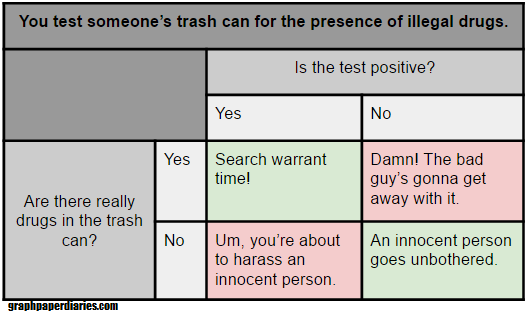
I was thinking about this after we hung up, and how important it is not to leave the impression that there’s only one way to be wrong.  In most situations that need a judgment call, there’s actually two ways to be wrong.  Stats and medicine have a really interesting tool for showing this phenomena: a 2×2 contingency matrix . Basically, you take two different conditions and sort how often they agree or disagree and under what circumstances those happen.

For example, for my brother’s class, this is the contingency matrix:

Skepticalgullible

In terms of outcomes,  we have 4 options:

  1. True Positive:  Believing a true idea (brilliant early adopter).
  2. False Negative (Type II error): Not believing a true idea (in denial/impeding progress).
  3. False Positive (Type I error): Believing a false idea (gullible rube)
  4. True Negative: Not believing a false idea (appropriately skeptical)

Of those four options, #2 and #3 are the two we want to avoid. In those cases the reality (true or not) clashes with the test (in this case our assessment of the truth).  In my talk and my brother’s later lessons, we focused on eliminating #3. One way of doing this is to be more discerning with what we believe or we don’t, but many people can leave with the impression that disbelieving everything is the way to go. While that will absolutely reduce the number of false positive beliefs, it will also increase the number of false negatives. Now, depending on the field this may not be a bad thing, but overall it’s just substituting one lack of thought for another. What’s trickier is to stay open to evidence while also being skeptical.

It’s probably worth mentioning that not everyone gets into these categories honestly…some people believe a true thing pretty much by accident or fail to believe a false thing for bad reasons. Every field has an example of someone who accidentally ended up on the right side of history. There also aren’t always just two possibilities, many scientific theories have shades of gray.

Caveats aside, it’s important to at least raise the possibility that not all errors are the same. Most of us have a bias towards one error or another, and will exhort others to avoid one at the expense of the other. However, for both our own sense of humility and the full education of others, it’s probably worth keeping an eye on the other way of being wrong.

Lost in Translation: Survey Edition

I ran across an interesting article from Quartz today that serves as an interesting warning for those attempting to compare cross-cultural survey results.

People from multiple countries were asked the same question “Would you personally accept a refugee into your own home?”, and the results were compared to find the “most welcoming” country.  China came out ahead by a large margin: 46% of residents said yes, as compared to 15% of US residents.

However, when the question was more closely examined, it was discovered that the English word “refugee” does not have an exact translation in Chinese. While in the US “refugee” almost always refers to someone from another country, in Chinese the word has a more neutral “person who has experienced a calamity” definition. Depending on the situation, it is then modified with either “domestic” or “international”.  The survey question did not contain either modifier, so it was up to the respondent’s personal interpretation.

So basically, people in different countries were answering different questions and then the results were compared. Surveys are already prone to lots of bias, and adding inexact translations into the mix can obviously heighten that effect. Interesting thing to be aware of when reading any research that compares international responses.

5 Things You Should Know About Medical Errors and Mortality

Medical Errors are No. 3 Cause of US Deaths“.  As someone who has spent her entire career working in hospitals, I was interested to see this headline a few weeks ago. I was intrigued by the data, but a little skeptical. Not only have I seen a lot of patient deaths, but it seems relatively rare in my day-to-day life that I see someone reference a death by medical error.  However, according to Makary et al in the BMJ this month, it happens over 250,000 times a year.

Since the report came out, two of my favorite websites (Science Based Medicine and Health News Review ) have come out with some critiques of the study. The pieces are both excellent and long, so I thought I’d go over some highlights:

  1. This study is actually a review, combined with some mathematical modeling. Though reported as a study in the press, this was actually an extrapolation based off of 4 earlier studies from 1999, 2002, 2004 and 2010. I don’t have access to the full paper, but according to the Skeptical Scalpel, the underlying papers found 35 preventable deaths. It’s that number that got extrapolated out to 250,000.
  2. No one needs to have made an error for something to be called an error. When you hear the word “error” you typically think of someone needing to do “x” but instead doing “y” or doing nothing at all. All 4 studies used in the Makary analysis had a different definition of “error”, and it wasn’t always that straightforward and required a lot of judgment calls to classify. Errors were essentially defined as “preventable adverse events”, even in cases where no one could say how you would have prevented it. For example, in one study serious post-surgical hemorrhaging was  always considered an error, even when there was no error identified. Essentially some conditions were assumed to ALWAYS be caused by an error, even if they were a known risk of the procedure. That definition wasn’t even the most liberal one used by the way….at least one of the studies called ALL “adverse events” during care preventable. That’s pretty broad.
  3. Some of the samples were skewed. The largest paper included actually looked exclusively at Medicare recipients (aka those over 65), and at least according to the Science Based Medicine review, it doesn’t seem they controlled for the age issue when extrapolating for the country as a whole. The numbers ultimately suggest that 1/3 of all deaths occurring in a hospital are due to error…..which seems a bit high.
  4. Prior health status isn’t known or reported. One of the primary complaints of the authors of the study is that “medical error” isn’t counted in official cause of death statistics, only the underlying condition. This means that someone seeking treatment for cancer they weren’t otherwise going to die from who dies of a medical error gets counted as a cancer death. On the other hand, this means that someone who was about to die of cancer but also has a medical error gets counted as a cancer death. Since sick people receive far more treatment, we do know most of these errors are happening to already sick people. Really the ideal metric here would be “years of life lost” to help control for people who were severely ill prior to the error.
  5. Over-reporting of medical errors isn’t entirely benign. A significant amount of my job is focused on improving the quality of what we do. I am always grateful when people point out that errors happen in medicine, and draw attention to the problem. On the other hand, there is some concern that stories like this could leave your average person with the impression that avoiding hospitals is safer than actually seeking care. This isn’t true. One of the reasons we have so many medical errors in this country is because medicine can actually do a lot for you. It’s not perfect by any means, but the more options we have and the longer we keep people alive using medicine, the more likely it is that someone administering that care is going to screw up. In many cases, delaying or avoiding care will kill you a heck of a lot faster even the most egregiously sloppy health care provider.

Again, none of this is to say that errors aren’t a big deal. No matter how you define them, we should always be working to reduce them. However, as with all data, it’s good to know exactly what we’re looking at here.

Statistical Tricks and Treats

Well hi!

After 8 fantastic weeks of working with Ben on the good, the bad, and the ugly of Pop Science, it’s time to move on to a new Sunday series.

When I give my talk to high school students, one of my biggest struggles is really not having time to cover any math. That’s  what I really love, but it’s pretty much impossible in a short time frame and when I’ve tried I always feel like I do kids a disservice. I mentioned some of this struggle in Part 7 of my Internet Science series, and I realized I probably have enough to say about this that I can make a whole series about it.

A few likely posts you’ll be seeing:

  1. That sneaky average
  2. Base rates and other shenanigans
  3. Independence and Probability
  4. To replicate or not to replicate
  5. Correlation and causation

If you’d like to see anything else, let me know!

What I’m Reading: May 2016

My brother sent me this article about a guy who is using data anomalies to track down Medicare fraud. Interesting use of patterns, data, and humans to go where the government can’t.

Things are getting meta: a new study looks at how much people trust scientists who do science blogging.

I’ve seen a few interesting comments recently on various metrics being influenced by shifting demographics. This one from the Economist covers household income stats, and how they may not always be as straightforward as they appear.

As a math person, I’m supposed to be outraged by this story about a flight that got delayed because a professor was scribbling equations and it freaked his seatmate out. I don’t know though….our TSA tagline is “if you see something, say something”. That’s just asking for false positives people, why are we surprised?

For those in the USA wondering what the heck happened with our primary system this year, I liked this explanation about how hard it is to get a system to reflect the will of the people.

My book of the month is What’s a p-value anyway? 34 Stories to Help You Actually Understand Statistics. This one is definitely going on my list of books to recommend for high school or college students trying to pass a Stats 101 class.


Ten Science Songs So Confusing They’re Not Even Wrong (Part 2)

Well hi there! Welcome to Part 2 of Ten Science So Confusing They’re Not Even Wrong, where we cover songs with science references so perplexing they can’t quite be classified.  If you missed part 1, you can find it here.

“Cosmic Thing” by The B-52s,
Nominated Line: whole song

Bethany: In the long and grand tradition of songs that just yell random words that are vaguely scienc-ey, comes a cosmic song with a wonderful chorus: COSMIC! COSMIC! WOOO COSMIC! IONOSPHERE! SHAKE YOUR HONEY BUNS!

I’m beginning to think science education may not be the purpose of this song.

Ben: The B-52s have always had a lyrical style that can best be described as “Kubla Khan, but written by a UCLA freshman taking an improv class while high on cheap ecstasy.” It’s simultaneously both unremarkable and unforgettable, and if this band hadn’t existed, I wouldn’t find myself singing “Everybody HAD! Matching TOWELS!” aloud at random and inappropriate intervals in my life.

I’m reluctant to spend much time on this song, because I’m worried that doing so will cause it to move permanently into a section of my brain, probably evicting something more important on its way in. By time this post is finished, I’ll have no recollection of the Webster-Ashburton treaty, but I will spend the rest of the month hum-shouting “don’t let it rest on the President’s desk!” Away with you, Fred Schneider! Haunt this cranium no more!

“Friction” by Echo & The Bunnymen
Nominated Line: whole song

Bethany: Friction! Hey friction! This song cites friction so much I was really excited to see what kind of physics problem they were going to throw me. There was a reference to telescopes, and I kind of thought I knew where things were going, and then we got to this line “If I ever catch that ventriloquist/I’ll squeeze his head right into my fist.”

Well then.

So the references to friction pick back up again with “stop this head motion”….then dies again with “Set the sails/You know all us boys gonna wind up in jail.” This test just got dark.

Ben: I have no beef with Echo and the Bunnymen, who I have always considered sort of the sonic equivalent of The Cure trying to create their own version of R.E.M.’s Monster (which, frankly, is sort of my jam). But there’s usually an unfascinating ambivalence to their lyrics, and it leaves the listener shrugging and going, “well, I guess it’s about something.”

I don’t know if the ventriloquist line is a metaphor, but I very much hope not. If this song was about the emotional pain that Ian McCulloch went through as a result of a dickish puppeteer upon whom he has vowed revenge, then I’m a million percent* back in on this song.

*since this is a science site, I should note that it is not actually possible to be a million percent into anything. I think.

Bethany: Wait, was this song on the Being John Malkovich sound track? I may have to rethink my review.

“What’s My Name” by Rihanna feat. Drake
Nominated Line: The square root of 69 is 8 something, cuz I’ve been trying to work it out.

Bethany: You know you’re a math geek when you hear a line like this and actually wonder why he stopped at 8 something, when there was so much more to say. Like 8.3066…..and that’s not the point here is it? No one was really going for math here were they? Well this is awkward.

Ben: It could be worse, Bethany. I had to go to Yahoo Answers in order to look up the joke. “Oh, eight as in… oh, I get it now.” Just humiliating all the way round.

It’s also a very Drake thing to throw in a bad math joke when appearing on a Rihanna song  – everything about his appearance shouts “I’m out of my league here and I know it.” Why else would he be wearing a UMass sweatshirt?

Bethany: Yeah, let’s just pretend this whole thing never happened.

“The Bad Touch” by Bloodhound Gang
Nominated Line: “Let’s do it like they do on the Discovery Channel.”

Bethany: Hey! It’s another song that’s not really wrong but makes me a little unsettled. I thought it would get better if I watched the video, but it actually got worse. The monkey costumes were actually used pretty well, which is part of the problem. Their impression of wild animals is just a little too good.

Ben: This is another song that brings up embarrassment, as I once had a pastor who emailed me to ask if I could put together “The Bloodhound Gang song” for a sermon she was doing. We had a good 36 hours of confusing, argumentative emails until I discovered that what she was actually referring to was this. We had very different cultural touchstones growing up.

This song arrived right about at the ideal point in my adolescence, as it was released during the summer I was 15 years old and working my first job at McDonald’s. I don’t think I’ve heard this song in at least a decade, but I bet if you plugged it into a karaoke machine and handed me a microphone, I could fly through the now-exceptionally-dated lyrics without barely a hiccup. “Yes I’m Siskel, yes I’m Ebert, and you’re getting two thumbs up!” The Wikipedia for this song says that it was remixed by both God Lives Underwater and Eiffel 65, which is a very turn-of-the-millenium piece of information.

My memory’s been abruptly jogged by writing this section: I did a post on this several years ago, during my “Hunt For The Most 90’s Song Of All Time!” As I recall, it scored moderately but not exceptionally highly. (I never finished the hunt, but it was clear early on that I wasn’t going to find a song more qualified than The Spice Girls’ “Wannabe.”)

Bethany: Okay, I was wondering if I should confess I know every word to this song, and you talked me in to it. I also still know all the words to “The Real Slim Shady”. That is definitely the reason I forget where I put my keys every morning.

Ben: If Smashmouth didn’t exist, I would still know trigonometry.

“Make her Say” by Kid Cudi feat Kanye West
Nominated Line: When You Used Your Medulla Oblongata And Give Me Scoliosis Until I Comatosest And Do While I’m Sleep, Yeah A Lil Osmosis

Ben: I’m ahead of Bethany again! And once again, it seems wise of me to step back and give her the lead. I’m an expert on all things Kanye, but not the central nervous system (the space for that information was taken up by the lyrics to “Love Shack”), and I better stick to my lane here.

Bethany: I’m going to start this in reverse order here. There’s an old joke in science major circles about “falling asleep on your textbook and learning by osmosis”. The proper response to this of course is “that assumes knowledge works like water, and you’re clearly not passing”. Science majors can be cruel.

Back to the beginning though. The medulla oblongata is a really important part of the brain, responsible for all sorts of nice things like breathing, swallowing, sneezing and reflexes.  I was going to give Kanye some credit here, because apparently there’s a condition called syringomyelia where the bone near the medulla oblogata has lesions and can eventually result in scoliosis….but then I realized he said that you use your medulla oblongata and give him scoliosis. I think there’s a blowjob joke in here somewhere, but frankly I’m not looking any further in to it.   Oh, and comatosest isn’t a word. You’re welcome.

Ben: We keep stumbling into accidental cunnilingus references, and that’s really not what we set out to do here (though, to be fair, I can only speak for me). A little research digs up the medulla oblongata controls a number of involuntary actions, like the um, gag reflex and, uh, swallowing, and um, I guess the point is that this might not just be blather that Ye is spitting here (pun not intended).

Basically, the more you look at this, the less it seems like a fun verse with a TI reference and you start to get focused on the fact that they sampled Lady GaGa’s “Poker Face” so that it became “poke her face” and… you know what, let’s just drop the mic and move on.

Bethany: Yeah, this is getting awkward. Science, you’re drunk. Go home.

Missed the rest of the series? Find it here!

Ten Science Songs So Confusing They’re Not Even Wrong (Part 1)

Well hi there!  Welcome back to Pop Science, the series where Ben and I take a look at the glorious inanity that happens when pop culture tries to get all science-like. The whole series is here, and we’ve focused on the good, the bad and the ugly. Today however, we’re doing something a little different: the confusing. These are the lyrics so wildly off base that you can’t even really criticize them. I mean, what does one say to “the color of the sky is 3?”. Let’s find out!

Miracles by Insane Clown Posse
Nominated Line:
whole song

Bethany: Ah, the song that launched a thousand magnet memes.

I could go through and correct this song, I could finally tell Shaggy how magnets work, but instead I’m going to give you my five favorite delightful observations they make about science:

5. “You don’t have to be high to look at the sky”.
4. “I fed a fish to a pelican at Frisco bay. It tried to eat my cell phone, he ran away”
3. “Shaggy’s little boys look just like Shaggy. And my little boy looks just like daddy”
2. “Magic everywhere in this bitch. Shit’s crazy”
1. “Water, fire, air and dirt Fucking magnets, how do they work?”

I mean, if this were a classroom, could I even kick this guy out? To say he’s high is an understatement, but is it weird it’s kind of making me laugh? I mean, it’s more entertaining than Hillary Duff, and it takes a certain amount of creativity to turn a couple of those phrases. But I can’t endorse this right? Downfall of America and all that? SO MUCH AMBIVALENCE.

Ben: I have not spent a lot of time in the discography of messieurs Violent J and Shaggy 2 Dope since my years working night shifts at McDonald’s, and inexplicably, time has warmed me to their schtick. This song drops me somewhere in a vortex between willful ignorance and playful stereotypes, and I found myself deeply charmed. Seeing Shaggy mime the act of running away while J details his story of almost losing his cell phone to a voracious pelican in a song about unexplainable miracles hits some sort of pleasure nodes I didn’t even know I had.

BLZl4gl

I wasn’t aware that ICP could be appreciated ironically, but there’s enough layers here to make an onion dip jealous. The fact that each member has no less than nine nicknames listed on their Wikipedia, all of them clearly based on some sort of unimaginable backstory. (Shaggy’s best were “Ham’d Burglah” and “Guy Gorfey,” while Violent J is also known as “Moon Glorious,” “Golden Jelly,” “Fats Pepper,” and “Bullet.” What lives these gentlemen must lead.)

College Humor has a series of videos called “If Google Was A Guy,” and I think it’s possible that ICP treats their tracks with the same sense of curiosity. They seem like the sort of people who would craft a single and shoot a gloriously expensive video just so that at some point, someone would come up and explain to them why there are rainbows. I hope someone has by now.

Bethany: Yes to everything Ben said. The science may not be there, but these guys know exactly who they are and who they’re appealing to. How else could you explain Juggalo Championship Wrestling?

The Scientist by Coldplay
Nominated Line:
whole song

Bethany: Oh Mr ex-Paltrow. You called your song “the scientist”, because, as you clarify “Questions of science, Science and progress, Do not speak as loud as my heart” . Oh good. I’ve got the whiny emo kid over here highjacking my science class. I mean, it’s like I asked for an essay on the cardiovascular system and you wrote me an essay on your broken heart. Fantastic.

This is going to be a long semester.

Ben: I’m the Coldplay stan of this pairing, but I was the one who suggested this song, since this really is indefensible. If we’d spoken up at the time, we might have been spared a number of things, including “conscious uncoupling” and the snoring mess that is A Head Full of Dreams.

“The Scientist” is a deeply emotive song, and its music video is cool as hell, but its a lyrical travesty from beginning to end. The words are structured in a way that no human has ever attempted to use as normal communication, and it makes a vague feint at rhyming that it never really succeeds at – only one word is rhymed throughout the song, and the words “heart” and “apart” are brazenly matched with “are,” and “hard.” Chris Martin is trying to rhyme mostly through a lack of elocution – which probably helps in the video, since he has to sing the song backwards, and in slow motion. You don’t want too many consonants cluttering that up.

Bethany: That is a far deeper explanation than I expected. I thought it was just one of those “I’m versatile! I can write deep and whiny songs about heartbreak from many angles! See, this one is even called the Scientist! I have a PhD in matters of the heart!”

Ben: “I have a PhD in matters of the heart” is actually my Tinder profile.

White Coats by New Model Army
Nominated Line:
whole song

Bethany: This song might be anti-science, but I can’t really tell.  Who are these men in white coats? Doctors? Scientists? Psychiatric professionals? What’s going on here?  Is this an anti-nuclear war song?  I mean, at least System of a Down had a clear thesis statement.

Ben: I can’t parse it either, and I’m not going to try. I was much too distracted by the music video, which is such a wonder of awfulness it seems impossible that it exists at all. At first I assumed that my ears were deceiving me, and despite the late-80’s sound to the song, it was a late-70’s tune, and the music video was from a pre-MTV time when bands made music videos just to have something to stick at the end of their concert VHS tapes.

But no, “White Coats” is from 1989, which may not necessarily be a peak year in music video creativity, was at least a decade into music video competence. And yet this video looks like it was shot on a borrowed video recorder by Brian, their untrustworthy roadie. Though they clearly spent a fair amount of the studio’s money on the affair, since at several points they cut to poorly executed helicopter shots of the band standing atop impressive cliff faces. I just hope they didn’t make Brian fly the helicopter, too.

Fancy by Iggy Azalea
Nominated Line: “I can hold you down, like I’m giving lessons in physics”

Bethany: Is it just me or did Iggy Azalea have one of the fastest “hey she’s cool!” to “hey she’s awful!” turns in the history of pop? I don’t really keep up with these things so much, but it gave even me whiplash.

Anyway, this video always gets some credit from me because it recreates the entire movie “Clueless”, which is actually a pretty cool concept for a video. The line “I can hold you down like I’m giving lessons in physics” however, not so much.

I mean, most physics courses do teach you something about gravity, which holds you down. But quite frankly, that works whether or not you know why, and the physics lesson itself rarely involves holding anyone down. Maybe they do things differently in Australia.

Ben: I have long been a defender of pop stars who the internet piles onto, as things get heinous so quickly, and I stick with them as long as I can (I’m sorry I had to leave you behind, Macklemore. The breakers got too big). I feel for Iggy, who somehow had a video break this month where her fiancé proudly announced that he’d cheated on her with multiple women, including a 19-year-old, and she still engendered shockingly little sympathy. The world is a callous place.

The “talentless” Azalea, who had two songs tied for number one in the summer of 2014, was introduced to us through this peppy track and its note-perfect recreation of Amy Heckerling’s Clueless (Heckerling later noted “it looks like they had more money for the video than I did the movie”).

I’m trying to come up with a defense of the line, and all I can manage is that Azalea is 5’10”, which is probably at least half a head taller than anyone she’s trying to match up against. As Archimedes would probably note, give me a place to stand and a long enough Azalea, and I can move the earth.

Bethany: By the way, I will admit I spent most of that video trying to read what’s on the white board behind her. It’s a pretty amusing list of the best all time rappers. I would have given her full credit on the physics line if it had instead been something like this:

Insert your musician of choice for Elvis, of course.

Supercollider by Fountains of Wayne
Nominated Line: whole song

Ben: I’ve somehow gotten ahead of Bethany on this one, but since I know absolutely nothing about supercolliders, or even regular colliders, I better wait for her to catch up.

Bethany: Huh, how’d I let that happen. Anyway, this whole song reminds me of this:

The use of the word “supercollider” in this song is clearly just meant to represent something vaguely spacey/sciencey, and it pretty much fails. The repeated line “Out of the blackness/Into the great big sky/Supercollider/Shooting inside your mind”.

A Supercollider actually has two technical meanings: either a programming language or a high velocity particle accelerator. While technically the latter group does shoot particles, they don’t shoot them in to the sky, nor do they shoot them in your mind. They actually shoot them in highly controlled environments in order to study their properties more closely . I mean, they could mean that they are testing their assumptions one at a time while psychologically controlling for their biases….but with lines like “Gather round the gas tower/don’t it kind of look like a bong”….I’m doubting they put that much thought in to it. I’m guessing they thought it was a little more involved in rockets or something.

Ben: My knowledge of supercolliders comes entirely from movies, where characters wander into scientific experiments and develop superpowers that are extraordinary and deadly, and also not explicitly licensed to DC or Marvel. I’m assuming that the songwriting process for this included a lot of bong hits and the viewing of some mid-90’s Michael Crichton-aping science fiction. Sounds like a good time, did not at all make for a good song.

Want part 2? Read it here.

Ten Songs That Get Science Wrong (Part 2)

Heeeeeeeeeeeeeey everybody, how’s your week been? We’re back this week with more terrible and gory “science” songs.  While Part 1 focused mostly on muppet fighting pits, part 2 takes some interesting twisting in to gravity, terminal velocity, digits of pi, and Jason Deruuuuuuuuuuulo.

(What A) Wonderful World by Sam Cooke
Nominated Line: Whole Song

Bethany: You would think this song would annoy me, but I’m still putting it above Jimmy Buffett from last week. This was actually Ben’s irritated nomination, so I’m going to let him take the first shot.

Ben: I can’t help myself, whenever I see this song title, I mentally start singing the superior Louis Armstrong song by the same title. I have to reorient myself to remember just which song we’re talking about.

First off, let’s be fair and admit the resume of Sam Cooke is unimpeachable. Even this nothing of a song has all the casual soulfulness of all of Cooke’s work. But, dear God, is it banal as all heaven. The message is supposed to be, “I may not know anything else, but at least I know that I love you,” but it fails even in that simplicity of thought. The bridge in the song claims “Now, I don’t claim to be an A student, but I’m trying to be. For maybe by being an A student, baby, I can win your love for me.” This is a pipe dream, Sam. The only fact you’ve managed to correctly assess in this song is that one and one is two, and that’s not going to take you very far. You’re a grown man.

Even the rhyming structure sounds like something thrown together by someone who just found out what a poem is. The only words he successfully manages to rhyme are “you” and “too,” which doesn’t really count. The other verses only manage one rhyme, the supremely unsatisfying “don’t know much about the French I took, don’t know much about a science book.” I don’t know which one of those awkward lines was the one forced in to create the rhyme, but neither one does you any credit.

Bethany: There is something extra irritating about a person mangling science in order to come up with a banal rhyme. Kinda like a kid advocating to write an essay in lieu of their algebra final, then producing “C” work.

Strychnine by The Sonics
Nominated Line: Some folks like water, some folks like wine, but I like the taste of straight strychnine.

Bethany: This song is some sort of terrible reverse PSA. It’s not just one line advocating for eating strychnine, it appears to be MULTIPLE lines advocating for strychnine consumption. Is this a good idea? Well, per the CDC: “Strychnine is a strong poison; only a small amount is needed to produce severe effects in people. Strychnine poisoning can cause extremely serious adverse health effects, including death.”

So no.

I’d stick with wine, and send someone over to the Sonics house for a wellness check.

Ben: There’s a real misunderstanding of how poison works in this song: “wine is red, poison is blue” – no, guys, that’s not how it works. While I’m pleased you’re not just downing Windex and antifreeze, poisons are generally not color-coded, unless you’re playing a Dungeons and Dragons game on a Windows 98 operating system.

On the flip side, we don’t need to run a wellness check on the Sonics. This song came out a full 52 years ago, and yet all five members of the Sonics are alive, recording albums, and touring. Maybe they know something we don’t.

Bethany: Well I’m glad they’re okay. I did a quick Google search to see if their bad advice had gotten them in any legal trouble over the years, and they appear to be okay on that front as well.

Swan Dive by Ani Difranco
Nominated Line: “Gravity is nothing to me, moving at the speed of sound”

Bethany: You may remember my love of Ani Difranco from Week 1 when Ben brought up a concert of hers I missed back in high school due to my tyrannical and unfair parents. I still love Ani, and Swan Dive is a great reason why. Beautiful song with just enough discordance to reflect the angst of the lyrics.

That being said, this lyric is just wrong. Things that move at the speed of sound are still subject to gravity. DON’T IGNORE GRAVITY ANI THAT WILL END BADLY. We are working on jets that go five times the speed of sound, and they still have to worry about gravity. It’s a force to be reckoned with. I mean, it lacks the cache of  the electromagnetic forces, strong force or weak force, but I still wouldn’t mess with it.

Ben: You’d think that in a song called “Swan Dive,” Miss Difranco would have a greater respect for what kind of effect gravity has. She mentions that she’s just going to “get her feet wet, until I drown.” Well, of course you are, Ani, on a swan dive you enter headfirst.

Do-a-Swan-Dive-From-the-Side-of-a-Swimming-Pool-Intro

Your feet are going to be the last thing to get wet.

Ani mentions that she’s diving into “shark-infested waters,” as if that’s going to be the thing that kills her. You’re traveling at the speed of sound towards a body of water, which is almost-but-not-quite impossible. Terminal velocity for a human is 118 mph, while the speed of sound is several times higher, at 767 mph. However, mankind has broken the sound barrier in free fall before. You might remember this:

However, that man was wearing a spacesuit and had a parachute. Even so, there were quite a few things that could have gone wrong midway, such as all of his blood boiling in his body.

Even if Miss DiFranco were to make it to the water on her ill-advised swan dive, things would be unlikely to go well for her afterwards.

Bethany: In her defense, a swan dive only starts with your hands if you’re a human calling something a swan dive. An actual swan dive as done by swans involves the feet being wet already.

Also, I think I’ve found the perfect solution for Ani’s scientific misunderstanding here AND a collaborator for her next album….these guys.

Pi by Kate Bush
Nominated Line: the part where she gets the digits of pi wrong

Bethany: Ugh. Kate Bush. Really. You would think I couldn’t hate a song that contained 150 digits of pi. But. They. Are. WRONG.

Check it out:

Kate Bush (first verse) 3.141592653589793238462643383279
Real pi 3.141592653589793238462643383279
Kate Bush (second verse) 5028841971693993751058231974944592307816406286208(…)821480865132
Real pi 502884197169399375105820974944592307816406286208998628034825

8253421170679821480865132

Kate Bush 8230664709384460955058223
Real pi 8230664709384460955058223

My only conclusion is that she had a mild stroke in the second verse and just skipped those extra digits. Why would you do this Kate? You had to know we’d check.

Ben: Oh, cripes, this song is nine-and-a-half minutes long? I don’t have this kind of time, Kate. I can just go look pi up on my phone, provided no one’s messed with the Wikipedia that day.

This is par for the course for Kate Bush, who thrives on gibberish, in case you’ve never see the lyrics to “50 Words For Snow.” I don’t know what Kate’s end game is, but it’s possible she’s just from another universe entirely. One that I don’t want to visit.

Bethany:  Her end game may be more well thought out than we’re giving her credit for, especially since her gaff here got her a whole mathematical conjecture named after her. The Kate Bush conjecture now reads: “Kate could have sung any finite sequence of digits and it would exist somewhere in the decimal expansion of Pi.”

I feel defeated.

Algebra by Jason Derulo
Nominated Line: “I got more problems than an algebra equation, they say become a doctor, I don’t have the patience.”

Bethany: Hi Jason, can we talk? About your problems here….for algebra, you can solve as many problems (or for as many variables) as you have equations. So if Jay-Z has 99 problems, he’s going to need 99 equations to solve them. You have one equation, and therefore only have one problem. Everything else is pretty unsolvable unless you call in reinforcements.

Ben: I flinched when I clicked the link to listen to the song, because I knew it would start with Derulo introducing himself, and of course, there it was. “Jason De-Rule-Ooooooooo!” Jason, this is a song on your own album. No one is confused about who is singing this song.

You have a problem with the first line, but my issue was with the second. Jason, stop fooling yourself, no one wants you to become a doctor. Everyone is quite certain that would be disastrous. Can you imagine a sentence scarier than, “excuse me, sir, Dr. Derulo will see you now?” I’d rather be operated on by Clive Owen at the Knick. Even if DeVry University gave you an honorary doctorate that they just emailed to you, I’d still sign the online petition protesting it.

Bethany: And there you have it folks! Now you may think we’ve hit the bottom, but we haven’t quite yet. You see, these 10 songs were all wrong, but at least they were coherently wrong. Next week we take on 10 songs that hit that special balance known as “not even wrong”.  Stay tuned.

Looking for songs that aren’t even wrong? Read that here!

Digital Nightmares and Things We Don’t Know

It took me a few years of working with data before I realized what my primary job was. You see, back when I was a young and naive little numbers girl, I thought my primary job was to use numbers to expand what we knew about topics. I would put together information, hopefully gain some new insights, and pass the data on thinking my job was done.

It didn’t take me long before I realized the job was barely half finished.

You see, getting new insights from data is good and important, but it’s no more important than what comes next. As soon as you have data that says “x”, the natural inclination of almost everybody is to immediately extrapolate that out to say “Oh great! So we know x, which means we know y and z too!”.  It’s then that my real job kicks in.  Defending, defining and reiterating the limitations of data is a constant struggle, but if you are going to be honest about what you’re doing it’s essential.

I bring this up because I ran across a disturbing story that illustrates how damaging it can be when we don’t read the fine print about our data.  The whole story is here (along with the great subtitle “The Hills Have IPs”), and it’s about one family’s tech-induced ten year nightmare.

The short version: 10 years ago, a company called MaxMind starts a business helping people identify locations for IP addresses associated with particular computers. When they can’t find a location, they set up a default for the geographic center of the USA. Unbeknownst to the company, this gets associated with the street address of a small farmhouse in Kansas.  Over the next decade, every person who attempts to track down an IP address that’s not otherwise located (about 600 million of them) is given this address, which causes a constant stream of irate people, law enforcement and others to show up at the door of this farmhouse believing that’s where their hacker/iPhone thief/caller/harasser etc lives. The family has no idea why this is happening, and the local police department literally says the bulk of their job is now keeping angry and confused people away from this family.

The reporter who wrote the article (seriously, go read it) is the first person to put two and two together and actually figure out where the mix up happened.

What’s interesting about this story is that when it was brought to their attention, the company pointed out they actually have ALWAYS told customers not to trust the addresses given. They have always told people that results were only accurate within zip code or town. It’s not surprising that many individuals failed to recognize this, but it IS concerning that so many law enforcement agencies failed to take this in to account.  This isn’t just local departments either….the FBI and IRS have investigated the address several times.

Want to know the scariest part? The reporter only figured this out by going through the companies records and then having someone build a computer program to find physical addresses associated with high numbers of  IP addresses.  While the Kansas farm was the worst, there were hundreds of other addresses with similar problems, including one that was a hub for lost iPhones that started her crusade. Without people grasping the limitations of this data, all of these homes are subject to people showing up angry, believing that someone else lives there.

As technology and the “big data” era expands, knowing what you don’t know is going to become increasingly critical. Small errors made at any one point in the system can and will be magnified over time until there can be real trouble. The fine print maybe never be as interesting as the big reveal, but it could save you a lot of trouble in the long run.

Ten Songs That Get Science Wrong (Pt 1)

Well hi there! Welcome back to our Pop Science series.  After two weeks working on the best science references in music (Part 1 and Part 2) , we moved on to two weeks on the most mediocre science references (Part 1 and Part 2).  If you’re losing track, I made a page for the whole thing here.  Anyway, we are now moving down the ladder one step further and heading in to the worst science references we could find.  Hang on to your hats, there’s muppet fighting pits ahead.  Ready? Of course you are!

It’s Hot by Jay-Z
Nominated Line: “.38 revolve like the sun round the Earth.”

Bethany: Okay, so let’s start out giving Jay-Z a little bit of credit here. For the vast majority of human history, this line would have appeared correct to most people. After all, from a simple “look up in the sky” perspective, it’s hard to tell if the earth revolves around the sun or if the sun revolves around the earth.  Aristotle believed the sun revolved around the earth, and it took centuries before the debate was settled.

Unfortunately for Mr Z here, this debate has been settled for quite some time.  The entire idea of heliocentrism made the Catholic church pretty cranky back in the day, but even the Pope gave up on debating this point in 1822.  Some of the greatest minds in science worked on the idea (Copernicus, Galileo, Kepler, Newton, Descartes, to name a few), and now the idea that the earth revolves around the sun is not particularly controversial.  Uncontroversial that is until a certain someone needed to rhyme the word “earth” with the word “dirt”.  Sigh.

Ben: Wow, you are way more forgiving of Jah’s lack of acceptance of one of the most basic principles of planetary orbit than I thought you’d be. It’s up to me to bring the pain.

First, let’s agree on this: this rhyming sequence is shoddy rubbish. It’s not that he uses “earth” to rhyme with “dirt” – it’s that he uses “dirt” to rhyme with “earth!” The nonsense bit of geocentrism kicks off the song’s third verse, and he rolls from that into “dirt,” “shirt,” and “hearse,” which is just a mess of a rhyming quatrain. And don’t try and tell me it’s an assonance. It isn’t.

There’s always an argument to be made about artistic license, but the rest of the verse is about guns… a word that already rhymes with “sun.” I feel this one could have been a quick fix.

Second, let’s expect more from Izzo, who proudly raps entirely off the top of his head and refers to himself as the “only n—– to rewrite history without a pen.” If you’re going to refer to yourself as an actual god, as you do in the first line of this very song, then at least meet the low standards we set for our third grade science classes.

Finally, you were 30  years old when you recorded this song, Mr. Hova. That is well past the date that you can refer to your reproductive parts as your “pee-pee.”

Bethany: It’s kind of hard to be harsh when you know there is no way someone would care about being corrected. I mean, this debate was settled 200 years ago. It’s not what he learned in school, it’s just willful ignorance. If I ran in to him, I’d probably just get something like this:

Ben: Truth. I would pay all the money in my bank account to have Jay-Z laugh the Jay-Z laugh at me.

Science by System of a Down
Nominated Line: whole song

Bethany: Man, who went and pissed System of a Down off? With lines like “science has failed our world” and “science has failed to recognize the most potent element of human existence”, I feel equal parts defensive and apologetic.  This might be a strongly religious song (“the spirit moves through all things” is repeated about a million times), I prefer the alternative explanation that Serj Tankian’s father was a robot who left he and his mother when he was a child.

Ben: It’s not just that this is a bad song (though it is), or that it’s anti-science to a truly alarming degree (though it is) – it’s the blatant lack of poeticism to the lyrics. It sounds like Serj wanted to see if he could write a song based entirely off the scribblings of a stoned high schooler’s Earth Science book cover. And I’m not sure he succeeded.

Mostly, I’m upset about the lack of evidence cited here, Serj. Tell us how science has failed us. Show your work.

Also, I set you up an appointment with the school counselor during your lunch break, just to make sure everything’s all right at home.

Bethany: I love how this series has taken Ben from a young and fresh-faced teacher to a grizzled veteran.

Ben: I’m basically Ryan Gosling in Half Nelson at this point.

Radioactive by Imagine Dragons
Nominated Line: whole song

Bethany: …..
…..
…..
…..
…..
…..

So, um, do I actually have to clarify that radioactivity does not cause muppet fighting pits? Because I’m happy to do that, but it seems like it should sort of go without saying. That video is really weird. I’m uncomfortable now. Here, have a video about the most radioactive places on earth while I go take a shower….a shower which, interestingly enough, would help me remove about 95% of radiation if I had actually been exposed.

Ben: I, for one, welcome our new muppet overlords.

There are real questions this video fails to address: how did muppet fighting pits begin? How was the pink bear granted his X-Manesque lazer abilities? If everyone is betting on the favorite, how is anyone making money on these fights? Why is everyone wearing cowboy hats?

More confusing is the behavior of the band, who has gotten themselves into a real pickle here. They’ve somehow become trapped in the basement of the muppet fighting arena, adjacent to but not connected with the muppet holding cell. They have their instruments with them, though they seem to have been taking very bad care of them – at this point, the drummer doesn’t even have any real drums, just barrels.

Even more concerning is the lack of awareness the band seems to have about basic radiation safety. The lead singer, Dan Reynolds, is literally sweating “rust,” which, when I ran it through WebMD, the site literally suggested I was having a brain aneurysm. The very next line, Reynolds announces he’s “breathing in the chemicals,” then we hear him take a deep breath. Guys: don’t do this.

On a probably related note, the song afterwards devolves into a collection of disparate actions so bizarre they defy interpretation. “I raise my flag, I dye my clothes, it’s a revolution I suppose.” Dude, if you aren’t sure, stop messing around with paint dye fumes and check yourself into a hospital. You really might be having an aneurysm after all.

Bethany: Oddly, I thought that line was one of the most straightforward and was just a 60s throwback/tie-dye reference. The rest sort of appears to be a fever dream of someone who just watched the Care Bears and the Deer Hunter back to back. Other than that Ben is completely correct. Chemicals, radioactivity, and laser beam teddy bears should not be messed with. Someone should make a gif-driven public safety video about this issue.

Ben: Challenge accepted. It’s our job to stop this before they conquer us all.

teddy_bear_pray_to_me

Ice Cream Freestyle by Flexmaster Funk or Canibus or Mike Tyson or something
Nominated Line:“I can double my density from 360 degrees to 720 instantly.”

Couldn’t find a video. Here are the written lyrics.

Bethany: Back when I was in engineering school, making sure you got your units right was a BIG DEAL. Like many other students, this admonishment from our teachers always felt a little pedantic to me. I mean, if I get the number you’re looking for then what’s the big deal?  About a month in to my freshman year however, an incident occurred that forever changed my perspective on this: the loss of the Mars Climate Orbiter.  For those of you not familiar with this, it was a $125 million dollar mistake that occurred when Lockheed Martin (the designer of the space craft) neglected to clarify with the NASA folks in Pasadena, CA whether or not everyone was using the metric system or the English system. Basically, the rocket was built on one set of units and run on another, the whole thing melted down and we flushed a substantial amount of money down the drain. The moral of the story was clear: units of measure matter.

Hopefully that explains why I absolutely cringed when I heard this lyric.  While doubling 360 does in fact give you 720, density is not measured in degrees. Density is actually mass divided by volume, and this typically is expressed in kg/m3 or some other similar unit.  Degrees is either temperature or used to measure mathematical angles.

Now interestingly, I found a few people arguing that the two lines are unrelated…that he’s claiming he can double his density AND go from 360 to 720 degrees. However, that would mean he’s just spinning around in a circle twice….which doesn’t seem like much to brag about.  My preferred explanation here is that he’s actually referencing going from a wood like pine (about 373 kgs/m3) to oak (about 710 kg/m3). In the process of that, he’ll blow by 451 degrees, which is where wood starts to burn.  What? It makes about as much sense as the original.

Ben: I haven’t been this confused since the Millenium Falcon made the Kessel run in twelve parsecs.

Math Suks by Jimmy Buffett
Nominated Line: whole song

Bethany: Oh Jimmy. Oh Jimmy. I’d say I was mad, or disappointed, but the truth is….I’m not. This is pretty much exactly what I would have expected out of you. It’s tepid, it’s vaguely tropical, and it’s about as fun and spontaneous as mandatory Hawaiian shirt day at the local Honda dealership. Math suks? Okay, sure Jimmy. Whatever you say.

Have a rebuttal from a young and still uneven Jon Stewart in a segment called “Actually Math is Quite Pleasant“. He’s nowhere near his peak in this, but it’s about what you deserve.

Ben: Look at that dark-haired young Stewart, with his baggy suit and unfortunate shirt, talking to the camera over a horrendous graphics package! And the Huffington Post couldn’t write up a clickbait piece the next morning explaining how Stewart had “eviscerated” Buffett the night before. What a simple time that was.

Look, Jimmy has made quite a career of his “there’s nothing that can’t be solved by a margarita or three!” ethos, and I applaud him for it. There are times that blatant ignorance is charming, and that time is usually when everyone is lightly sunburned and clad in hideous shirts visible from space and a man turns a middle school refrain into a pleasant, touristy tune that can be played over the speakers of a Sandals resort.

On the flip side, the YouTube suggestions for videos to watch after this one were entirely for a college commencement speech that Buffett had given, which seems to be moving entirely out of his wheelhouse. Fortunately, the college in question was the University of Miami, so no harm done.

Bethany, I’m finishing my section in a sleep-deprived haze, so I’m not certain of what really happened during much of this debate. Was there really a teddy bear that could kill people with his lazer eyes? It all seems so unlikely.

Bethany: Oh it happened.  By the way, am I the only one still surprised the song “Radioactive” was never featured on the O.C.? That’s the most O.C. song ever, and it pains me it came along 6 years too late to be the soundtrack for (spoiler alert) Marissa Cooper’s death.

And on that note, we’ll see you next week folks!

Read Part 2 here.