Well, I missed towel day.
Here’s a infographic:

Interesting stuff from Juice Analytics…30 days to better data storytelling.
Also, just in time for summer, a whole bunch of science reading. I just finished Space Chronicles and am starting My Beloved Brontosaurus.
Speaking of dinosaurs, here’s the list of best to worst.
On a fun note, here’s 20 biopic actors and the famous people they played. I always thought Charlize Theron deserved every bit of that Oscar she got for Monster.
In other news, here’s the top 10 species discovered in 2012. The Semachrysa jadeis my favorite story. It was found on Flickr.
Ann Althouse linked to an article about the struggle of working class male undergrads vs middle-class undergrads:
Combine the “chiselled out of rock” body of actor Ryan Reynolds, the intellectual prowess of writer Christopher Hitchens and the “funny, quirky” demeanour of film star Joseph Gordon-Levitt and you have the perfect role model for male middle-class undergraduates.
But while bourgeois students can “seamlessly integrate” many types of masculinity, a study at two universities concludes that their working-class peers find squaring the many demands placed on the modern man more challenging.
This looked like an interesting study, and I was all ready to read up on it…but it hasn’t been published yet. It’s a conference paper. That’s fine, but I was pretty interested that this article gave pretty much zero proof of the assertion that middle class males were seamlessly integrating different types of masculinity, or that working class ones were struggling. The only piece of data reported suggested that middle class men weree integrating anything was that they included “well groomed” and “metrosexual” as priorities in being good looking, whereas working class men did not.
Other than that, the article was mostly researcher’s continued assertion that this phenomena occurred…though I question her bias a bit as she stated that working class men’s way of thinking about intelligence “belies an assumption of entitlement to dominance….arguably a refashioning of traditional male hegemony”.
So how much of this is data and how much was spin? Who knows. Despite what the journalist is reporting, we might all just have to wait for the paper.

I didn’t mention it in my post yesterday, but part of the impetus to my father sending me the link about the water fluoridation was an ongoing discussion we have about the reputation of Republicans as “anti-science”. I actually get asked about this a lot, and my standard answer tends to be something along the lines of “I think almost everyone is anti-science”.
You may noticed I’ve added my Twitter feed to the side bar. I’ve just started messing with it a bit, but I’m putting up some interesting links that I don’t get a chance to write about here, and it felt weird to keep things separate.
My Dad sent me an article today about Portland’s ongoing debate about putting fluoride in their water.
There’s a lot of interesting science around water fluoridation, but that’s not what caught my eye. What I noticed was this paragraph:
Almost every credible national, state, and local health and science organization—private and public—gives its blessing to optimal levels of water fluoridation: The American Medical Association, the American Dental Association, the Environmental Protection Agency, the World Health Organization, American Academy of Family Physicians, and the Center for Disease Control and Prevention, which named the measure one of the 10 greatest public health achievements of the 20th century. They all agree that fluoridated water is perfectly safe and extremely effective at preventing tooth decay.
I was intrigued by that paragraph because the link they provide for the organizations that support water fluoridation has 11 pages of organization names and their statements supporting it.
While there’s many well known names on there, I was thinking about how hard it really is to know about lesser known organizations, and how easy it is to confuse various organization names.
Example: the American Medical Association is one of the biggest medical groups in the country. The Association of American Physicians is a group dedicated to furthering biomedical research. The Association of American Physicians and Surgeons is a group dedicated to “fighting socialized medicine and the government takeover of medicine”.
Now you might recognize the difference between the first one and the other two, but my guess is most people will not remember which one is which 20 minutes after you finish reading this blog post.
Now I’m certainly not saying that these 11 pages are crap…there’s some big names on that list. What I am saying is that random names of groups is something people must take some due diligence to investigate. I’m sure that the anti-fluoridation people could also come up with a long list of organizations that support them, even if it represented far fewer people. In this age of propaganda, we must remember that organization names alone may not be enough to convince people. Too much data causes overload, and we can’t blame people for this. Now go brush your teeth.

Hey it’s Friday! And Arrested Development’s almost back! Here’s a graph of all the running jokes!
Speaking of which, want a text the second Netflix posts the next season? Instructions for text notification here.
Now seriously, Friday is tough. Here’s the 21 stages of Friday.
On a down note, the cicadas are coming. Here’s how far they’ve gotten.
Oh well, apparently they’re edible. Here’s how to cook them.
Does that gross you out? Fine. Here’s how much money it would take to build the Starship Enterprise.
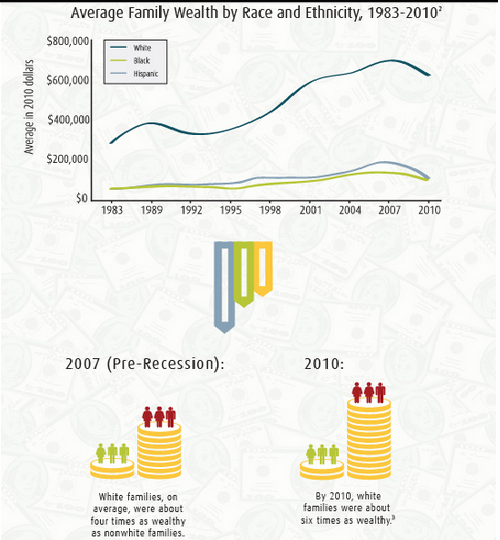
Recently, my brother was a contributor to an infographic his organization put together about race and the wealth gap. Despite knowing that I am inherently biased against infographics, he called me and asked my opinion on some criticism it had received. The whole thing’s fairly large, so I’m only posting the piece that caused the controversy: